


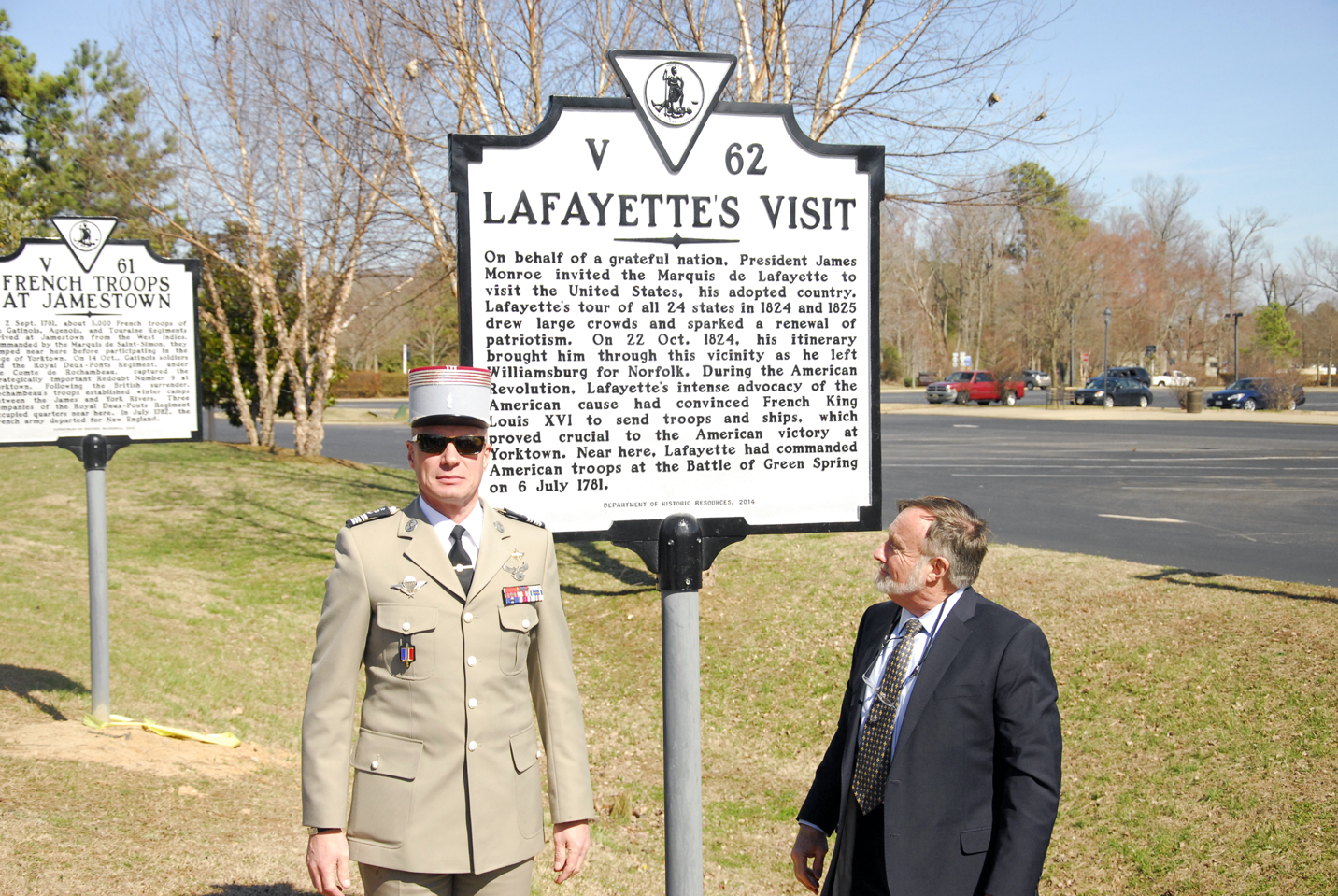
Two historic highway markers commemorating French activities in the Historic Triangle during and after the Revolutionary War were unveiled Wednesday at their new homes along Jamestown Road.
The two markers are adjacent to Jamestown Settlement. One marks the spot thousands of French troops camped in 1781 and 1782, and the other is to recognize that the Marquis de Lafayette departed from the area near the Jamestown-Scotland Ferry wharf after an extensive tour of the United States in 1824 and 1825.
“It’s a great way to get history and know it will be preserved,” Alain Outlaw of the James City County Historical Commission said of the signs. The group’s work was directly responsible for the placement of the two signs along with many others installed at the county’s myriad historic sites since 1927.
The French troops commemorated in the marker were from the West Indies. They camped at the open-air site — now the home of Jamestown Settlement and the open fields surrounding it — first in September 1781 when they were on their way to the siege at Yorktown.
After the war ended, a regiment of French troops established winter quarters at the site from October 1781 to July 1782 before heading to New England.
The other marker shows where the Marquis de Lafayette left the Historic Triangle on his way to Norfolk during his tour of the United States in 1824 and 1825.
Outlaw said Lafayette was a “rockstar” during the tour because of his advocacy for the fledgling nation from the opening days of the Revolutionary War until the defeat of the British. Many streets up and down the east coast are named after Lafayette due to his celebrity in those days.
Lafayette also led American troops against the British in the Battle of Green Spring on July 6, 1781. That fight took place near the site of the markers, and the French leader’s involvement in it is mentioned on one of the markers. Outlaw said the area looks much as it did when Lafayette was here during the Revolutionary War.
The commission began work about two years ago to bring the signs to fruition. Gaining approval is a slow process. After text has been written, it is sent to researchers with the Virginia Department of Historic Resources, who analyze it for accuracy before issuing approval. Installation must then be approved by the Virginia Department of Transportation, which places the signs and then maintains them.
Col. Philippe Roux of the French Army — officially the Armée de Terre — attended Wednesday’s ceremony. Roux is a liaison officer working with U.S. Army personnel at Fort Eustis. He said he hopes that a strong bond can continue to exist between the people of the United States and France, noting how the French provided assistance to the Americans during the Revolution, that the Americans paid France back during the world wars and that the two have recently fought side-by-side in battlefields like Kosovo and Afghanistan.
Outlaw said he was glad the two signs could be installed exactly where the events they describe took place. They join a slew of other signs, which line several hundred feet of Jamestown Road in the area of Jamestown Settlement.
The complete text of the two signs is as follows:
French Troops
On September 2, 1781 3,000 French troops from the West Indies landed at Jamestown and camped in this vicinity on their way to the siege at Yorktown. Consisting of the Gatinois, Agenois and Touraine Regiments, they were commanded by General Saint-Simon. At the battle of Yorktown, Gatinois soldiers captured strategic Redoubt Number 9. Following the allied victory, French soldiers of the Royal Deux-Ponts Regiment, who also participated in the Redoubt Number 9 attack, established winter quarters near here from October 1781 to July 1782 before returning to New England with French General Rochambeau and General George Washington.
Lafayette Visit
During his Farewell Tour of all 24 states in 1824 and 1825, the Marquis de Lafayette departed from this vicinity on his way to Norfolk, having visited Williamsburg. President James Monroe had invited him to tour his adopted country. Near here, during the Virginia Campaign, General Lafayette led American troops at the Battle of Green Spring July 6, 1781. Beyond military exploits, his intense lobbying for the American cause in France in 1779 and 1780 was a major factor in the French decision to send troops and a portion of the French fleet here both in 1780 and 1781. There would not have been a victory at Yorktown without this support.
