



The research is clear: People don’t go on vacation specifically to learn about history; they go because they want to have fun.
That is one of the major findings of two years of research informing the Williamsburg Area Destination Marketing Committee, which is tasked with marketing the greater Williamsburg area to tourists.
WADMC’s campaign for 2015 thus seeks to play up how much fun tourists can have at the area’s established — and upcoming — attractions. A precise cost for the campaign has not yet been finalized, as WADMC is still finalizing deals for television commercials and Internet ad placements.
At the forefront of the campaign are two real families who were dropped into the Historic Triangle last August for four days of unscripted vacation time at places throughout the area, from Busch Gardens to Alewerks Brewing Company.
Cameras followed them, and what resulted is a slick mashup of imagery tying the area together. They engage with exotic animals at Busch Gardens. They experience the live action of Colonial Williamsburg’s Revolutionary City. They kayak through the waters surrounding Jamestown Island.
In each shot, they are together as a family, engaging in hands-on activities. Their faces tell the story of their experience in the Historic Triangle: They are having fun by letting loose in the myriad activities available in the area, from finding thrills in the theme parks to a relaxed focus on the historical interpretation of the living history museums.
“Now we’ve got authentic families telling other consumers, ‘Wow, look at our vacation, we had a great time.’ ‘These are all the things we did,’” WADMC Executive Director Corrina Ferguson said.
These stories are at the heart of WADMC’s 2015 campaign. They have been broken down into 30-second television spots set to be aired in March. Longer versions will be available online at WADMC’s website, where people who click online ads will be directed.
“People respond more to emotions in stories than they do to lists of products, and I think that’s the biggest change for us,” Ferguson said. “And the fact that we’re trying to maintain the use of our well-known history brand but add to it.”
The two families in the campaign, found by a casting agency, are similar in composition.
“They went through a pretty rigorous casting process,” Ferguson said. “It was a little intimidating and a little bit of a risk to bring a real family in that they were not actors. They didn’t have experience being filmed.”
One of the families has a mother, father and three kids aged 9, 11 and 13. They had been to the area once several years ago but had not returned. The other features a grandmother, mother, father and three kids: ages 10, 14 and 16. That family held season passes to Busch Gardens and Water Country USA but had not explored any of the other attractions in the Triangle.
The videos come after about two years of research into what people are thinking about when they plan vacations and how they perceive the Greater Williamsburg area.
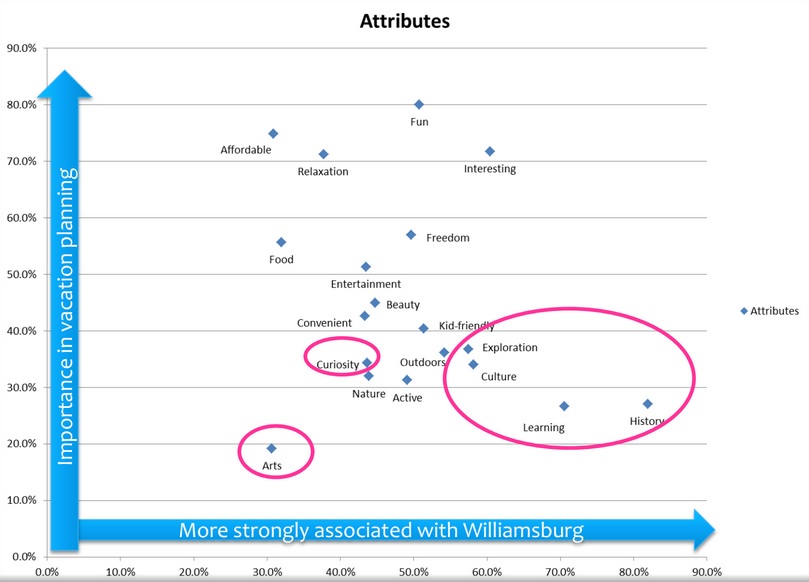
The first round of research was in 2013. Online surveys targeted key markets like New York City, Washington, D.C. and locations across Virginia. It revealed that slightly more than half of people who decided not to visit the Historic Triangle did so because they felt they had either “been there, done that” or they just were not interested.
It also showed that almost 70 percent of respondents were either not at all likely or not very likely to visit. A destination’s arts, history and learning offerings were found to be the least important attributes in vacation planning, while affordable, relaxing, fun and interesting were the most important.
Further research in 2014 reiterated what the 2013 research had found while pointing to freedom to choose a vacation style as the Triangle’s key to attracting more tourists. While history is not a major reason people choose to travel to a destination, they will visit — and enjoy — historical sites as part of a trip to have fun.
It also identified freedom to have fun, to be curious and to relax as the three pillars that should define future advertising that showcases the area’s diverse offerings to potential visitors. WADMC hopes the videos will do just that.
“Those were words people responded very positively to,” Ferguson said. “We’re serving up the destination in a language and a storytelling way that people have told us they will respond favorably to.”
The campaign features eight videos about two minutes in length, with four videos per family. Each family will have an introductory video, followed by one video for each of the three pillars.
The video campaigns are set to be formally unveiled at a March 27 forum on tourism in the Historic Triangle. The families’ vacations also resulted in dozens of still photographs, some of which are already being used in printed advertisements for the area.
WADMC receives the proceeds from a $2-per-night room tax assessed on hotel rooms sold in the Triangle. It uses that money to market the area and attract more tourists, which the U.S. Travel Association estimates brought more than $1.1 billion of economic activity to the area in 2013.
Related Coverage:
