


A Tuesday discussion by James City County leaders about a proposal to build a resort on a nearly 700-acre waterfront site in Grove turned into a symposium on the area’s traffic problems and lack of services.
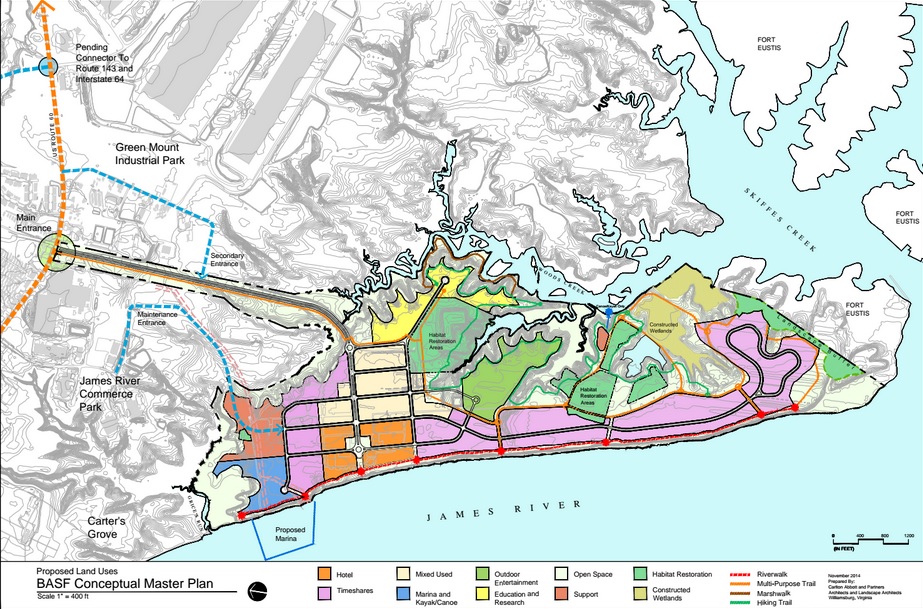
BASF Corporation, a chemical company which until the 1990s operated manufacturing plants on the land, submitted a proposal last year to change the land’s zoning designation. That proposal included a conceptual plan for construction of a resort hotel, timeshares and a nearly 2-mile waterfront path à la the Yorktown Beach riverwalk.
The proposal to change the land’s designation was OK’d by the James City County Planning Commission Working Group in a 4-3 vote in December, but many hurdles remain for the project to clear. The James City County Board of Supervisors were split on the project Tuesday, though no vote was taken.
Tuesday’s conversation — which was between the supervisors and working group — largely focused on how the proposal would affect the area and on issues facing Grove that include traffic problems and lack of services. Supervisor Mary Jones (Berkeley) came out in favor of the BASF proposal, however the others expressed concerns about the project.
“[Pocahontas Trail] is our biggest killer in that end [of the county],” said Supervisor Michael Hipple (Powhatan), the chairman of the board. “It would be nice to have that road widened. That would give the Grove area a chance. Right now, the Grove area doesn’t have a chance with that road like that.”
Pocahontas Trail is the only artery that touches much of the development in Grove. Other than a section near the Anheuser Busch Brewery and Busch Gardens, the road is two lanes, leaving the area’s residents, numerous industrial developments and passersby to contend with a car-choked road.
Leanne Pollock of the James City County Planning Division said Pocahontas Trail is projected to operate at a level of service of F by 2034, meaning frequent backups and breakdowns in traffic flow during the evening commute. That projection does not take into consideration any development of the BASF land.
Relief for that area of Grove could be had if a long-planned road linking Pocahontas Trail with Route 143 were to come to fruition. About $34 million of funding has been identified for the project, which is estimated to cost between $53.8 million and $72.8 million.
The road, known as the Skiffes Creek Connector, would branch off from Greenmount Parkway — the road which leads to the Walmart Distribution Center — before crossing the railroad tracks and linking with Route 143 in the area of the Virginia Peninsula Regional Jail and the Lee Hall interchange on Interstate 64 (Exit 247).
The new road would link traffic from the industrial parks situated along Greenmount Parkway and the lower part of Grove, hopefully lessening the traffic on Pocahontas Trail. But until funding for the rest of the project can be identified and put in place, it cannot come to fruition to help an area that its representative on the working group, George Drummond, called the “most neglected” in the county.
“Each neighborhood should have a public park,” he said. “We don’t have that. We have a community center that’s open four or five hours a day.”
He said the county draws significant tax revenue from industrial companies that call Grove home without investing much back into the area. Grove is home to large-scale industrial operations like the Anheuser Busch Brewery and the Walmart Distribution Center along with industrial parks, such as the James River Commerce Center and the Green Mount Industrial Park.
Grove is home to the Abram Frink Jr. Community Center, which offers a gymnasium, meeting rooms, outdoor athletic amenities and a fitness area. The county offers more than 30 parks and recreation destinations like parks, trails and boat launches, though the community center is the only such amenity in Grove.
For Drummond, the BASF proposal for a resort and the jobs and tax revenue it would bring to the county represents a win for Grove.
Several of the supervisors expressed concern about the BASF proposal, touching on issues including opposition to the project by nearby Fort Eustis, the road situation and the loss of industrial land the county would suffer if the resort project were to move forward.
“Certainly I would have thought that there are better and higher uses for this land than the applicant has proposed,” said Supervisor John McGlennon (Roberts), who represents the Grove area. He said removing the land’s current industrial designation would “give me pause.”
The approximately 700 acres of land BASF owns in Grove is zoned for industrial uses, representing a significant chunk of the 2,467 acres of still usable industrial land in James City County. The tract of land owned by BASF is also under one owner — aside from two small parcels within the BASF land — which makes it one of the few large sites connected to utilities zoned for industrial development.
All manufacturing activities on the land were over by 1994. Since then, BASF has been trying to sell the land and to cleanup environmental issues left behind from its work there.
During a December meeting of the working group, Chris Henderson of real estate firm CBRE said he has been involved in the marketing of the land for much of the time it has been for sale and that of the 12 parties to express interest in the land, two were industrial.
Henderson said those parties were all interested in the land because of its frontage along the James River but that its current zoning caused them to go elsewhere.
Supervisor Kevin Onizuk (Jamestown) said the resort would bring jobs and tax revenue to the county but that a “more economically vibrant” user could bring higher paying jobs to Grove.
“[I’m] not completely against [the resort proposal], but we certainly need to be very cautious,” he said.
Onizuk said concerns from Fort Eustis about the proposed use trouble him. The military base is on land in Newport News across Skiffes Creek from the BASF land. It also owns 71 acres on the tip of the landmass where the BASF land is concentrated.
The military uses the waterways adjacent to the base for training activities and has expressed opposition to the project.
Onizuk said the military’s concerns are legitimate. He pointed to communities near military bases in Virginia Beach, where he said people will move in and not think the base is a problem only to start complaining after they hear the jets flying overhead.
“Fort Eustis is a major and significant employer for this area,” he said. “We definitely have to take that into consideration. Economic benefits from this type of resort could be easily offset by having the military not find as much value in having Fort Eustis as a significant installation.”
Fort Eustis is among the installations the U.S. Army is looking at for reductions in troop numbers. Current plans call for up to 4,200 military and civilian jobs to be cut from the base in the coming years, representing an estimated $312 million blow to tax revenues for local governments.
Another challenge for the resort comes in the form of a power line proposed by Dominion Virginia Power to cross the James River from a site near the Hog Island Wildlife Management Area in Surry County to James City County. The route preferred by Dominion would come ashore on the BASF property, cutting it in two.
A case opposing the line is currently under consideration by the Supreme Court of Virginia, and the U.S. Army Corps of Engineers has yet to sign off on Dominion’s proposed route. Both represent hurdles the line must clear before construction can begin.
Jones said she would support the designation change for the BASF land.
“It’s prime waterfront property, and quite frankly timeshares have been very good for James City County,” she said. “I see this as an opportunity where we can get improvements along [the Pocahontas Trail] corridor. I see this as an opportunity to do something positive with the BASF property and utilize the waterfront. If manufacturing or something were feasible, we’d see a lot more activity.”
BASF’s bid to change the designation was filed with the county as part of its update to the James City County Comprehensive Plan. The plan serves as a guiding document for land use and development across the county.
The plan designates all land in the county for certain uses. Shifting the land’s current designation — primarily industrial, with pockets of mixed use and conservation — to all mixed use would set the table for the resort plans to be more formally introduced. At present, they are no more than a conceptual plan.
The comprehensive plan is slated to be adopted later this year. The supervisors will make a decision on whether to allow the designation of the BASF land to change prior to adopting the updated comprehensive plan.
Related Coverage:
