


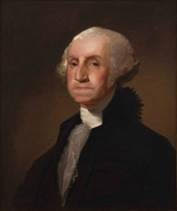
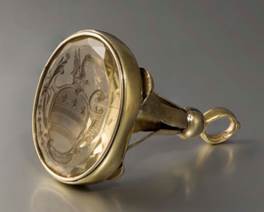
A watch seal belonging to America’s first president is on display alongside a portrait of the famous president and military leader at the Art Museums of Colonial Williamsburg thanks to four benefactors who recently donated the relics.
Colonial Williamsburg visitors can find the artifacts in the entryway to the art museums. The portrait is by Gilbert Stuart and based off his unfinished “Athenaeum” painting, whose iconic depiction of the American legend served as the inspiration for his image on the $1 bill.
The watch seal — a small item typically worn attached to a watch chain and used to commemorate status — is visible in a 1776 portrait painted by Charles Willson Peale to commemorate the liberation of Boston from the British. It was personally commissioned by Washington in 1771 and features an engraving of his coat of arms.
The portrait was donated to the Colonial Williamsburg Foundation by Douglas N. Morton and Marilyn L. Brown in honor of Colin G. Campbell and his wife, Nancy. Campbell is the chairman emeritus of the Colonial Williamsburg Foundation’s Board of Trustees. He served as president and CEO of the living history museum from 2003 until October, when he stepped down and was replaced by Mitchell Reiss. The seal is a gift from Carolyn and Michael McNamara.
“The Washington family motto was Exitus Acta Probat, or ‘The Ends Justify the Means,’ and his successes alone merit his place first among our nation’s founders,” Reiss said in a news release announcing the gifts. “The depth of Washington’s heroism, however, comes from his individual acts, and the judgment and integrity that guided his hand – and America – through the tenuous years of our nation’s founding.”
In 1796, Martha Washington hired Stuart to paint portraits of the Washingtons. Neither of the paintings were finished. They have come to be known as the “Athenaeum portraits” because of their 150 years of ownership by the Boston Athenaeum, a library. Gilbert used an original portrait to paint about 75 more portraits, one of which was the gift to Colonial Williamsburg.
“Williamsburg hosted Washington throughout his life, as a lawmaker, and perhaps most importantly as his headquarters before the victory at Yorktown,” Reiss said. “His is just one of the many rich stories we tell here at Colonial Williamsburg, and these generous gifts will engage our guests and illuminate Washington for generations to come. The Stuart portrait in particular is a fitting tribute to the Campbells’ great contributions to the Foundation and region.”
Campbell said in the news release he and his wife were “humbled” by the contribution of the portrait to Colonial Williamsburg in their honor.
“We look forward to enjoying this remarkable work, along with the Foundation’s extensive collections, on our regular visits to the Art Museums,” he said.
The seal was personally ordered by Washington from Robert Cary & Company in London. He provided his own gold alloy socket of unknown origin in which to set the seal. Though seals were commonly used to close correspondence, watch seals were more expensive and served as a piece of jewelry to demonstrate the wearer’s status.
Colonial Williamsburg Curator of Metals Janine E. Skerry believes the seal was given as a gift from Martha Washington to fellow Virginian John Marshall, a close family friend. It was then passed down from generation to generation until it wound up in the jewelry box of Ann Waller — a direct descendent of Marshall — who died in 1990.
Following Waller’s death, the seal was sold to another party before it was acquired by the McNamaras to be donated to Colonial Williamsburg.
The donators of the portrait, Douglas N. Morton and Marilyn L. Brown, are from Colorado and have been longtime supporters of Colonial Williamsburg. They have donated $2.3 million to the $600 million Campaign for History and Citizenship, an initiative that seeks to raise money for several new programs and buildings.
The McNamaras live in Williamsburg and are also longtime supporters of Colonial Williamsburg. They fully funded the “A Rich and Varied Culture: The Material World of the Early South,” an exhibit featuring furniture, fine art, ceramics, metals and textiles which is on display at the DeWitt Wallace Decorative Arts Museum through May 2019.
“There are more than 70,000 pieces in our collections and each tells a compelling story, but items like these, along with Peale’s ‘Washington at Princeton.’ place our guests in almost direct contact with the man and his time,” Ronald L. Hurst, Colonial Williamsburg vice president of collections, conservation and museums and Carlisle H. Humelsine chief curator said in the release. “Without the commitment and generosity of benefactors like Marilyn, Doug and the McNamaras, we simply could not provide that kind of experience.”
