


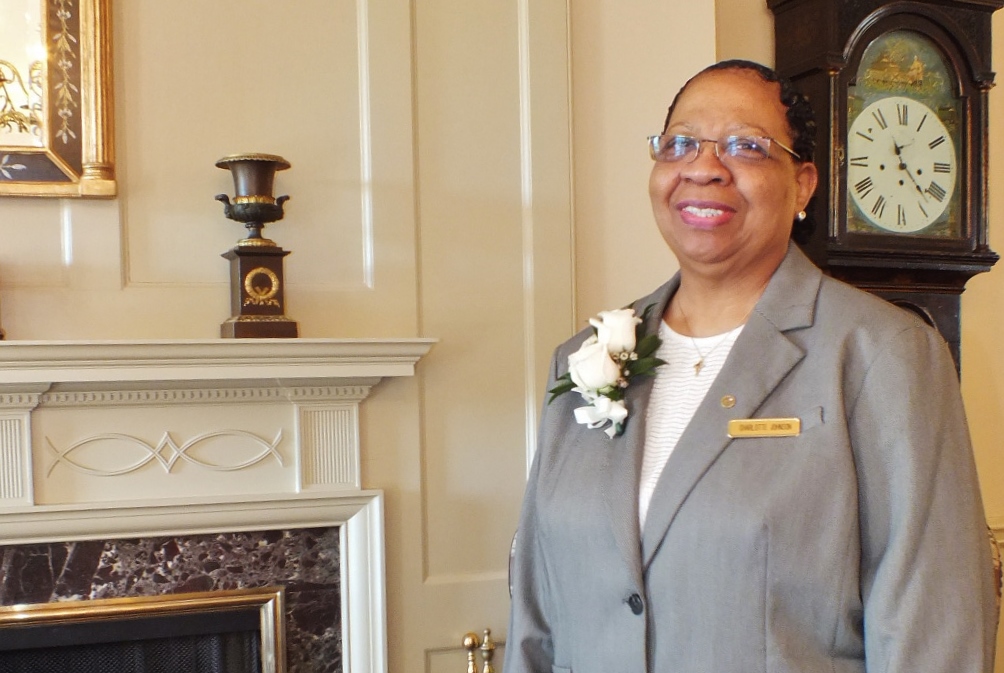
When Charlotte Johnson started working at the Williamsburg Inn in 1964, she earned $18.75 per week.
In those days, she never thought she would work for Colonial Williamsburg for 50 years, but last week marked a half-century of service with the place she calls her second home.
Johnson came to the area to be near her sister, and found the area reminded her of her Hometown in Kentucky. She initially worked at William & Mary in a student center that was known at that time as the Wigwam.
A single mother of two with her 6-week-old daughter in tow, Johnson started as busser in the dining room of the inn in 1964 – the year The Beatles came to America, the year Lyndon Johnson defeated Barry Goldwater to hold the presidency and the year Martin Luther King Jr. was awarded the Nobel Peace Prize.
The times – and the menu – have changed since then.
When Johnson began her work at Colonial Williamsburg’s resort hotel, the Regency Room had yet to be built and meals were only served in an L-shaped dining room. The kitchen was on the opposite side of the building from where it is now.
Alcohol was not served by the drink until the 1980s – champagne cocktails were the only spirited libations for guests. There was not even a bar until a 2001 renovation, and wait-staff had to visit a window into the kitchen to place drink orders.
In addition to the layout of the building, Johnson recollects how innovations in technology changed her work over the years. In the age before computers, the reservation office carried a hefty book of guests to the restaurant every evening.
Attitudes have evolved as well: Twice a week in the 1960s, the inn held a “plantation breakfast” where servers wore costumes.
Johnson, who is black, does not recall any specific issues of racism or segregation, but said the town is more open than it was decades ago. Colonial Williamsburg became one of the first to begin the integration process locally, hiring black people and forcing buildings it owned to desegregate.
As a busser, she did a little bit of everything at the inn, substituting for room service or hostess, and enjoyed getting to know the folks in town by waiting tables at private functions.
By 1974 she was working as a waitress when her mentor — fondly recalled as “Miss Jackson” — retired. Johnson took over that role and continued to climb the ladder to captain of the dining room. Captains’ duties included seating, scheduling and other tasks related to guest services.
Johnson said she was always encouraged to move up through the ranks at the inn. Having two children pushed her to excel. While she said she was scared at first, she came to embrace new responsibility and management duties.
In 1987, the Williamsburg Inn eliminated the captains positions and offered Johnson severance pay or the chance to apply for another job at the establishment. She chose to take the severance package, but had no new course in mind when she received a call from the inn just a couple months later to offer her a new supervisor title.
“Oh, I was ready to come back,” Johnson said.
The break was not long enough to count against her tenure with Colonial Williamsburg, earning her the distinction having the most years with the inn in its recorded history. Johnson had not realized she worked straight-through without breaks for more than five decades until the feat was pointed out to her when she signed up for social security.
She now works as assistant manager of the dining room, the first manager to start from the bottom and rise to the rank.
With that honor, Johnson does not just aspire to set an example for entry-level employees.
“I hope I’ve been a role model, period,” she said.
Not one to lose sight of her beginnings, Johnson makes sure to take time in her day to interact with employees, asking them how their days are going or about their children. Her goal is to make sure those under her know no matter their role, they are important to the operation. She is always willing to lend a hand, too.
“I’m not the type that I can’t wipe the coffee up if it spills,” Johnson said.
One of her favorite memories from her 50 years was being one in a group of 12 employees who deemed themselves the Action for Excellence Team. They organized appreciation events for other Colonial Williamsburg employees.
It all goes to being proud of the product, and Johnson loves walking into the Williamsburg Inn every day knowing she is part of something great.
The inn sees a wide variety of guests in any given day, but Johnson has been around for some of the most notable visitors: the Queen of England, President Reagan for the 1983 Economic Summit, opera star Andrea Bocelli, and most recently Judith Sheindlin – Judge Judy of television fame – and Joan Rivers. Johnson does not get starstruck though – those people are just guests, she said.
She has also seen many repeat guests who might not be celebrities, but who are meaningful to her nonetheless. Johnson said visitors to the inn seem to be getting younger as the next generation of patrons returns to relive anniversaries or family vacations from years past.
She recently spoke with a guest who remembered Johnson helping her into a booster seat; the woman is now 24.
Johnson keeps in contact with those she has encountered over the years, maintaining correspondence with four people currently through notes and pictures of their children and grandchildren.
She has grandchildren of her own now, in whom Johnson tries to instill the importance of hard work and the lesson nothing is achieved from inactivity.
It is a sentiment she applies to her own life. After 50 years with Colonial Williamsburg, Johnson is eyeing retirement, but said she would likely stay working part-while while she continues to actively volunteer in her church.
If she did stop working, Johnson thought of one relief: Her legs would be grateful not to wear pantyhose every day. Even those have changed in the course of her time at the inn – Lyrca was invented in 1958 but not used in most hose until the 1980s.
To honor Johnson’s service, Colonial Williamsburg held a reception March 19. Her family and some of the employees who had worked with her years earlier attended and spoke to Johnson’s hard-working attitude.
She was presented with a Colonial Williamsburg pin, adorned with the number 50 and a small diamond. Other employees receive numbered pins when they reach decade milestones, but Johnson’s is the first of its kind in numeral and sparkle, a testament to her exceptional achievement.
One person joked the diamond was actually glass, but Johnson does not need a gemstone to feel honored.
“Even if it was just a pin,” she said, “I’d still be grateful.”
