


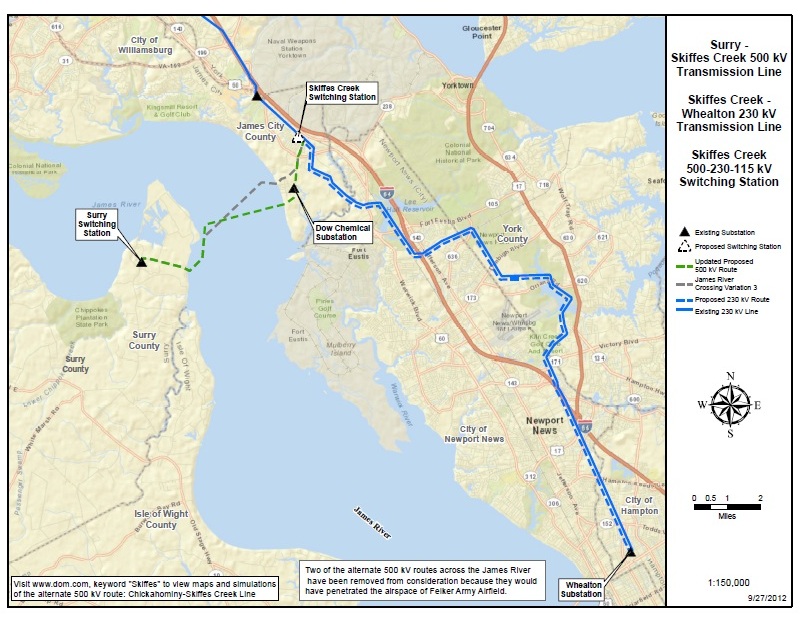
James City County has asked a circuit court judge to require Dominion Virginia Power to obtain a special-use permit in order to construct the proposed Skiffes Creek Switching Station.
Dominion’s plan to construct an overhead 500kV line from Surry to a proposed Skiffes Creek Switching Station has caused pushback from James City County and a number of other concerned municipalities, organizations and citizens. Part of an ongoing State Corporation Commission case over the line includes a Dominion request to have the special-use permit process waived, citing a section of Virginia law that says the SCC commissioners can determine necessity for a transmission line to trump municipal code.
The section of law Dominion cited in its request deals with transmission lines, not switching stations, so Dominion is asking the commissioners to count the switching station as a transmission line.
A day before the closing briefs were due to the SCC in May, James City County Deputy Attorney Adam Kinsman filed a petition in the Williamsburg-James City County Circuit Court to request a judge require the special-use permit.
“A switching station is not a use permitted as a matter of right in the R-8, Rural Residential zoning district and is only permitted upon issuance of a special use permit,” reads the county’s petition.
After explaining the multi-year history of Dominion’s endeavor to study and plan construction of the proposed overhead power line, Kinsman’s motion gets to the point:
“[Dominion’s] representatives testified before the SCC hearing examiner that because [Dominion] considered a switching station part of the definition of a ‘transmission line,’ a special use permit was not necessary for the switching station … [Dominion] testified that it could apply for a special use permit, but time constraints precluded such action,” Kinsman’s petition reads.
The petition submitted argues the law about transmission lines does not apply to switching stations, a special use permit is required and Dominion can’t build the station until it obtains that permit.
Mid-June, Dominion’s attorneys answered back to the petition: “… The county’s petition represents a misuse of the declaratory judgment statute …”
Dominion filed a motion to dismiss, arguing the switching station is necessary to the project and “any declaratory judgment by this court on the ‘transmission line’ issue would be an improper advisory opinion.”
The power company’s attorneys also call attention to the pending case before the SCC as a case that predates the circuit court motion.
Kinsman said in an interview the issue of whether Dominion needs a special-use permit or whether the transmission line law will apply to the switching station is “purely a question of law.” He believes any judgment from the circuit court would overrule the SCC.
The next steps would be for Kinsman and Dominion’s attorneys to come together to request a hearing date for a summary judgment from the court. Each party would file arguments with the court and then stand before a judge to argue each side. The hearing would likely be about an hour.
In the SCC case, all closing briefs were filed; the hearing examiner will compile a report along with his recommendations to forward to the commissioners. Each party in the case will have the opportunity to comment on the hearing examiner’s recommendations. Dominion has asked for a decision by Oct. 1 in the SCC case, which the commissioners can decide whether to heed.
Related Coverage:
- Closing Briefs Filed in Dominion Overhead Power Line SCC Case
- JCC Denies Site Plan Approval for Dominion’s Skiffes Creek Station; Still No Application Submitted for SUP
- SCC Hearing Concludes for Power Line Case
- JCC Offer to Purchase Land for Dominion Not Rooted in Prior County Discussion
- Power Line Hearing: JCC Offers to Buy Land, Questions Veracity of Dominion Research
- Evidentiary Hearing on Proposed Overhead Powerline to Begin Today
- JCC Supes to Vote on More Funding for Fight Against Dominion
- Officials Unsure Retrofitting Entire Yorktown Power Station is an Option
- SCC Changes Hearing Examiner, Date for Dominion Power Line Case
- GA Subcommittee to Send Letter Opposing Proposed Power Lines
- Chickahominy Chief Says Overland Power Line Would Harm Tribal Grounds
- Is Burying Proposed Power Line Across James an Option?
