


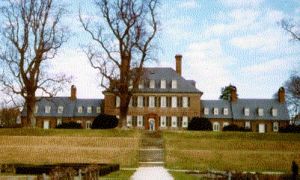
Back in November, a federal bankruptcy judge wanted Halsey Minor in court. The dot-com millionaire, facing bankruptcy in a venture that was formed to purchase the historic Carter’s Grove mansion and property from the Colonial Williamsburg Foundation, has been hard to reach.
Court documents say about a month’s worth of newspapers, mail and packages littered the porch of Minor’s home when a process server tried to deliver subpoenas on four occasions last November. The situation caused Stanley Samorajczyk, the court-appointed trustee for the estate, to be concerned Minor wouldn’t appear at future depositions, hearings or trials related to the case.
Samorajczyk’s concern led to a recent request to the Eastern District of Virginia U.S. Bankruptcy Court that Minor be held in contempt for failing to appear at a deposition and not responding to the numerous subpoenas. The trustee also asks that Minor be apprehended and brought to court.
It’s the latest twist in a years-long court case that, last year at least, looked like it was headed to a conclusion with Carter’s Grove scheduled to be on the market possibly as early as this spring.
Minor set up Carter’s Grove LLC in 2007 to purchase the property for just over $15 million from CWF. Minor didn’t make the last two payments owed on the property, and then filed for Chapter 11 on Feb. 14, 2011.
In June 2012, Minor filed suit against CWF, alleging it sold the property at a “grossly inflated price” to mislead him, according to documents filed with the bankruptcy court.
Samorajczyk, who was appointed trustee in April 2012, and CWF agreed in July 2012 to a plan for repairs to the mansion, which had fallen into disrepair. CWF agreed to fund the repairs, estimated at $3.3 million, to ready the property for sale.
The latest issue follows Samorajczyk’s repeated – and failed – attempts to contact Minor for documents relating to a $3.4 million lien on the Carter’s Grove property. Sotheby’s, an auction house, put a $3.4 million lien on the property for attorney fees associated with a previous case concerning artwork Minor bought but never paid for. Samorajczyk filed a motion in August 2012 to be able to look into the lien, whose timing just weeks before the bankruptcy filing made the trustee question the validity of the claim.
In October, the court granted Samorajczyk access to the Sotheby’s lien information after a hearing at which Minor neither appeared nor objected. The court’s order was attempted to be served to Minor at the address he gave the court, which uncovered the uncollected mail, newspapers and packages. Three more attempts to serve Minor at one of his companies also fizzled when the building manager informed the process server that Minor’s company hadn’t been in the building for two years.
Samorajczyk’s efforts to locate Minor and Minor Ventures finally led to the New York law firm of Johnson Gallagher Magliery, LLC, where an associate attorney accepted the subpoena. The subpoena asked for the Sotheby’s lien documents and that Minor appear at a February deposition. According to court records, the documents were not produced and Minor didn’t appear at the deposition.
Desiree Parker contributed to this article.
Related Coverage:
