


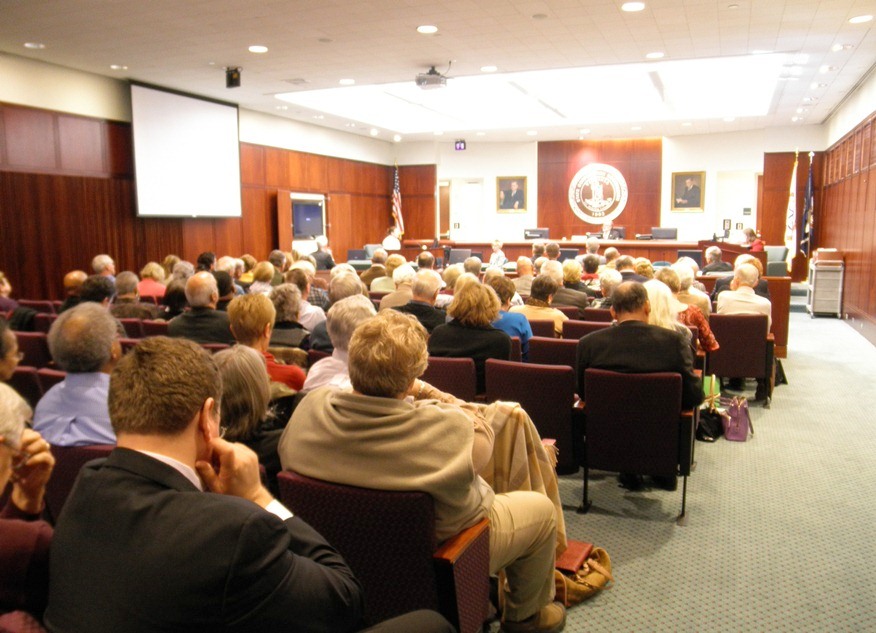
As residents worried about the impact of a proposed power line that would either cross over the James River or come down from Chickahominy, Stephen Adkins had a bigger concern: the Chickahominy line would cross over tribal grounds.
Adkins, the Chickahominy Indian Chief, was the first speaker at a State Corporation Commission hearing – the last for public input – on the proposed Dominion Virginia Power transmission line the utility says is necessary by 2015 to provide power to the area. Adkins said to his knowledge no assessment of the impact on the tribe’s powwow grounds and tribal center has been done and the Native Americans are not being considered the “most endangered historical resource.”
The Jamestown settlers traveled up the Chickahominy River to trade for corn and, if it weren’t for the tribes along the river, the settlers might not have survived, Adkins said. This would be the first time to showcase the Chickahominy tribe as an asset and a historical part of the community, he said.
In the ongoing SCC case with Dominion Virginia Power, James City County opposes both a line over the James River and one that would go overland at the Chickahominy. Some county representatives and citizens think the over-river crossing would mar a historic viewshed citizens value and the county relies on for tourism while the Chickahominy line would affect citizens’ homes and end up a much more expensive alternative.
Several James City County residents who live in Colonial Heritage, an active adult community, arrived by charter bus at Thursday’s public hearing to comment on the two line options. The group of Colonial Heritage residents, as well as a large number of other speakers, were wearing stickers the Colonial Heritage residents ordered made that read “SMaC” for “Save My Chickahominy.”
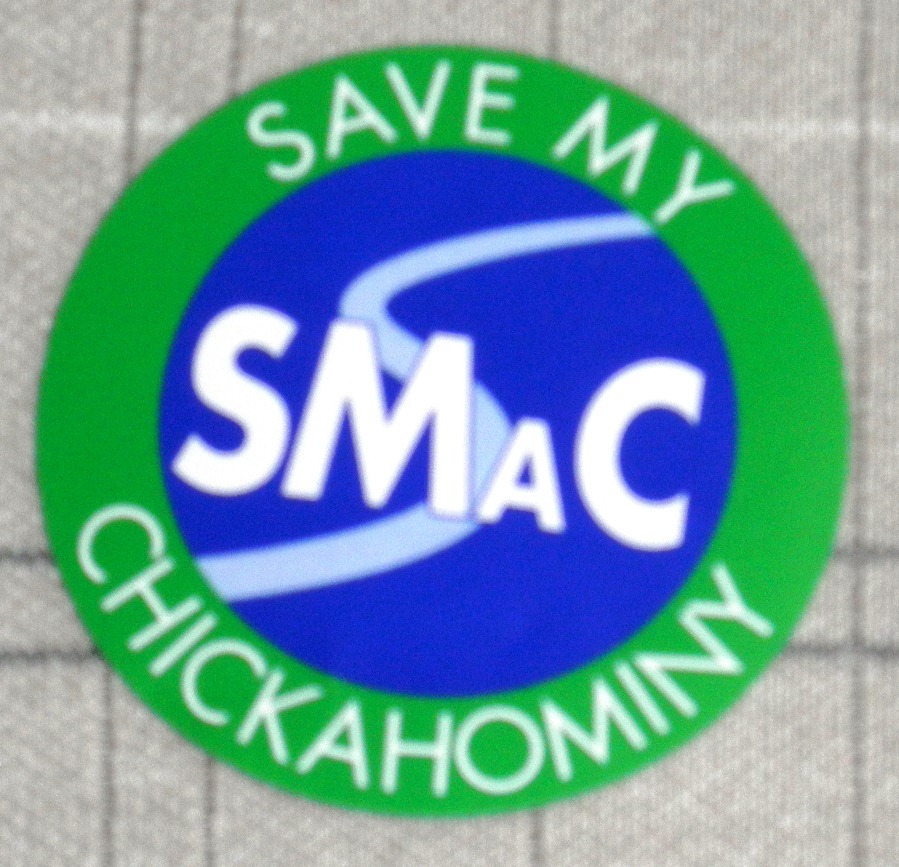
The consensus among Colonial Heritage residents was opposition for the Chickahominy line and, in some cases, support of the over-river line near Kingsmill.
“A line over or under the river is going to affect someone, but we have to choose a less-obtrusive line,” said Colonial Heritage resident Page Sutton.
John Roberts, also a Colonial Heritage resident, said he formulated his opinions on the two lines based on the North American Energy Reliability Corporation (NERC) standards. He said he opposes the Chickahominy line because Dominion does not project it to be as reliable as the Surry-Skiffes Creek line. He said energy costs need to be reduced and the military bases in the area cannot be subjected to unreliable power.
Attorneys present at the hearing were able to cross-examine speakers. Andrew McRoberts, counsel for James City County, pointed out that James City County opposes the over-river line. He asked Roberts if he would support an alternative line that addressed the NERC standards; Roberts said he would.
Victoria Gussman of Toano asked that other alternatives for the line be considered. She said the overhead power lines would degrade the view “completely and irreversibly.” She said the questions of need and urgency “may not be adequately generated” and the necessity for a large line might not exist. Gussman served as a former James City County planning director.
Several Charles City County residents spoke in opposition to the Chickahominy line, saying it would affect the Cedar Grove Baptist Church and the cemetery located there. Other residents from that area who spoke live in historic homes eligible for the National Register of Historic Places and said they didn’t want the historic value sacrificed.
Elva Yates owns Poplar Springs in Charles City County, which is a home on the National Register of Historic Places and she was worried nobody would want to buy her home if the Chickahominy line was built within view of her property.
Michael Thomas is the SCC hearing examiner assigned to the Dominion case and is ultimately responsible for writing a report to submit to the commissioners for a decision in the case. At the public hearing, Thomas discussed the option of what he called the “hearing examiner’s proposed line.” He said he would like the option of putting either a single or double circuit 230kV line under the river or as a hybrid of over- and under-river crossing.
Thomas said he calculated the cost of putting a single circuit 230kV line under the river and said, by his calculation the line would cost about $60 million whereas Dominion’s first-choice Surry-Skiffes Creek line would cost about $55 million.
“I’m focused on those two alternatives,” Thomas said. “Is it worth another $5 million…if it can be done?…The answer to that, in my opinion, is yes.”
He estimated the cost of a double circuit 230kV line to be about $95 million and said he wanted to know the cost to Dominion ratepayers and wanted to “assure everyone that those numbers will be looked at.”
The retirement of three generation stations in Yorktown and Chesapeake have pushed the need for the power line construction up to 2015 from the original proposed date in 2019. Thomas said he was also interested in finding out if retiring generators would be a better decision that refueling them.
Thomas said he wants more information and answers to his questions prior to making his report to the commissioners.
An evidentiary hearing in this case will be held at 10 a.m. on Tuesday, Feb. 26. The hearing will take place in the SCC courtroom on the second floor of the Tyler Building at 1300 E. Main St. in Richmond. The evidentiary hearing will be open to the public but there may be periods where confidential information may be discussed, at which time the public will be asked to leave to the courtroom.
Information on easements can be given by local county or city land records departments. Parcel viewers are available for James City County, the City of Williamsburg and Charles City County.
Dominion can provide a copy of their easement information by emailing [email protected] with “Easement request” in the subject line. It could take up to six weeks for the request to be processed but information on easements relating to the Surry-Skiffes Creek and Chickahominy lines is readily available. For information about right-of-way usage, visit the Dominion website.
Information on the case can be found on the SCC website, along with a listing of all documents attached to the case.
Read previous articles about opposition to the Surry-Skiffes Creek line, the October 2012 public hearing and the option of burying a 500kV line.
