


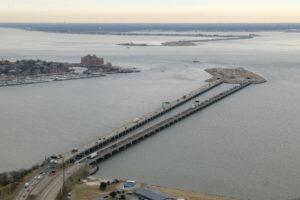
Peninsula residents battle traffic in the Hampton Roads Bridge-Tunnel to get to work every day. This month, drivers are invited to weigh in on possible solutions to the usual gridlock.
The Virginia Department of Transportation will host two public hearings in January to discuss alternatives for the HRBT, focusing on the potential environmental impacts of four options. The Hampton-Roads Bridge-Tunnel saw a daily volume of 44,100 eastbound travelers entering the tunnel from the Peninsula in 2011, according to VDOT. The daily volume is expected to increase to 56,100 tunnel and bridge travelers by 2040.
Data collected by the Census Bureau from 2006 to 2008 showed about 2,200 residents of the Historic Triangle commute to one of the five cities on the Southside of Hampton Roads, using either the HRBT or Monitor-Merrimac Memorial Bridge-Tunnel.
In cooperation with the Federal Highway Administration, VDOT is preparing an Environmental Impact Statement that explores possible implications of four alternatives to the HRBT. The draft version of the statement is currently available for review online.
The public hearings will be from 4 to 7 p.m. Jan. 23 at Granby High School in Norfolk and from 4 to 7 p.m. Jan. 24 at St. Mary Star of the Sea School in Hampton. A full copy of the draft can also be found at the Williamsburg VDOT office, located at 4451 Ironbound Road.
The public hearings will not feature any formal presentations, but will include maps, drawings and other materials to explain the alternatives. Citizens who attend will be able to speak about the study with VDOT representatives and share their opinions on the best options.
Anyone wanting to share a comment, but unable to attend the public hearings, can fill out the electronic comment form, send emails to [email protected] or mail comments to Tom Heil, Team Project Manager at 2901 S. Lynnhaven Road, Suite 300, Virginia Beach, VA 23452. All comments are due by Feb. 13, 2013.
VDOT has identified four options for the future of I-64 in the HRBT corridor. One option, called the No-Build Alternative, would make no substantial changes, which could pose significant problems in the future. VDOT estimates traffic volumes on all sections of I-64 in the study area will grow by 12-26 percent by 2040, resulting in longer lines of traffic and less reliable travel times. Additionally, the aging of the existing highway, bridge and tunnel will lead to higher maintenance costs.
That leaves three alternatives to consider. In one scenario, called the Build-8 Alternative, the two existing bridges would carry four westbound lanes and a new bridge would carry four eastbound lanes and would lead into a new eastbound tunnel. The interchanges on I-64 would have to be modified to accommodate higher volumes. The project is estimated at $4.4 to $5.5 billion.
The second option, the Build-8 Managed Alternative, would add one or more lane that would be managed based on either tolls or occupancy. The two existing bridges would carry four westbound lanes, while a new bridge would carry four eastbound lanes. The two current tunnels would carry westbound traffic, while a new tunnel would carry four eastbound lanes, with a buffer separating managed and general purpose lanes throughout. In both the Build-8 and the Build-8 Managed options, the mainline roads would have four lanes traveling in each direction. Its estimated cost is between $4.7 and $5.9 billion.
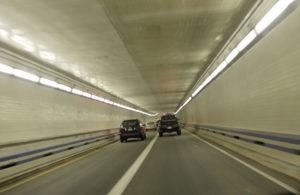
The final proposed alternative, dubbed the Build-10 Alternative, would stretch the mainline roads to five lanes traveling in each direction, with a median and shoulders throughout. The two existing bridges would carry four westbound lanes, while a new bridge would carry one westbound and five eastbound lanes, with a barrier separating them.
The two existing tunnels would carry four westbound lanes, and a new tunnel would carry one westbound lane and five eastbound lanes. The sole westbound lane would be physically separated from the eastbound lanes in the new tunnel. In this scenario, all lanes would be general purpose. The Build-10 plan has an estimated cost of $5.3 to $6.7 billion.
VDOT has already ruled out several other options, including rehabilitation, reconstruction or replacement of the existing HRBT and the addition of reversible lanes, all of which would not fully address the capacity needs.
A suggestion to add just two additional lanes of capacity, for a Build-6 alternative, would only partially address some of the needs, but would not adequately alleviate congestion, according to VDOT. A proposed Build-12 alternative was rejected because of its high environmental impact. A high bridge option could work, but creates logistical problems for the shipping industries and would present new environmental impacts.
VDOT also considered adding a ferry; a private ferry service once took travelers from Hampton to Norfolk. VDOT ruled a ferry alternative would not address the deficiencies of the existing bridge-tunnel, and would not significantly address capacity needs because ridership would be expected to range between 600 and 1,100 vehicles daily, which equals less than one percent of the projected traffic volume by 2040 if no improvements are made.
In its preparation of the environmental impact study, VDOT evaluated how changes along the HRBT corridor would affect residential and business properties, parks, historic properties, wetlands, wildlife habitat and the economy.
In most cases, the hundreds of acres converted for VDOT use would be institutional land in Hampton and military-owned land in Norfolk. Any of the build alternatives would require between 25 and 26 acres of parks and recreational land in those areas.
The build alternatives would impact Hampton and Norfolk residents and business owners located close to the highway. Depending on which build alternative was chosen, between 261 and 315 residences would have to be relocated through right-of-way acquisition. Between 16 and 17 businesses could be displaced. See a full chart of potential environmental impacts here.
After the public hearing comments are reviewed, the Commonwealth Transportation Board (CTB) will identify a preferred alternative. No state or federal funding is currently available for any of the proposed changes.
VDOT expects the study to conclude, with a selection of the best alternative, in the summer of 2014. If one of the alternative options to build a bridge or tunnel is chosen, and funding is available, the study might continue to consider design, right-of-way acquisition and construction. The process could take several years, according to a press release from VDOT.
