


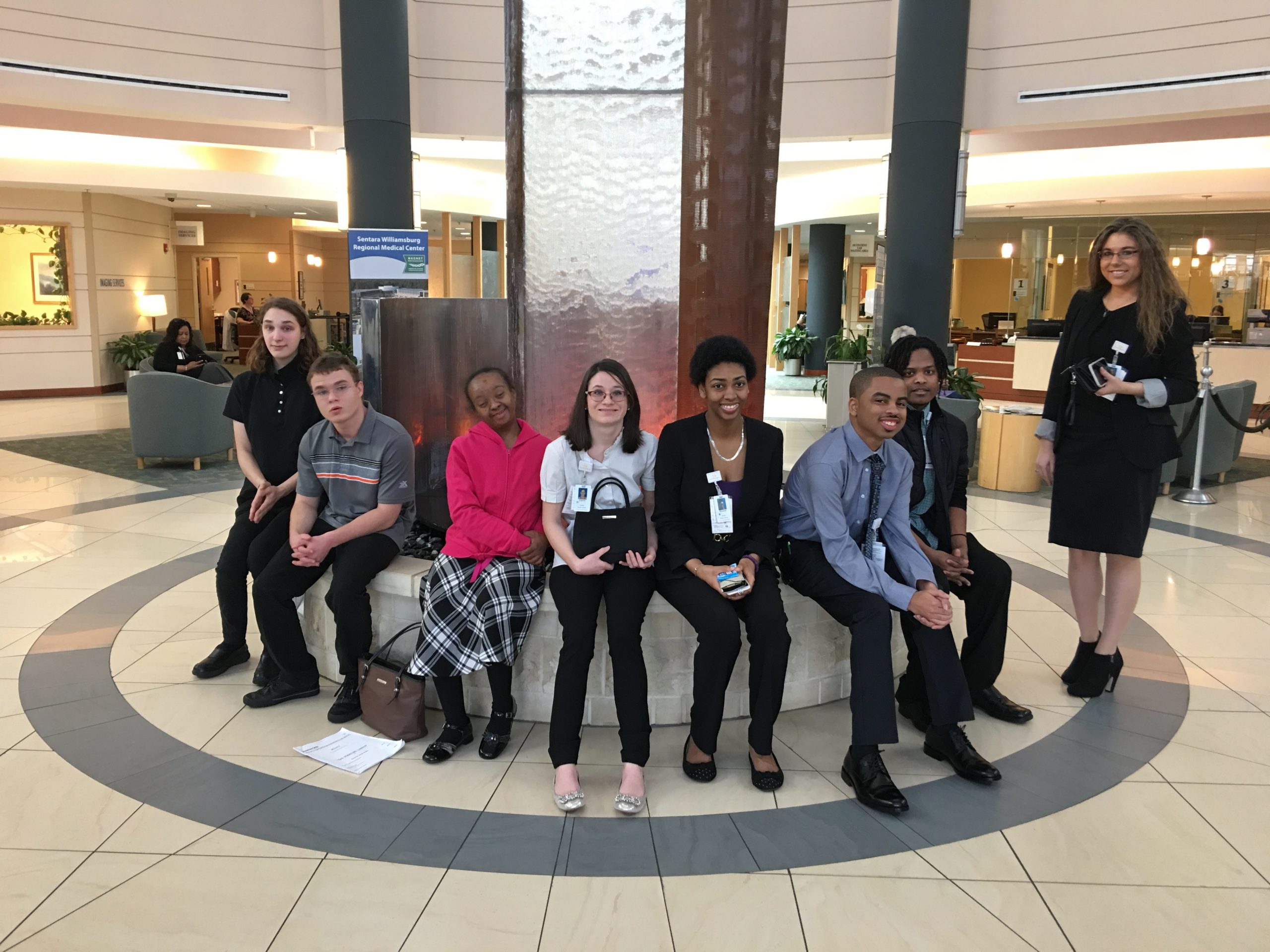
A.J. Cruz and Lauren Fernandez are both self-described “people persons.” That quality wasn’t always cultivated or respected in high school. Both have developmental disabilities, which made high school a challenging place.
But during a year-long transitional program following graduation, they got their groove back. Last week, the students graduated from a program called Project SEARCH, capping the year they spent working at Sentara Williamsburg Regional Medical Center.
The Project SEARCH program started in the 1990s, at the Cincinnati Children’s Hospital Medical Center. Since the hospital served individuals with developmental disabilities, it decided to hire staff with such disabilities for some of its entry-level positions.
In Virginia, three Sentara hospitals signed onto the project seven years ago: Sentara Williamsburg Regional Medical Center, Sentara CarePlex Hospital in Hampton, and Sentara Norfolk General Hospital in Norfolk.
About seventy students have been through the program in Williamsburg. An average class has ten students. Students find out about it at school, through teachers or guidance counselors. Then they apply through their county.
The Choice Group, a Richmond-based employment agency that helps people who have encountered difficulties find work in the mainstream work place, and the Virginia Department for Aging and Rehabilitative Services are also involved in the program.
“They want two things: they want someone to respect them, and to treat them like adults,” said Don West, the program leader at Sentara Williamsburg. “There are many, many stories of how we brought those people in here and provide nurturing environment.”
West recalls one young man who was very shy, and constantly looked at the floor. “His mother said, ‘He would like to be in this program, but he doesn’t want to get beat up. Was picked on a lot,’” West said.
But all that changed after the young man spent a year buffing floors in the hospital. “He excelled. He got his confidence back,” West said. “I got a card from him. Now he is working at an outlet mall doing sales. This man, who wouldn’t even look me in the eye, is now doing sales.”
Preparing students for the real world
Ann Jo Cosgrove, the program’s teacher and coordinator at Sentara Williamsburg, said, “The students that I’ve worked with have grown in maturity and their comfort in working in the real world. Many of them may have not been very successful in high school. When they come here, they just shine.”
“They become responsible, professional adults,” she added. “In turn, they get to network with people in the hospital. A.J. [Cruz] says he knows everybody. It really turns out to be a win-win situation for everybody.”
Cruz, who graduated from Lafayette High School in 2015, did three 10-week internships: in physical therapy, patient transport and food service.
He said his favorite part of the program was his contact with both patients and staff. “The staff treats me like I’m a team member, and I like meeting new patients every day,” Cruz said. “I had this one patient, and we used to talk about baseball every day. That was pretty nice.”
Fernandez said she also enjoyed her contact with patients most. “I’m a people person so I restock rooms and I get to talk to patients. They say, ‘Thank you so much doing this,’” she said.
Now that they’ve graduated from the program, both are applying for jobs outside the hospital—although both would consider one day working at a hospital again.
“I didn’t know that it could be so much fun to work in a hospital,” Cruz said.
Interns are well-liked employees
West said the students are also a big hit with hospital staff, and patients and visitors. “They just love them because of their bedside manner. They’re friendly, open and help when they can,” West said, adding, “Everyone that I’ve hired is so appreciative of their jobs. They’re the first ones to get to work and the last ones to leave; and they don’t call in sick.”
As with any job matching situation, they pair students with jobs where they can use and develop their skills.
“A student working in the linen department loves to count,” West said. “So he counts all the sheets and blankets. He knows exactly how many sheets go on each floor.”
“People will ask me, ‘What is their disability?’” West said. “And I say, ‘It doesn’t matter.’ Each one of these wonderful students brings their own special skills to the table.”
Placing them in jobs after the internship has been successful. A lot of students work at long-term care facilities; others stay on at the hospitals. Others work in stores, like Forever 21 and Barnes & Noble Bookstore, Cosgrove added.
“The goal of the program is to find them competitive employment,” Cosgrove said. “A lot of their skills will transfer into another type of job in another location.”

