


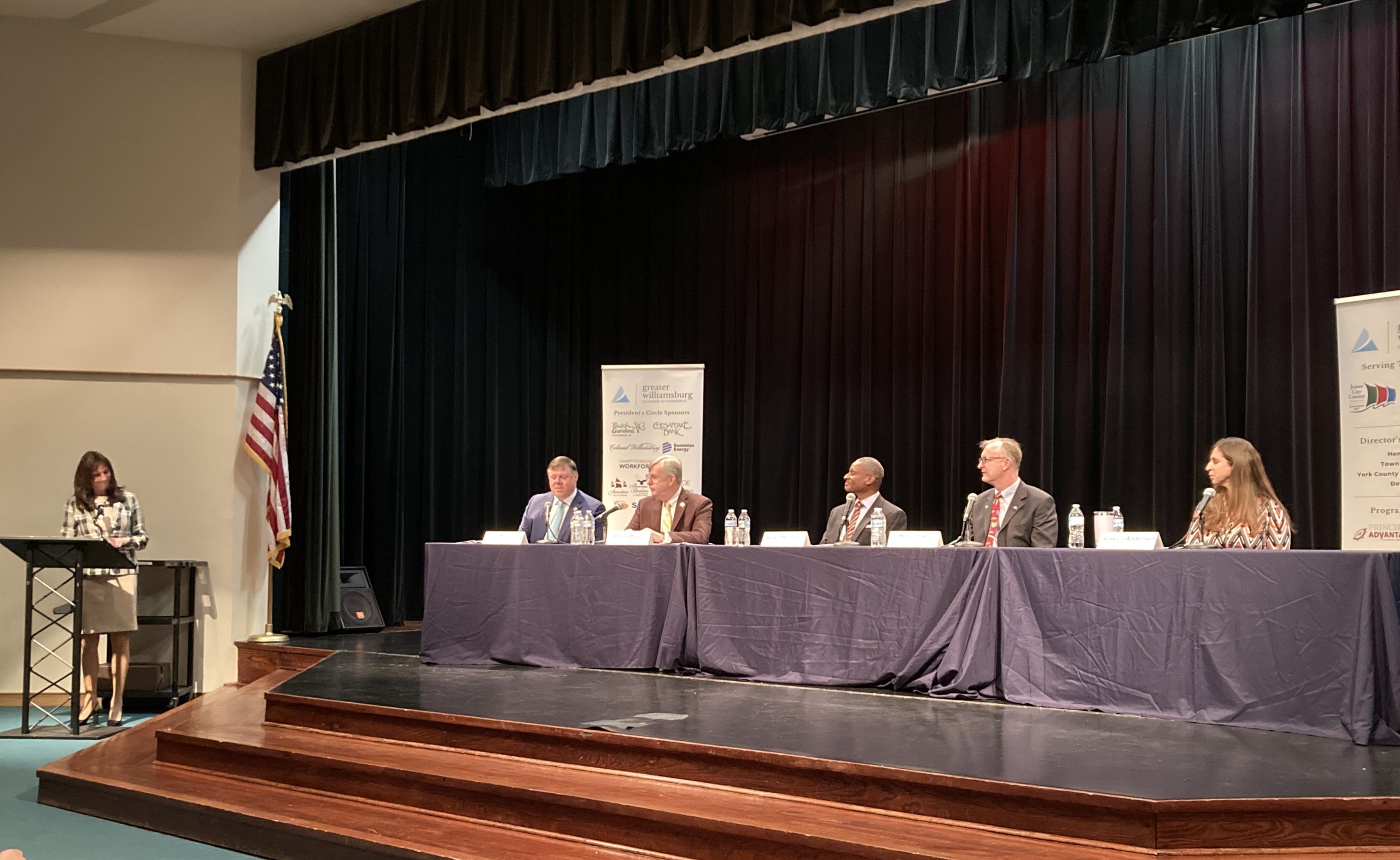
WILLIAMSBURG — With lawmakers preparing for the General Assembly Session beginning Jan. 14, local representatives took part in the Greater Williamsburg Chamber of Commerce’s 2026 Pre-Session Legislative Forum Wednesday morning.
The forum, moderated by Mindy Carlin of Access Point Public Affairs, saw Senators Ryan McDougle and Danny Diggs, and Delegates-Elect Jessica Anderson, Dr. Mark Downey and Virgil Thornton field questions at the Williamsburg Regional Library Theater.
Key topics included the need for affordable housing, workforce training, investing in education, the future of the right-to-work law, the potential impact of sales tax policy changes, and investments in education, mental health and public transportation.
The formerly all-Republican delegation now includes three Democrats after the November election losses by Delegates Amanda Batten, Chad Green and A.C. Cordoza.
“I think my new colleagues here with me, we all ran on kind of the same message. We want to make life more affordable, more accessible, and really lift up our children,” said Anderson.
The delegation stressed its focus on maintaining bipartisan cooperation.
“I look forward to working with them … in fact, we’re already doing some bills together that they’re carrying in the house, and I’m carrying it in the Senate,” said Diggs. “And so, there’s already this bipartisan relationship, and we’ve got good relationships already on that.”
Affordability — particularly of housing, child care and healthcare — was a key topic acknowledged by both the Democrats and Republicans in the room, and one that highlighted the Senators’ concerns about too much power being taken from local governments.
“It has been my policy that whatever the state tries to put out there, and I think there’s been some bad bills, that whatever we do, we need to protect localities’ rights of zoning, because every locality is different, and every locality has different needs and wants and where they want to go,” cautioned Diggs.
“It is important that we deal with this from a state level, but it is equally, not more important that the local communities retain control,” McDougle concurred.
“I agree with everything that’s been brought up here, but we also need to work on making sure that people can have increases in their income, making sure that we raise the minimum wage, make sure that we provide incentives for first-time home buyers,” said Downey.
Virginia’s “right-to-work” law bans requiring union membership or paying union dues as a condition of employment. In December, legislation was filed to repeal it. Gov.-elect Abigail Spanberger said she opposes repeal of the law, but opened the door to the possibility of reforms.
“I think it’s pretty significant in the fabric of how our economies work here in Virginia. Right to work is not just a title. I’ve heard that the governor said that she will veto any legislation to repeal it. But it’s more than repealing. It’s also just gutting the policies,” said McDougle, cautioning of the dangers of increased local taxes. “It will be the most substantial issue that affects how much money citizens — community members — keep in their pockets.”
Thornton agreed it was a complex issue, noting that union workers are better paid and have better benefits.
“Coming from the field of working with unions at Newport News Shipbuilding … and seeing the protections that are in place by unions, and then also having to work with a company that actually has a very good relationship with the union, that’s extremely important,” he said. “There are members that are paying dues so that the union would have its strength, because there is strength in numbers … there’s power in that, and to have that power, there needs to be membership, and that’s only when they complete that power.”
Another issue that could prove contentious is potential changes in the state sales tax.
“When you’re looking at changing the tax structure, it is very complicated, and the metric that I use to base it on is, are Virginians paying more money? So, if it is termed a restructuring or reform or change, but it’s actually just a tax increase, then we’re going to be aggressively against it, and we’re going to talk about that,” said McDougle, who also serves as Senate minority leader.
The delegation found itself on the same page more often than not, however, including on recreational marijuana, where the general feeling was that information is still lacking and guardrails need to be put in place.
“Right now, there’s no ability for law enforcement to test somebody on the side of the road to determine that they’re under the influence of marijuana. We need to make sure those tools are in place at the same time that the market’s expanded,” McDougle said.
All also saw the need for workforce development in the schools.
“One of the things I think we still struggle with in our K-12 schools is making sure, as we’re having conversations with students, that they know it’s a great thing to go into a career and technical field,” said McDougle, adding that outcome needs to be as acceptable in the K-12 system as it is in the community.
They also agreed on making child care more affordable and accessible.
“This is a complex issue, and I think this is one way you see that there’s bipartisan agreement. Everybody understands that there’s a challenge and that we need to try to solve the challenge. What the solution is seems a little more elusive,” said McDougle.
And while politics on the national stage remain polarized, the delegation was quick to highlight bipartisanship and the work it is already doing together for the region.
“We need people in the General Assembly that are there to represent everyone that is in their community, regardless of party. Whatever the idea comes from, wherever it comes from, if there’s a good idea that’s going to benefit our community, then get behind it,” said Downey. “I think Virginia is unique in that way, because we tend to put our community and our commonwealth ahead of a lot of the vitriol that we see at the federal level. And I think we can continue to be a strong role model for the rest of the country on how government should run and how it should benefit our residents and individuals.”
The 60-day 2026 General Assembly Session will convene at noon on Wednesday, Jan. 14, in Richmond.

