


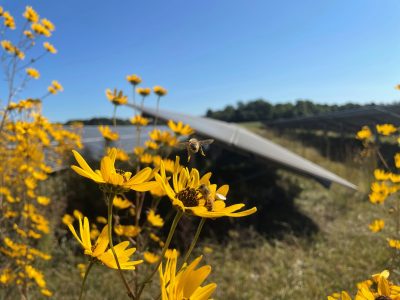
WILLIAMSBURG — A research project at William & Mary is examining how solar farms can benefit local ecosystems.
Graduate biology student Bryce Donaghue is studying how vegetation beneath solar panels attracts insects and creates new hunting grounds for bats. His goal is to demonstrate that renewable energy sites can also serve as thriving wildlife habitats, supporting species that are increasingly at risk.
Donaghue’s research focuses on measuring insect activity and bat behavior across multiple solar sites in Virginia. Using acoustic monitoring equipment and insect sampling, he’s tracking how changes in vegetation management, such as planting native wildflowers or reducing mowing, affect biodiversity. The findings could help energy companies design solar farms that benefit both the environment and local wildlife populations.
“Bats were never something that popped into my mind at first,” he said. “So when I came to William & Mary, my advisor and I were brainstorming about what we wanted this project to look like, and I wanted it to be about wildlife and vegetation, how the two affect one another.”
“Some of the Native American tribes we worked with started putting in native plants underneath the solar panels … they provide some kind of shade, and so the plants can do well,” he added.
Bats are particularly valuable in ecosystems, acting as indicators of environmental health and contributing billions in pest control annually.
“Bats are great indicators of a healthy ecosystem. If bats are preferentially hanging out in an area more, it’s generally an indicator that that system is doing pretty well,” Donaghue said.
The research also challenges the perception that renewable energy projects necessarily harm wildlife habitats.
“This is gonna happen regardless,” he said. “But if I can be the one that’s in the room trying to say, hey, can we mitigate the effect? Maybe we don’t put something right here that’s going to take out this endangered animal, maybe we put something next door, that’s how I can play a part.”
The study included solar sites primarily in Virginia, and one in North Carolina, examining how bats and insects interact with intentionally planted pollinator habitats under solar panels. The findings suggest that bats respond positively to these enhanced environments.
“When you look at an open meadow with native wildflowers, you’re like, okay, during the day there are absolutely more bugs here. I’m assuming at night there have to be more bugs too, and that’s the whole reasoning behind it,” Donaghue said.
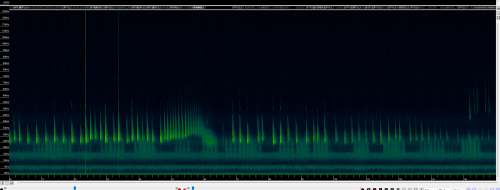
Beyond data collection, the fieldwork experience has been memorable. “I love just driving and seeing different parts of the country. There was one of my sites on the way back where I would always drive by this beautiful manor by a wetland, and seeing all the history … it’s fascinating,” he said.
Donaghue hopes his work encourages a broader understanding of the relationship between renewable energy and conservation. “Realize we’re not removed from this ecosystem. We are very much a part of the system, and we’re the only species that’s really contributing to changing it as much as it is,” he said.

