


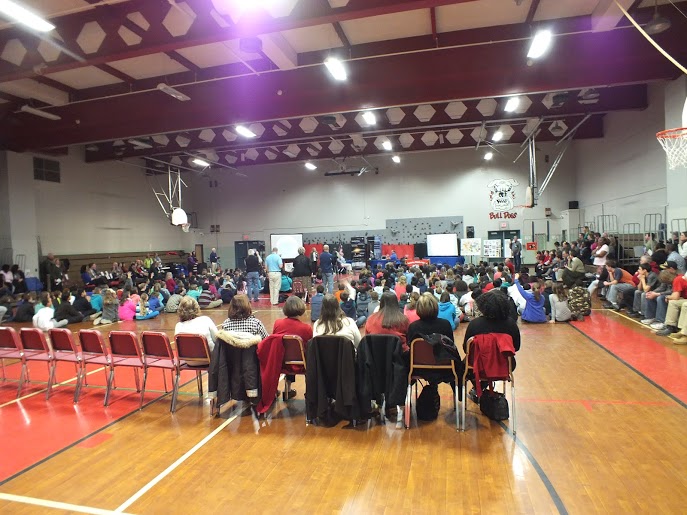
In a packed Berkeley Middle School Gymnasium, a storm of static came over the speakers Wednesday. A man at the front of the room sat with his back to the audience with headphones on, adjusting dials on a piece of equipment on a table in front of him.
“November alpha one sierra sierra, November alpha one sierra sierra, this is kilo four Romeo Charlie, kilo four Romeo Charlie. Wiliamsburg, Virginia calling. Over,” he said.
Sixth-graders sitting on the gym floor were smiling, leaning forward and putting their hands over their mouths, anxious as the man used call signs and radio equipment to make live contact with the astronauts aboard the International Space Station. The students’ call to the space station ended several months of preparatory education about NASA and space.
Berkeley was one of seven schools in the nation this year chosen to take part in the Amateur Radio on the International Space Station program, a cooperative effort of NASA and two radio organizations, ARRL and AMSAT, that connects public forums with the ISS. Ahead of the contact with ISS, Dr. Kimberly Brush, NASA Langley Research Center’s educator professional development coordinator, began working with Berkeley in October to bring demonstrations and educational experiences to prepare the kids for the radio call.
She taught the students about planets, solar systems and galaxies, and the kids had the opportunity to try on a spacesuit glove. One day, a man showed up dressed in a full spacesuit — a day sixth-grader Anna Coghill said stuck out in her mind.
“I was amazed to find out the suit weighs almost 300 pounds on Earth,” Coghill said.
Williamsburg Area Amateur Radio, a social club for communications gurus, joined in on the effort by providing their equipment and knowledge to help contact the station. The Williamsburg Fire Department got involved, helping install a large rotating antenna on the roof with the help of a long ladder from one of their trucks.
Chuck White, a member of Williamsburg Area Amateur Radio and the man in the front of the room who was tuning in the space station, also taught the children about the antennae and equipment involved. White’s team spent several months pulling together the equipment and expertise to make the contact.
“It mushroomed into a pretty large project for us,” White said.
It all started when Marjorie Thrash, a science teacher at Berkeley, got a tip from a parent about the ARISS program. Thrash said she was looking for speakers and events to bring to the school related to science and it seemed like a good fit.
Thrash and Bob Bruce, an instructional resource teacher, started working on the project last spring and pulled together a proposal to send to ARISS. They got White and his team involved, then White, a retired captain of the fire department, helped get the the truck and ladder to the school to install the antenna.
On Wednesday, the students waited in the gym as White made several attempts to contact the ISS. A faint voice made its way through the speakers, repeating the same call signs White had been issuing. It was Expedition 38 Flight Engineer Mike Hopkins speaking to the crowd while the ISS began to pass over the eastern U.S. — shown by a live graphic on a large screen that tracked the space station’s movement at 17,500 mph.
Just a few weeks ago, while many students were in their homes enjoying holiday treats on Christmas Eve, Hopkins was floating in space outside the ISS. He had the task of installing a refrigerator-sized coolant pump that day in the second-ever Christmas Eve spacewalk — a walk that made national headlines not only because of its rarity but also because of the risk. Now Hopkins sat on the other side of a radio frequency that reached him at more than 200 miles above the Earth’s surface.
Ten Berkeley sixth-graders were lined up to ask him questions. The first asked him if he liked being an astronaut. After a loss of signal, more static and more call signs from White trying to re-establish a connection, Hopkins’ voice came through.
“This is Colonel Mike Hopkins, I love everything about it. I love the work and I love the people,” he said.
Another student asked him about his favorite experiment on the ISS and another asked about his future career plans. Hopkins said they had many cool experiments going on but he was most excited about an upcoming study on the behavior of ants in low gravity. After his stint in space, he plans to go back to flying in the Air Force.
Finally, a student asked him to name the biggest challenge about being an astronaut. The signal was getting weak, but through the static and noise, two words stuck out: “Being patient.”
After that, Berkeley Middle School lost contact with the International Space Station. Not all students got to ask their questions, but that was no surprise.
“We knew that if everything went perfectly, we’d have about nine or 10 minutes [to talk to Hopkins],” said White, who explained the first antenna had failed, forcing him to switch to a backup antenna that allows a weaker transmission.
Instead, they got about five or six minutes. The short transmission time did not seem to matter to the audience, who erupted into applause.
“I thought it was a very fantastic moment,” sixth-grader Kelvin Marerro said. “It was a very rare and cool experience.”
Coghill, who had earlier been amazed by the weight of a spacesuit on earth, said she was not disappointed either – not by a long shot.
“Coming from my heart,” she said, “I never thought I would experience anything like this in my entire life.”
