


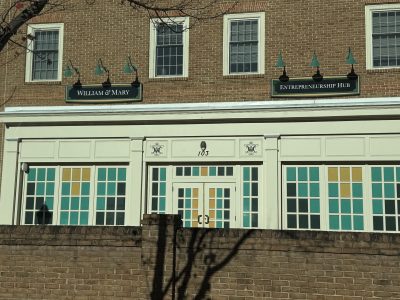
WILLIAMSBURG — What began as a small initiative inside William & Mary’s business school has grown into a cross-campus resource and regional center for innovation, thanks to the vision behind the university’s Entrepreneurship Hub.
Graham Henshaw, Executive Director of the center, said, “We definitely would like more people to know that we are a resource.”
The Hub, located along Richmond Road, has become a collaborative space where students, faculty, and local entrepreneurs can connect through programs, mentorship, and workshops. But its origins stretch back nearly a decade.
“I joined William & Mary full-time in 2015,” Henshaw said. “At that time, we were an initiative embedded within the business school … There wasn’t any physical location whatsoever … The joke was, if you can find us, we’re happy to help you.”
Back then, the center served only MBA students. Henshaw was brought in with a charge to grow entrepreneurship across the university.
“What we observed was that it was happening all across the campus,” he said. “There were pockets of entrepreneurial activity everywhere, but there was no density of activity in one place.”
To address that, he campaigned for a permanent space and redefined the center’s mission.
Henshaw said, “we made our mission to be about equipping people with the skills and mindset that entrepreneurs have, so that they could then apply that toolkit on whatever it is they were working on that they cared about.”
That broader focus opened the door to a larger audience.
“We’re not saying that the only manifestation of entrepreneurial thinking should be a startup,” he said. “You can be a journalist and apply the principles of entrepreneurial thinking. You can be a teacher and apply the principles of entrepreneurial thinking.”
Support from William & Mary President Katherine Rowe, herself an entrepreneur, helped expand the center’s reach.
“She became a huge champion of what we were doing,” Henshaw said. “What we’ve become is thanks in large part to a president who is our biggest cheerleader, our biggest supporter and advocate to spread this across campus.”
The Hub’s collaboration with the Launchpad Incubator, a regional business accelerator supported by Williamsburg, James City County, and York County, further strengthened its community connection.
“What if we co-locate?” Henshaw recalled asking. “What if we have the Launchpad embedded as a cornerstone program within the Entrepreneurship Hub’s offerings? And they loved it.”
That partnership has become a cornerstone of the Hub’s identity.
“These scrappy young ventures like Mike’s company need access to raw talent and capable talent,” Henshaw said. “And likewise, students, the best thing a student can do to gain entrepreneurial exposure is to work at a startup.”
The result is a collaborative environment where “collisions” between students and entrepreneurs happen daily.
“On any given day, you’ll find a mix of students and entrepreneurs in that space,” Henshaw said. “We wanted to create an environment where those collisions would happen around the coffee maker in the kitchen. And we’ve seen so many internships come from that sort of joint partnership.”
The Hub’s programming follows a three-part model: learn, engage, build.
“We want people fundamentally to learn the language and the toolkit of entrepreneurial thinking,” Henshaw said. “Engage is about building an entrepreneurial community. And is about building the capacity to use the tools and the skills.”
Community members can take advantage of micro-courses, guest speaker events, and a Venture Acceleration Program designed for regional entrepreneurs.
“We pull cohorts of entrepreneurs together to go through this rigorous six-week program,” Henshaw said. “They should accelerate their venture from where they came in on week one to where they leave on week six.”
Today, the Hub connects students from more than 45 majors with local businesses, startups, and nonprofit organizations.
“It’s stronger because we have this diverse audience that each bring something unique to the table,” Henshaw said. “You have a psychology student who’s learning the ins and outs of psychology, but now they’re also learning an entrepreneurial toolkit that’s going to help them see the world through a different lens.”
For Henshaw, that cross-disciplinary collaboration is what makes the Hub thrive.
“We have really smart entrepreneurial students at the Hub that come from all different kinds of backgrounds,” he said. “And that’s where we have a little bit of an amplifier effect because of that diversity.”
For more information, visit wm.edu/offices/entrepreneurship.

