


 With tuition and fees increasing annually at many schools, some legislators in Virginia are trying to put a cap on how much public universities can charge for athletic fees.
Del. Kirk Cox (R-66), a Republican from suburban Richmond and the House majority leader, sponsored House Bill 1897, which aims to limit how much funding for university athletic departments could come from student fees.
The limits would be based on the university’s level of competition in National Collegiate Athletic Association play.
Universities playing in the “Power Five” conferences at the Football Bowl Subdivision level – formerly I-A – would be limited to 20 percent of their total budgets coming from student fees. FBS schools in non-Power Five conferences would be capped at 55 percent, while universities competing in the Football Championship Subdivision – formerly I-AA – would be limited to 70 percent of their athletic budgets coming from student fees.
Jeff Smith, a specialist in the cost of college sports at the University of South Carolina Upstate, calculated the total athletic subsidy provided by Virginia’s public university students at more than $140 million for 2010-11, the most recent year for data. That figure was second nationally, trailing only California’s total of about $169 million.
Adjusted for population, Smith said Virginia was the worst state in the country for subsidizing intercollegiate athletics with student fee dollars.
Cox said the purpose of the bill is not to hamstring intercollegiate athletics, but to keep the cost of attending Virginia’s public colleges and universities down.
“I’m a 30-year retired public school teacher, and I’ve done a lot of coaching, so I obviously think sports play a big role,” he said. “I really felt like student fees as a percentage of college costs had gotten out of control.”
Cox said his bill would encourage universities to increase athletic revenue from non-fee sources, like ticket sales, and make it difficult to raise athletic fees to provide quick boosts in funds.
A provision in the bill requires universities that raise their athletic fees to boost revenue from all other sources by a proportional amount over a five-year average, keeping the fee-to-total budget ratio essentially unchanged.
“It’s fair in that, if you have one year in which you have to go up on student fees, then it gives you a little bit of time to get [up] the generated revenue,” Cox said. “Obviously, we wanted to make sure we weren’t creating the opportunity to raise student fees dramatically.”
The bill was approved by the House of Delegates and state Senate, and is currently awaiting action by Gov. Terry McAuliffe. Should McAuliffe sign it, the limits would come into effect July 1, 2016.
If H.B. 1897 becomes law, the effects of its funding thresholds on Virginia’s public universities would not be uniform.
The University of Virginia and Virginia Tech – each members of the FBS-Atlantic Coast Conference – are both under the 20 percent threshold established by the bill for FBS schools.
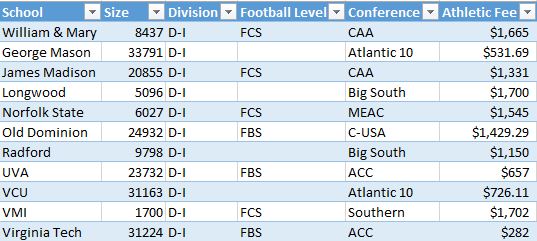 Schools in the Power Five conferences, like the ACC, typically have lower athletic fees than FBS schools in other conferences and universities in lower divisions.
Those schools make up for levying lower athletic fees by spreading the fee among larger student bodies. Both U.Va. and Virginia Tech have more than 23,000 students.
They also benefit from higher game attendance figures, meaning more tickets are sold, and higher contributions from their conferences through revenue sharing agreements and lucrative television contracts. In 2014, each of the 14 universities in the Southeastern Conference received an average of payout of $20.9 million from such agreements.
With 65 percent of its $41.1 million athletic budget coming from athletic fees, Old Dominion University – a member of non-Power Five Conference USA – would have to cut the subsidy provided by its athletic fees by more than $4 million to reach the 55 percent limit set by the bill.
ODU transitioned from FCS to FBS football in 2014, but other universities would find it harder to make a similar move under H.B. 1897. The bill requires schools considering adding a major sport or changing division levels to submit a plan for the change to a state Intercollegiate Athletics Review Commission, followed by approval from the General Assembly.
James Madison University, a member of the FCS-Colonial Athletic Association, would also have to reduce its reliance on student athletic fees to be compliant with the bill’s 70 percent threshold, as nearly 77 percent of its $43.8 million athletic budget comes from fees.
William & Mary also competes in the CAA, but the percent of its athletic budget coming from its annual athletic fee is not near the limit established by the legislation. Fifty percent of its $23.7 million athletic budget – about $11.7 million – comes from athletic fees.
As it is currently constructed, Cox’s bill would not reduce the cost of attendance at William & Mary, as the school would not currently run afoul of the bill’s threshold for FCS programs.
 The college levies an annual athletic fee of $1,665 for all full-time enrolled students, in-state and out-of-state, undergraduate and graduate. That fee is the fourth-highest among Virginia’s public universities, behind only the FCS Virginia Military Institute’s $1,702 fee, Longwood University’s $1,700 and the Division II University of Virginia at Wise’s $1,676.
Over four years, that fee at William & Mary totals $6,660, and represents 9.4 percent of annual tuition and fees for in-state undergraduates, and 4.2 percent for out-of-state undergraduates for the 2014-15 academic year.
University spokesman Brian Whitson said maintaining a competitive athletic program requires a substantial investment of resources, and William & Mary tries to limit the amount of athletic funding coming from students. He said the college’s Board of Visitors’ target for student funding of the program is 50 percent of the program’s budget.
“When you want to have a successful athletics program — and you don’t have the type of TV contracts that come with the major conferences — you have to make decisions on how to fund it,” Whitson said in an email. “For William & Mary, student fees is one part of that funding but there are others — ticket sales, auxiliary services and private donations.”
