


Parking fines are about to get more expensive in the City of Williamsburg.
City Council voted unanimously Thursday to amend the fine schedule for parking violations. In an effort to make more parking spots available during peak times of the day, repeat offenders will now have to pay larger fines as they rack up parking tickets.
Interim City Manager Andrew Trivette presented the proposed changes to City Council before their vote. He cited a parking study which found the city does not have a parking shortage, with more than 4,300 spots in the downtown area.
However, problems arise from a lack of turnover in the most sought after parking areas. Increasing the cost of fines, he said, will have the effect of dissuading people from violating the city’s parking laws.
“It’s all about turnover of vehicles in spaces where people want to be,” Vice Mayor Doug Pons said. “There’s cars that stay too long because they can get away with it. Increasing the fines I think will be that detriment to the folks who park there and take advantage of it. ”
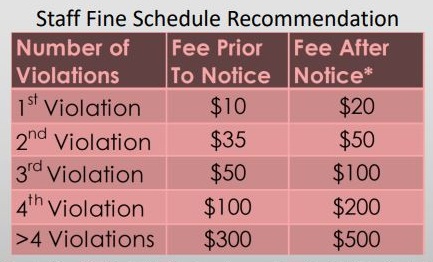
The fine for first-time violators will remain $10, and the fine for third and fourth-time violations will remain $50 and $100, respectively. The fine for second-time violations will increase by $5 to $35.
However, fines for violations in excess of four in a single year will jump from $100 to $300.
Repeat violations will reset to zero at the end of each calendar year.
Fees will also increase greatly when paid late, after the 14-day window — after a ticket is issued.
The changes come as phase one of the implementation plan for the 2016 Downtown Parking Study, which aims to ease the “perception” of a shortage of parking spots near popular destinations downtown.
The city added three new parking officers a year ago as part of the first phase of the implementation, and is buying and installing sensors on parking spots to gain additional data on where residents and tourists park.

