



1776 was a big year in American history.
The United States declared independence from Britain. Patrick Henry became the first governor of Virginia. Thomas Jefferson invented the swivel chair.
The College of William & Mary also became the “birthplace of the American college fraternity” with the organization of the Phi Beta Kappa Society.
Now, 214 years later, the college boasts 32 Greek organizations, including multicultural groups and historically African American organizations.
While its Greek community may be as old as the United States itself, William & Mary is not immune to an issue that many other schools also face: Hazing.
While sororities, fraternities and many colleges such as William & Mary have anti-hazing policies, some hazing – like forced eating and social isolation within Hermandad de Sigma Iota Alpha, Inc. (SIA) this fall – slips through the cracks.
On Nov. 22, SIA, a service-based sorority, was suspended as a student organization for violating the college’s hazing policy.
School officials say members forced new members to eat food, socially isolated them and limited their contact with non-members.
Before SIA’s suspension this fall, the most recent Greek organization to be suspended for hazing was the Epsilon Alpha chapter of the fraternity Lambda Chi Alpha in 2013, according to college spokeswoman Suzanne Seurattan.
Hazing across the country
William & Mary, like many colleges and universities, has been the location of hazing.
Just in November, a fraternity and sorority at the University of West Florida were suspended for hazing. Ohio State University canceled all Greek life activities amid hazing allegations, and Texas State University suspended recruiting events when a 20-year-old transfer student died after a Phi Kappa Psi event.
As hazing at fraternities and sororities created a ripple effect across the country this November, SIA became the second William & Mary organization to be suspended for hazing since 2013.
In 2013, William & Mary’s student newspaper, the Flat Hat, reported Lambda Chi Alpha was suspended following hazing involving alcohol. The month-long investigation resulted in the fraternity’s suspension until spring 2018.
Like SIA, Lambda Chi Alpha lost its privileges and is no longer considered a student organization.
“William & Mary’s policies and the work of its Hazing Prevention Coalition emphasize that hazing has no place in our university life, either on or off campus,” Seurattan said.
Just before Lambda Chi Alpha was suspended, the Fraternity & Sorority Coalition visited William & Mary, finding two “significant” hazing investigations were underway, the coalition’s report states.
The April 2013 report states the college president was “very disturbed” by the hazing behavior, and wanted to address “any and all” hazing issues among Greek life organizations.
Anti-hazing policies and protecting students
Despite complaints of hazing each semester, Assistant Director of Student Leadership Development Joe Wheeless said fraternities and sororities at William & Mary all have anti-hazing policies in place.
“While there might be specific wording that is different, all of them are essentially the same,” he said.
SIA’s national chapter has an anti-hazing policy in place, which is listed on their website and states the organization “does not tolerate hazing of any kind.”

Wheeless said hazing is not limited to fraternities and sororities – it can occur in any member-based organization – but the college receives about five anonymous hazing complaints within the Greek community each semester.
William & Mary organized the Hazing Prevention Coalition in 2010, which spreads the word about interrupting or reporting hazing behavior and activities, according to Anne Arseneau, director of Student Leadership Development.
Greek organizations are mostly self-governing, but must comply with college policy when applicable, Seurattan said.
But their control can only go so far.
College administration investigations or “check-ins” with Greek organizations are typically only sparked by a complaint or report of hazing.
The health of William & Mary’s fraternities and sororities
While hazing is an issue that surfaces occasionally at William & Mary, the Fraternity & Sorority Coalition found other issues involving alcohol use in 2013.
In the fall 2017 semester, another William & Mary Greek organization, Pi Kappa Alpha, was sanctioned.
Known as PiKA, the fraternity lost privileges to its fraternity house on campus and must remain on good behavior to regain those privileges.
PiKA failed to comply with sanctions stemming from a Vietnam War-themed party during the spring 2017 semester. PiKA was sanctioned for having open alcohol at the party, and the Asian American Student Initiative released a petition that condemned the party and for its “culturally insensitive” decorations and the Vietnam theme.
In February 2012, five of 10 William & Mary sororities were on “high alert” or probation with their national organization, the report said.
In 2013, William & Mary Police said the fraternity and sorority community had a “far higher” rate of alcohol-related calls per capita, according to the coalition’s report.
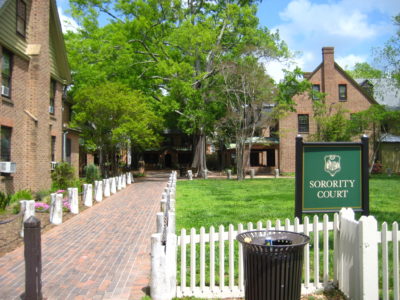
One Greek council, which governs 10 of William & Mary’s fraternities and sororities, told the coalition in 2013 that drinking is “overwhelmingly” a part of their community.
The report continued: “… although [the council leaders] are uncomfortable with the College’s recent … findings, they indicated most fraternity/sorority chapters do not change their behavior even after being sanctioned for a violation.”
Off-campus accountability
Both the college and national fraternity and sorority organizations have measures in place to hold members accountable for their actions, but incidents at off-campus housing or facilities can slip through the cracks.
The 2013 report states many chapters did not regularly hold their members accountable for off-campus incidents.
Further, campus police told the coalition most documented violations occurred off-campus, including finding students passed out after returning from an off-campus fraternity.
Before its suspension, SIA did not live in William & Mary sorority/fraternity housing, Seurattan said.
Although SIA has been sanctioned for hazing its members, the Williamsburg Police Department “has had no known interaction with the Sigma Iota Alpha sorority chapter at William and Mary or its members,” according to department spokesman Maj. Greg Riley.
The report states “Students desire the ability to create their own policies and procedures, but without accountability among peers or from administrators.”
WYDaily reached out to a founding member of the SIA chapter at William & Mary’s and SIA’s national chapter, neither of which responded by publication time.
Send tips to [email protected].

