


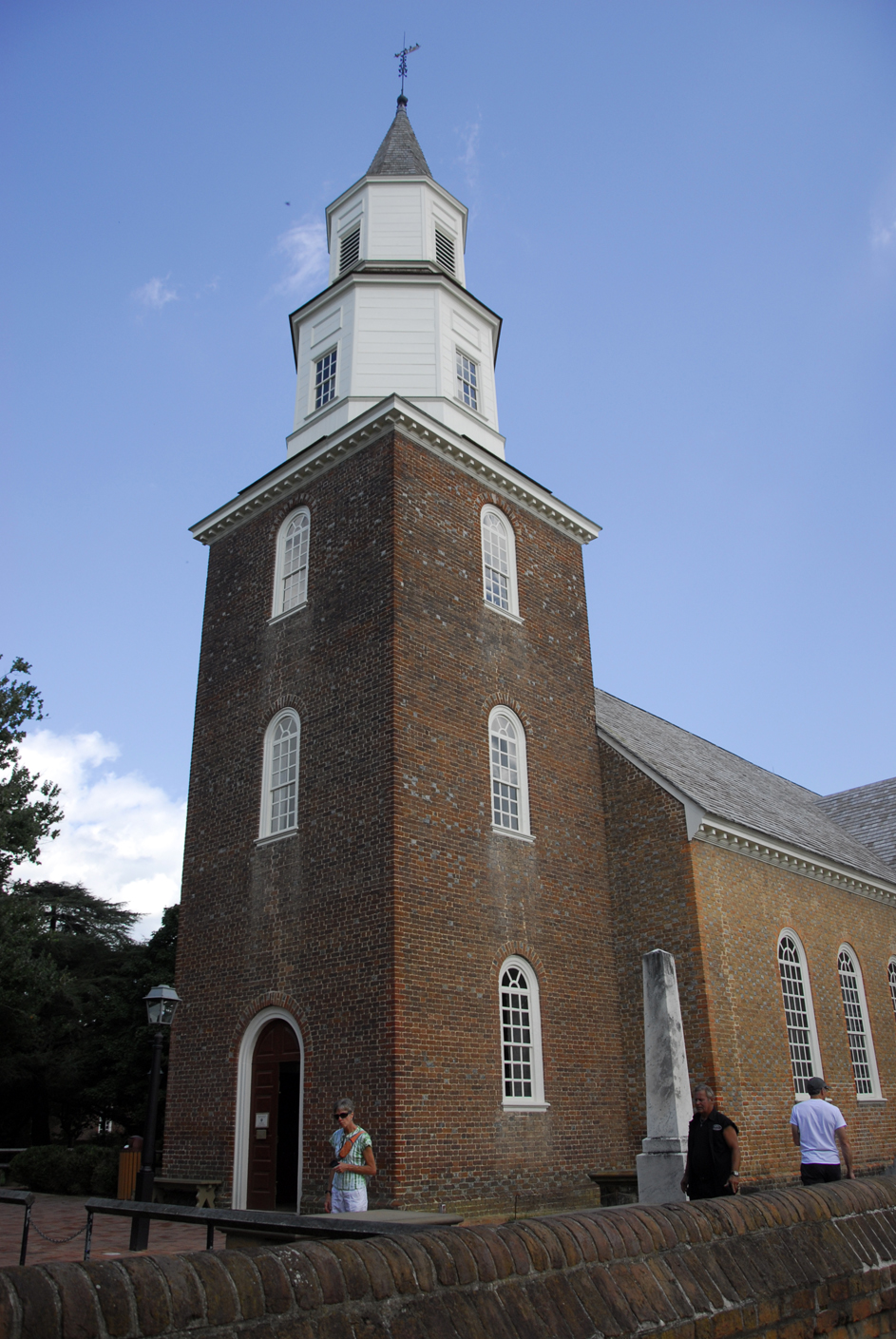
When parishioners gather Sunday at Bruton Parish Church, they will get the chance to hear from a special visitor, whom some will remember as having delivered the televised sermon at the 2011 wedding of Prince William and Catherine Middleton.
The appearance by the 132nd Bishop of London, Richard Chartres, is the latest in a slew of events the parish is holding to celebrate the 300th anniversary of its current building. The festivities will run through next year.
Chartres will preach at four services Sunday and will also present a forum on the history and present-day status of the international association that binds the Church of England to other churches, including the American Episcopal Church, of which Bruton Parish is a member.
Bruton Parish has been a Williamsburg institution since the Union Jack hung over the Governor’s Palace and the Capitol building. In those days, the Bishop of London had oversight of church operations in the colonies.
“He’s a historian who can speak intelligently about the relationship between his office and the colonial church,” Rev. Christopher L. Epperson, the 35th rector of Bruton Parish, said of Chartres. “This isn’t about looking at the past for the sake of nostalgia. This is about looking at our history and the past to consider our identity as the people of God in this place and what that means for our future.”
Bruton Parish currently has about 2,000 members, along with an outreach group for the many people who visit the church while visiting Williamsburg and then decide they want to keep in contact. That group, the Friends of Bruton, has about 1,000 members.
The church’s footprint in the Historic Triangle is broad. Along with offering church services, it participates in numerous charitable endeavors.
For example, the church is responsible for funding a Habitat for Humanity house currently under construction in James City County. It is a participant in the Community of Faith Mission, when it opens its doors for a week during the cold months to provide the homeless a warm place to sleep.
It works with Avalon: A Center for Women and Children and the United Way of Greater Williamsburg. The church also does work in teaching English as a second language and helps with outreach in Grove, where its members participate in several services, including a weekly distribution of food.
“Bruton Parish has always been ready to adapt to meet the needs of people in every era,” Epperson said. “It’s a living, dynamic organization, and that’s why it’s enjoyed a long life. I credit it to the people of Bruton Parish who time and time again ask what it means to be faithful in our time.”
Epperson said membership has been growing in recent years, especially among young families. He credits the growth to being able to offer both a large children’s program and a more traditional church experience.
“Children and families find that attractive,” he said. “Our relatively traditional worship and tone is authentic. I’m not criticizing churches with a rock band, but it would be silly for us. It’s not who we are.”
Bruton Parish Through the Centuries
Bruton Parish began in 1674 when two existing congregations merged and selected a name to honor the prominent Ludwell family, which had its ancestral homes in Bruton in County Somerset, England. A small brick church was built for this congregation, but after the founding of the College of William & Mary in 1693 and the creation of Williamsburg as Virginia’s colonial capital in 1699, that building was too small to handle the surge of parishioners.
At the time, the Church of England was established by law as the only legal religion in colonial Virginia. That meant the influx of population — everyone was required to attend church services — needed a place to go worship, according to Anne Conkling, a longtime member of the church who does historical interpretation work.
Conversations began in the beginning of the 18th century about a new building, culminating with the construction of the present day Bruton Parish Church in 1715.
During the last decades of British rule, the church became the go-to place for William & Mary students and members of the General Assembly and governor’s office. When the legislators were in town for a session, luminaries including Thomas Jefferson, George Washington and Patrick Henry worshiped at Bruton Parish Church. Other historical figures from the era who attended service at the church include George Wythe and Thomas Nelson, Conkling said.
But by the time the Revolutionary War had ended, the church suffered a series of blows. Until 1776, when the General Assembly ended tax support for the church, taxes were collected and disbursed to the church to both fund its operations and pay for a range of social welfare services that in present day are handled by the government.
Bruton Parish was at the time a member of the Church of England, which alienated those loyal to the independence movement. Prior to the revolution, other sects of Christianity, like the Baptists, Presbyterians and Quakers, were strictly regulated and not allowed to have a church or meet without a license. Once the revolution began, those religions flourished while the British Church of English waned, Conkling said.
In 1780, Richmond became the state capital, costing Bruton Parish the bulk of its members. The church fell into several decades of low membership while the building was in disrepair.
“It went from being the only show in town with everyone required to come and required to pay to having very few members,” Conkling said. “By 1811, we had less than 25 members, and they were little old ladies that kept it going with bake sales and picnics.”
By 1840, the church had been completely remodeled, with a large wall installed in the middle to create space for Sunday School classes. The organ was sold to raise money, the altar was moved to the western end of the church and the tower became a coal bin. This version of the church, which had less than 100 members, bore little resemblance to the colonial version or the present-day version.
During the Civil War, the church served as a Confederate field hospital. Then Rev. Thomas M. Ambler tried to substitute a prayer for the president of the United States with a prayer for the governor of Virginia, but Union forces in the area forbade the move. Ambler began holding service at his home.
Restoration of the church began in earnest in the first decade of the 20th century, when the partition was removed and a new organ was added. In 1907, during the 300th anniversary of the founding of Jamestown, King Edward VII presented a large Bible and President Theodore Roosevelt donated a bronze lectern to hold it.
The reverend, W.A.R. Goodwin, had plans for more than just the church. Since his arrival in Williamsburg from seminary school, he wanted to restore the city to its colonial heyday, Conkling said. He met John D. Rockefeller at a dinner party, and during a later visit, walked with the oil giant around the city and shared his dreams of creating what is now Colonial Williamsburg. A substantial investment from Rockefeller followed, and the living history museum was brought to life.
Membership climbed after 1940 as the church grew into the institution it is today. Presidents Lyndon B. Johnson and Ronald Reagan have attended service at Bruton Parish, while Christmas and Easter have been televised nationally.
At present, the congregation has about 2,000 members.
