


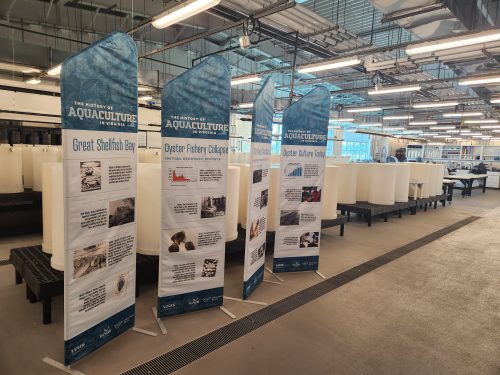
GLOUCESTER POINT — The market for farmed shellfish in Virginia has grown dramatically in the past five years, according to the latest industry report from William & Mary’s Batten School of Coastal & Marine Sciences & VIMS, whose research and support have played an important role in the growth of Virginia’s Aquaculture Industry.
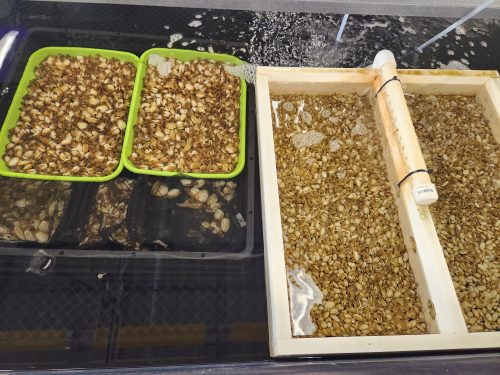
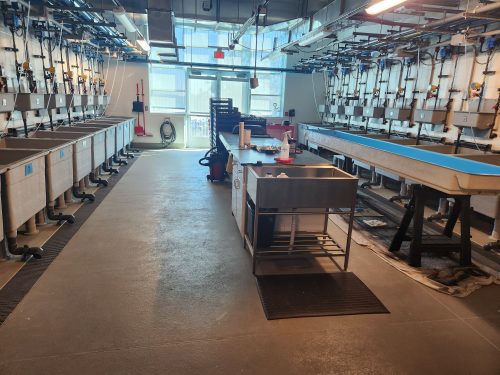
Shellfish aquaculture is the farming of shellfish like oysters and clams for food, and the Acuff Centre for Aquaculture — home to the Marine Science school’s shellfish aquaculture spawning — is one of the primary facilities used by VIMS, as well as industry members and collaborators.
VIMS gives credit to the industry for the boom — those who actually raise the shellfish — while comparing the role it plays as comparable to a trainer for an athlete, researching the issues and concerns the industry brings to it.
“We’re there to make sure that the industry can perform the best that it can,” said Professor Bill Walton, Shellfish Aquaculture Program coordinator.
Shellfish Aquaculture in Virginia specifically refers to oysters and clams. Aquaculture farming of shellfish differs from that of a fishery in that it isn’t about simply going to a commercial fishing location to obtain shellfish. In aquaculture, a party leases an area to work, and the shellfish are raised in the water and harvested when they reach maturity. This makes it non-fed aquaculture, as producers don’t need to feed their stock since they are raised in open water.
Walton explains it would be impossible to grow enough food to support shellfish such as oysters and clams, and that is why they are grown in natural bodies of water. As such, he said this form of aquaculture is less intensive than other forms, such as Salmon on Tilapia.
The Acuff Centre spawns shellfish for research and educational purposes. VIMS, however, also has a breeding program to help consistently provide a genetically improved animal through selective breeding, something done in tandem with the industry’s own breeding.
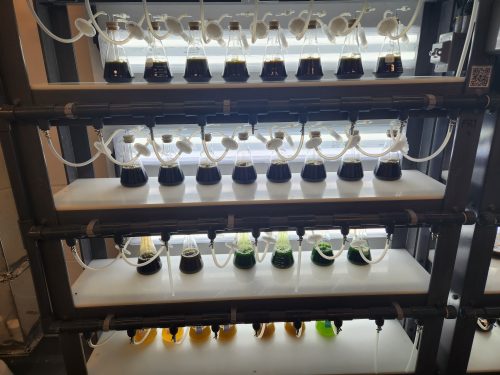
In addition to certain species of clams and oysters, Acuff also houses an algae growing area, where 11 different strains of algae are grown not only for food for the larvae at the facility during spawning season, but also for research. Currently, Walton says there is a lot of research being done on densities and how the variety of food affects shellfish. He adds there is also interest in new diets that could be used to improve larval performance.
Another project that the facility is working on is growing shellfish such as mussels to help populate polluted waters, as mussels are not as tempting to eat as oysters, and thus do not create an attractive nuisance.
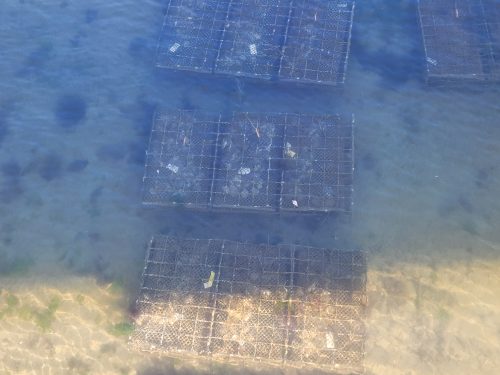
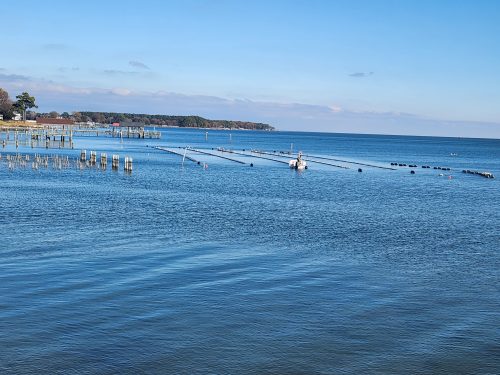
Oyster aquaculture drives increase in sales
Direct farm sales for shellfish aquaculture in Virginia in 2024 totalled $81 million, a 52% increase from the $53 million total sales in 2018, according to the MAP report. Farmed oysters drove most of this growth by more than doubling in sales in this timeframe, with hard clam sales remaining steady as the backbone of the market.
Kim Huskey, VP of Government Affairs for Cherrystone Aqua Farms, applauded the return of the MAP report and said she especially appreciated the infographic Hudson and Marine Business Specialist Shelby White created.
“It reinforces our key points with data and ensures that Virginia’s shellfish industries issues are communicated accurately,” Huskey said. “It also serves as a lasting reference for legislators and their staff, helping them recall details after the meeting and lending weight to our position as they consider policy decisions.”
These sales numbers make Virginia a national leader in both hard clam and eastern oyster production, according to the Batten School & VIMS. The continued expansion of hatcheries, which supply growers in-state and elsewhere with seed, has also given the industry a boost, with sales in hatchery products nearly doubling pre-pandemic numbers.
Challenges and opportunities for Virginia shellfish farmers
Finding local employees, however, was the top challenge listed by surveyed farmers, an issue common across American aquaculture, according to the Batten School & VIMS. Other highly-ranked challenges included operating costs, market availability and coastal hazards.
This ranking of problems faced by shellfish aquaculturists give MAP researchers and extension agents a starting point for where to come up with systemic solutions to help farmers surmount industry-wide challenges, it adds.
The Batten School & VIMS said the industry report is part of the broader work happening at the school that make Virginia a national leader in shellfish aquaculture. From pioneering disease-resistant oysters to offering a new graduate subconcentration in shellfish aquaculture, they offer technical guidance, training, and policy expertise to growers and communities statewide.
Now that the report is resuming its normal annual publishing schedule, Hudson hopes to produce the next iteration even faster, the school said. Her goal is to release it in time for the next General Assembly session, so that decision makers remain informed about developments and trends within Virginia’s exciting aquaculture industry.
Visit William & Mary’s ScholarWorks to view the full report.

