



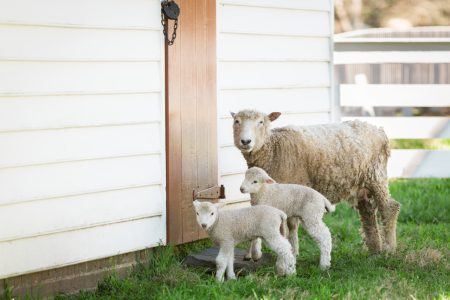
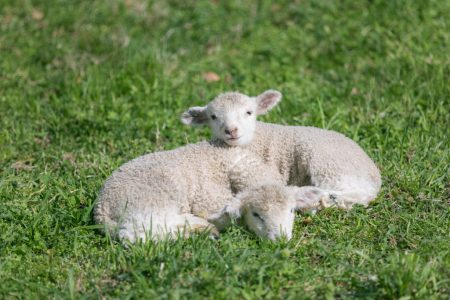
WILLIAMSBURG— Spring has sprung in the Historic Triangle and with that comes the return of the baby lambs at Colonial Williamsburg.
Darin Durham, Manager of Animal Husbandry for the Colonial Williamsburg Foundation, sat down with WYDaily to share more about its rare breed program and the 2026 baby lambs.
The rare breed program started in the 1980s as a way to protect some of the dying breeds, especially those that have ties to the Colonial Williamsburg area.
The sheep at the site are a Leicester Longwool breed. The breed was originally located in Leicester, England and was initially developed in 1740 by a famous geneticist at the time. The sheep are known to be dual purpose, providing both meat and wool. During the 1700s, England controlled much of the wool industry and because the country did not want to create any competition, the King of England made it a rule that the particular breed of sheep were not allowed to be taken from England.
Durham also shared that the Leicester Longwool are the first breed in history that was held to a breed standard.
“The sheep were always held to a high standard, but this particular breed of sheep had to meet certain quality standards to be considered a Leicester Longwool,” Durham explained.
In 1990, when the first sheep arrived in Colonial Williamsburg, the team brought them in from Tasmania. While they could have gone to England, at the time, the country was going through a rough patch of Hoof and Mouth disease.
“The team at CW worked a lot with the Livestock Conservancy group. They try to keep a log of how many of these breeds are in America. At the time, when we got the Leicesters, there were none here. Now there are between 2500-3500,” Durham shared.
The babies get rotated around Colonial Williamsburg but can often be found in pastures on Waller Street behind the Blue Bell Tavern, the corner of Francis and Colonial Street, the Prentice Pasture behind the Governor’s Palace gardens, near the Saint George Tucker House on Nicholson Street, and beside the Native American Encampment on Nicholson Street.
The lambs are raised in the colonial area and are mainly used for their wool. The sheep are sheared once a year, while the babies are sheared twice a year.
“When a lamb is born, the first growth of that wool is going to be the highest quality,” Durham explained.
Durham also explained why the baby lambs draw so much attention.
“I think it’s mainly the cuteness factor. It’s spring and everybody has the winter blues after the cold and icy winter we had. The flowers are out, the tulips are out, and the little lambs are out and everybody loves that,” Durham said.
More baby lambs will be making their appearances in the historic district throughout the remainder of March and April.
To learn more about the Leicester Longwool, visit colonialwilliamsburg.org/discover/preserving-the-past/rare-breeds.