


NORFOLK — There’s a lot of talk in Hampton Roads about tunnels. Thousands of people drive through four in the area every day. A lot of conversation is centered around the time it takes to get one from end to the other — but, there’s another question out there.
What health risks are posed by exposure to the air in the tunnels?
It’s no secret that automobile emissions have had a major impact on the environment,
specifically relating to global warming. But what about these emissions and their possible impact on human health, especially in an enclosed space such as one of the many tunnels drivers in Hampton Roads travel through daily?
After all, even a short list of the things that come out of a car’s tailpipe can impact one’s health: hydrocarbons, carbon monoxide (CO), Nitrogen oxide (NO), Nitrogen dioxide (NO 2), Sulfur oxide (SOx ), and Sulfur dioxide (SO 2 ), just to name a few. When you add to that list specific volatile organic compounds (VOCs) and particulate matter — much of which is toxic and known to cause respiratory disease and cancer — even the most unconcerned souls should take heed.
So what kind of air quality monitoring is being done in area tunnels and what might
drivers need to know to protect their health?

Four main tunnels
There are four main tunnels in the area. Two, the Hampton Roads Bridge Tunnel (HRBT)
and Monitor-Merrimac Memorial Bridge Tunnel (MMMBT), are maintained by the Virginia
Department of Transportation (VDOT); and two, the Downtown and Midtown tunnels, by
Elizabeth River Crossings (ERC).
All in all, the length in both directions of the tunnels isn’t especially staggering, probably
around eight miles or so combined. But add in the fact that hundreds of thousands of cars speed — or crawl — through the tunnels every day, and that during rush hour the time spent in these enclosed underground chambers increases the risk of human exposure to the tunnel air can increase as well.
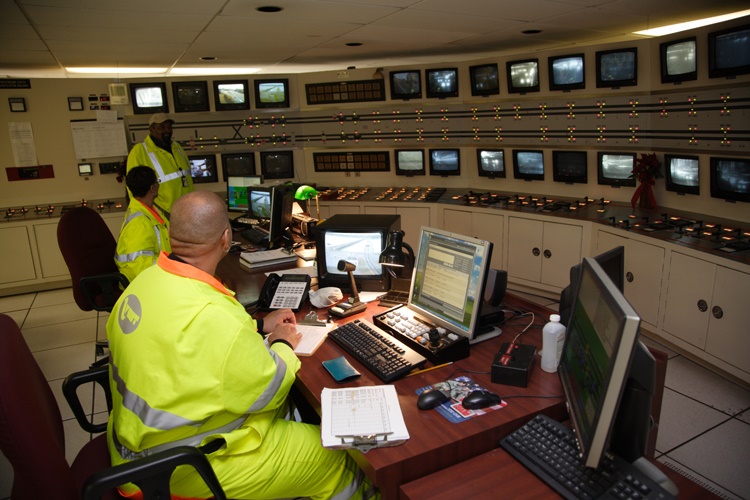
VDOT Communications Manager Paula Miller said that there are three CO sensors in each of the tunnel bores, and these sensors are monitored in control rooms.
The turbidity, or smoke and dust in the air, is also tracked on Closed Circuit TV cameras.
“The CO levels in the tunnels now run between three to 20 PPM (parts-per-million),
which is well in the ‘safe’ zone according to EPA standards,” she said, adding that the
Environmental Protection Agency states a person can be exposed to 35 PPM for one hour and still be considered safe and in the normal range.
However, she said, “There is a level and a time element when considering exposure to
CO. The average travel time a motorist is exposed to the tunnel environment is one to two
minutes depending on traffic flow.”
The CO display being monitored in the control room has an alarm, and if the parts-per-
million go above 35-40, control room personnel will activate additional ventilation fans in order to bring the CO levels down.
“Over the years,” Miller said, “with the refined computerized ignition systems in
automobiles, the CO output of vehicles has been greatly reduced and CO levels and smoke is no longer an issue. It is rare that a CO alarm is activated requiring more ventilation.”
During peak traffic periods motorists may notice exhaust fumes in the tunnels, but that’s
not necessarily an indicator of dangerous gas levels that might present a health hazard.
Downtown and Midtown Elizabeth River Crossings, which manages the nearly three miles of underground passages that make up the Midtown and Downtown tunnels, uses a series of Air Quality Sensors in each tunnel, which measures and monitor carbon monoxide, nitric oxide, and nitrogen dioxide levels.
The sensors, said Carley Dodson, Communications Manager for ERC, can also detect
smoke and decreased visibility.
“Normal traffic flow moves air out of the tunnel. If necessary, the jet fans come on and
remain on until acceptable levels are met.”
Evening rush hour, especially during the summer months when it is hot and humid, can
lead to higher levels of certain contaminants.
Dodson also said that air quality conditions in the tunnel seldom make work risky for
ERC staff, but that if necessary respiratory devices can be used — or work will simply stop until conditions improve. Any health risk to drivers is “very minimal.” She recommends that while it is not necessary, it is advisable to keep car windows rolled up when traversing the tunnels.
Health Tips
What kind of health risks do automobile emissions pose? Janice Nolen, assistant vice president of national policy for the American Lung Association, said the fuels that cars and trucks burn are much cleaner than they once were.
“But even with those changes, harmful emissions from tailpipes include nitrogen oxides,
sulfur dioxide, carbon monoxide, and volatile organic compounds, including benzene, 1, 3-butadiene and others,” Nolen said. “Some heavy duty diesel trucks (18-wheelers) that are much older and dirtier remain on the road as well.”
Nolan explained that nitrogen oxides and sulfur dioxide can worsen asthma, increase
coughing and wheezing, and increase the risk of hospital admissions. Carbon monoxide can cause headaches, dizziness, confusion, and at higher levels, nausea, loss of consciousness and premature death.
VOCs, she added, have a range of health harms that include coughing, wheezing, and
irritation to the eyes, while some, like benzene, may cause cancer with long exposure. Diesel emissions also include a higher amount of particle pollution, which can trigger
asthma, cause heart attacks and increase the risk of premature death and lung cancer.
“Tunnels can make it harder for these emissions and pollutants to escape, so some
researchers look at them (tunnels) as good places to study and to better understand vehicle emissions,” Nolan said. “They aren’t the only places, however; for example, studies have found that people who live within 300 to 500 meters of a busy highway can be exposed to much higher concentrations of tailpipe emissions.”
People who drive on busy highways regularly, including police, bus drivers and truck
drivers can be exposed to similar emissions, she added.
For drivers though there are just a few things that can help lower the risk of exposure to
emissions.
“Travel during less crowded times,” Nolan said. “And when you are in the tunnel, keep
your windows rolled up and your ventilation set to recirculate the interior air.”
For additional information about automobile emissions and their potential health effects,
visit the American Lung Association online.

