


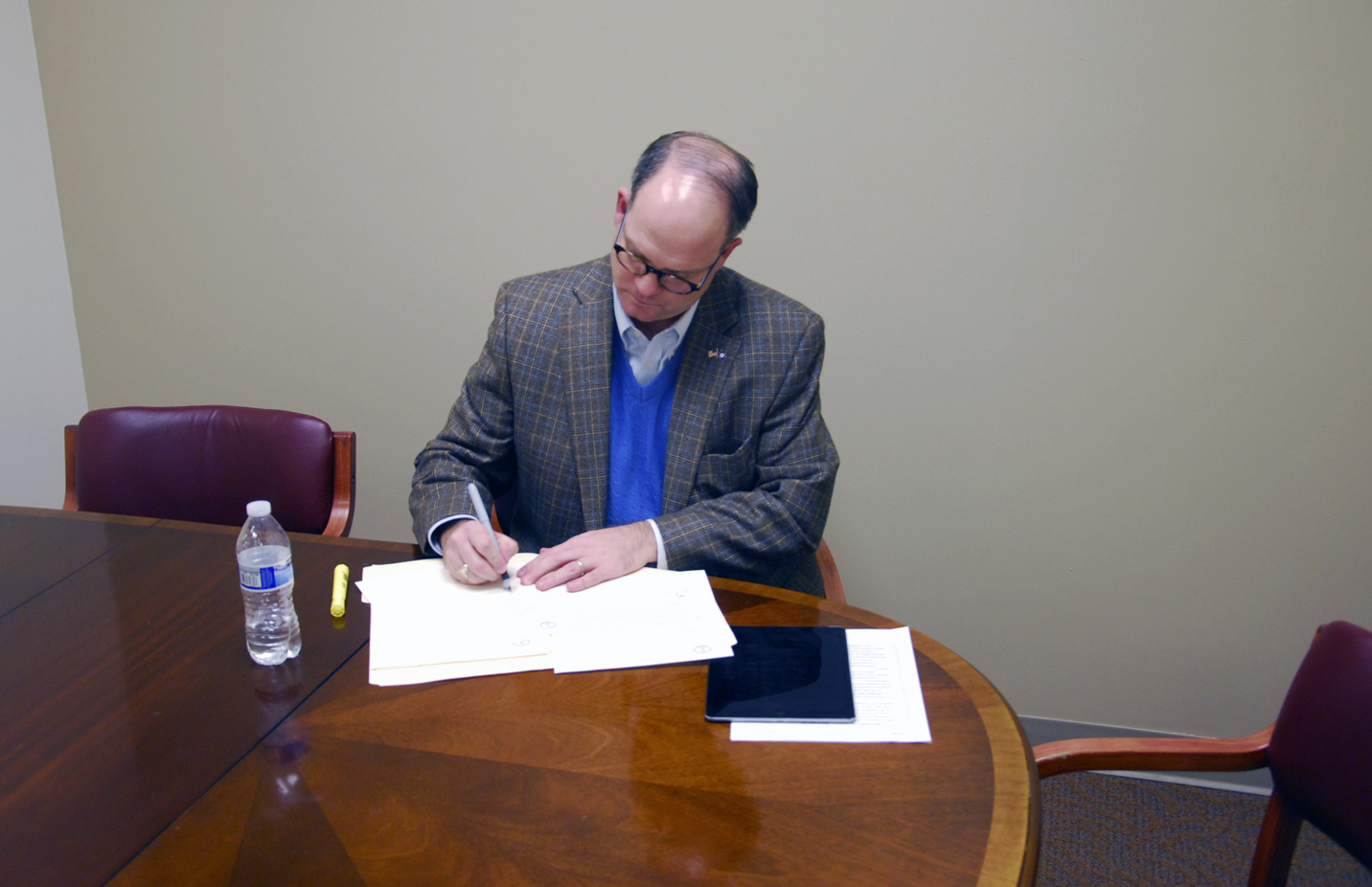
Many of the major bills Del. Monty Mason (D-93) introduced during the 2014 General Assembly session were not passed, but that did not mean his goals did not come to fruition.
Reforms he sought in mental health services — like the creation of an electronic bed registry and the extension of emergency detention orders — and in education emerged from Richmond with the governor’s signature but with the names of other legislators listed as the sponsors.
“When you’re in the minority, especially as a freshman, you walk in knowing you have little chance of getting some of your legislation passed,” said Mason, who served his first term last session. “So you immediately look for partners.”
And that is what he did. He said he built numerous partnerships with other freshman legislators in the House of Delegates to hammer out legislation important to him.
“You can get a lot done if you don’t care whose name is on the top of the paper,” he said. “It’s more important to have good public policy passed than to have your bill signed in a picture session with the governor.”
Mason will look to those partnerships forged last year when the General Assembly’s 2015 session begins today in Richmond. He brings with him a diverse package of legislation, touching on areas including veterans issues, tourism, startup companies and tougher penalties for people who seek to defraud senior citizens.
He plans to work with members of Gov. Terry McAuliffe’s administration to help shepherd a package of legislation pertaining to military families and veterans.
Both McAuliffe and Mason want community colleges to adopt policies for awarding credits to students who have completed military training courses. Mason said he was inspired by what he saw during a tour of a helicopter repair station at Fort Eustis, which is in the heart of his district.
“It’s not the old grease shop,” he said. “You could eat off the floor. They have the helicopter chassis wired with a bank of computers, and the instructor using computers creates problems in real time [students] have to sniff out and solve.”
He said those are the types of jobs that need to be kept in the area, noting the high degree of technical training many service members receive.
Mason will be carrying legislation identical to a bill from state Sen. John Miller (D-1) that seeks to require parents to identify whether they serve in the military when registering children for school.
McAuliffe supports the legislation, which its proponents say would help teachers to know when stressful changes like a parent deploying on a ship might be at work in a student’s life and to make it easier for school divisions to recoup funding from the federal government for services provided to students of service members.
Tourism is an important part of Mason’s district, which includes Busch Gardens, Jamestown Island and Colonial Williamsburg. To help attract tourism ventures to the state, he supports a plan to create a grant that would send money to companies looking to establish a tourist attraction in the state.
“The state doesn’t have any type of program that offers scalable opportunities to attract product development to the tourism sector from outside the state,” he said.
Mason said upgrading and improving tourism offerings is an important part of maintaining that industry in the state, citing improvements like Christmas Town at Busch Gardens and Revolutionary City at Colonial Williamsburg as initiatives that bolstered existing tourist destinations.
His district is chock full of the hotels that have grown around the tourism business. He has plans for a bill that would make sure that full taxes are paid on purchased rooms.
The localities levy the transient occupancy tax on people staying in space rented out for less than 30 days. So when a booking agency purchases a block of rooms, it pays the tax on the price it negotiates with the place of lodging. That agency then turns around and sells the rooms at higher prices to customers, but the difference is not subjected to the tax.
“All we’re saying is we need to level the playing field,” Mason said.
For school divisions across the state, Mason will carry a bill allowing for footage from cameras installed on school buses to be submitted to local law enforcement when someone improperly passes a stopped bus.
“This stems from more rural areas,” he said. “The school bus light comes on, you look around and you see nobody, so you blow by.”
The bill does not require school divisions to install the cameras but rather opens a path for footage from existing cameras to be used to prosecute people who illegally pass stopped school buses.
Mason said he has heard the same complaint from the Williamsburg Area Transit Authority and Hampton Roads Transit about cars passing stopped buses.
He said transit, “a vitally important economic engine [for employees and businesses],” is an important issue to him. He will be working to promote its importance in the General Assembly during the upcoming session.
To do that, he plans to introduce a bill seeking $1.9 million to carry out a study determining the viability of potential high-capacity transportation projects on the Peninsula.
“Everyone thinks train [when high-capacity transportation is mentioned],” he said. “Everyone jumps and thinks train. I’m starting with bus.”
He said he wants to investigate whether rapid transit lanes for buses are a viable solution on the Peninsula. The lanes allow for buses to move faster between destinations by avoiding the stop-and-go traffic of busy roads and constant stops. Instead, the system would use fewer stops at strategic locations.
“Theoretically the Peninsula is set up perfectly for high-capacity transit,” he said.
Mason also wants to reintroduce a bill he first sponsored during the 2014 session to up the penalties on people convicted of defrauding seniors via the Internet. He has spent his career working in fraud prevention and risk reduction for Visa, providing him a window into the plight of those who are victimized by fraud.
This time, he wants to add defrauding via the phone to the legislation. The bill would require people convicted of the crime to spend two or more years in prison and pay a fine of up to $100,000.
“This is going to have economic impact and it’s going to be very difficult to get it out of committee, but I want to keep making points based upon things that are important to my district and to those that come to me, because it’s a long slog,” he said.
The bill’s cost is represented in the added time convicts would have to spend incarcerated. Current law calls for either one year minimum in jail, or at the discretion of the judge trying the case, up to 12 months in jail. Mason’s legislation would force judges to sentence convicts to two or more years in prison for the offense.
“I increase it a level of felony, not for the extra year in jail and knowing full well these guys are hard to catch, but [for the increased fine revenues], so on the off chance we ever caught these guys and they weren’t in the Eastern Bloc or [Russia], we could go after them for money,” he said.
For startup companies, Mason plans to introduce legislation that updates requirements placed on document storage. The state requires certain documents physically accessible to certain parties involved with the company, such as investors. He wants to update state law to allow for those documents to be stored digitally.
“Why can’t you use Dropbox to do certain things as long as everyone has access?” he asked.
Mason’s 93rd District includes Williamsburg, parts of James City and York counties and Newport News. He said he plans to run for re-election in this year’s election.
