


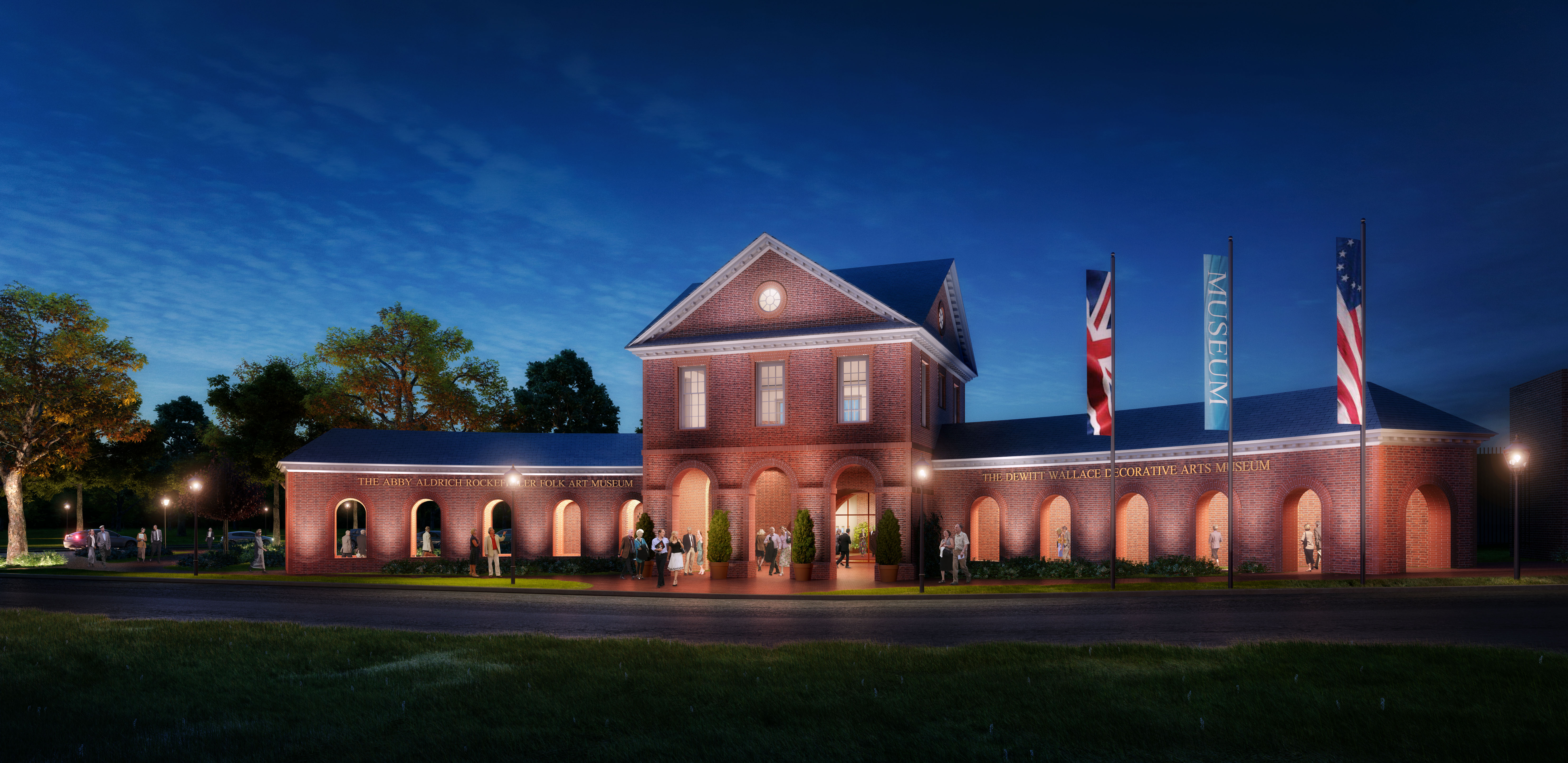
The current entrance to the art museums of Colonial Williamsburg is at the restored public hospital on Francis Street, requiring guests to pass through that building and an underground passageway before reaching the museums.
By shifting that entrance to a larger building on South Nassau Street with better signage and no underground passageway, the museums will be much more visible to passersby on the street, with a two-story brick entry area marked by flags and letters embossed on the building’s walls to lure guests.
“I think the philosophy 30-plus years ago [when the museum building was built] was that the museum should not intrude on the vistas of the historic area,” said Ron Hurst, the vice president of collections, conservation and museums and the Carlisle Humelsine chief curator for the Colonial Williamsburg Foundation. “It was thought that screening it with the public hospital would be a good way of doing that. What we’ve learned from 30 years of operating experience is that that’s very confusing and counterintuitive.”
The entrance would replace the underground passageway linking the public hospital with the two museums. The public hospital — a building set away from the road by a grass field — and a sign near the road are the current markers for the museum. The museum building is largely masked from main thoroughfares in the area.
When the new entrance is complete, visitors will pass through a lobby with a help desk to access a concourse leading to an all new café and gift shop before reaching the gallery space.
Along with the need to better expose the museums to visitors in the city, the museums have run out of space to exhibit the more than 75,000 artifacts split between them. The $40 million in museum upgrades are contingent upon a $600 million fundraising campaign currently underway. More than $300 million has been raised so far, but until more money is raised, a date for construction to begin will not be set.
The current café is located underneath the museums. By relocating it to the concourse, the café will be able to offer a much wider variety of food and drinks.
“We can’t do things that produce heat or steam [because of the current café’s proximity to the artifacts in the museums],” Hurst said.
The new café will also have space for more expansive special events than what is currently available. An outdoor terrace will be available for those events and for guests who want to dine outdoors when the weather is nice.
The additional 8,000 square feet of gallery space will be split between the two museums. The DeWitt Wallace Decorative Arts Museum specializes in American and British antiques ranging from furniture to paintings to firearms. The Abby Aldrich Rockefeller Folk Art Museum deals with both colonial and contemporary artists outside mainstream art circles who express themselves via the materials they had at hand.
The space will allow those museums to host dedicated galleries for the first time for several collections, including coins and currency, musical instruments, tools and weapons, maps and prints, toys and fine art. The extra space represents a 22 percent increase from the current amount of square footage in the museums.
Other improvements to the museums include upgrades to the building’s heating and ventilation systems, upgrades to Hennage Auditorium — located inside the building shared by the museums — and the creation of new space for exhibits to be built prior to being placed on the floor.
The museum upgrades are part of a broader package of improvements for the living history museum that will be funded with the proceeds of the $600 million fundraising campaign, known as the Campaign for History and Citizenship.
Other improvements in that program include the construction of a state-of-the-art archaeology lab, maintenance of existing historic structures through projects like painting them to accurately portray how they would have appeared more than 200 years ago and repairing aging stone and brick. The historic area of the museum will have greater offerings detailing the lives of Native and African Americans, the struggle for religious freedom and the military.
Related Coverage:
