



Of the three proposed options to connect Mooretown and Croaker roads, the one that cuts through the largest area of undeveloped land received the most support from citizens at a public meeting Monday night.
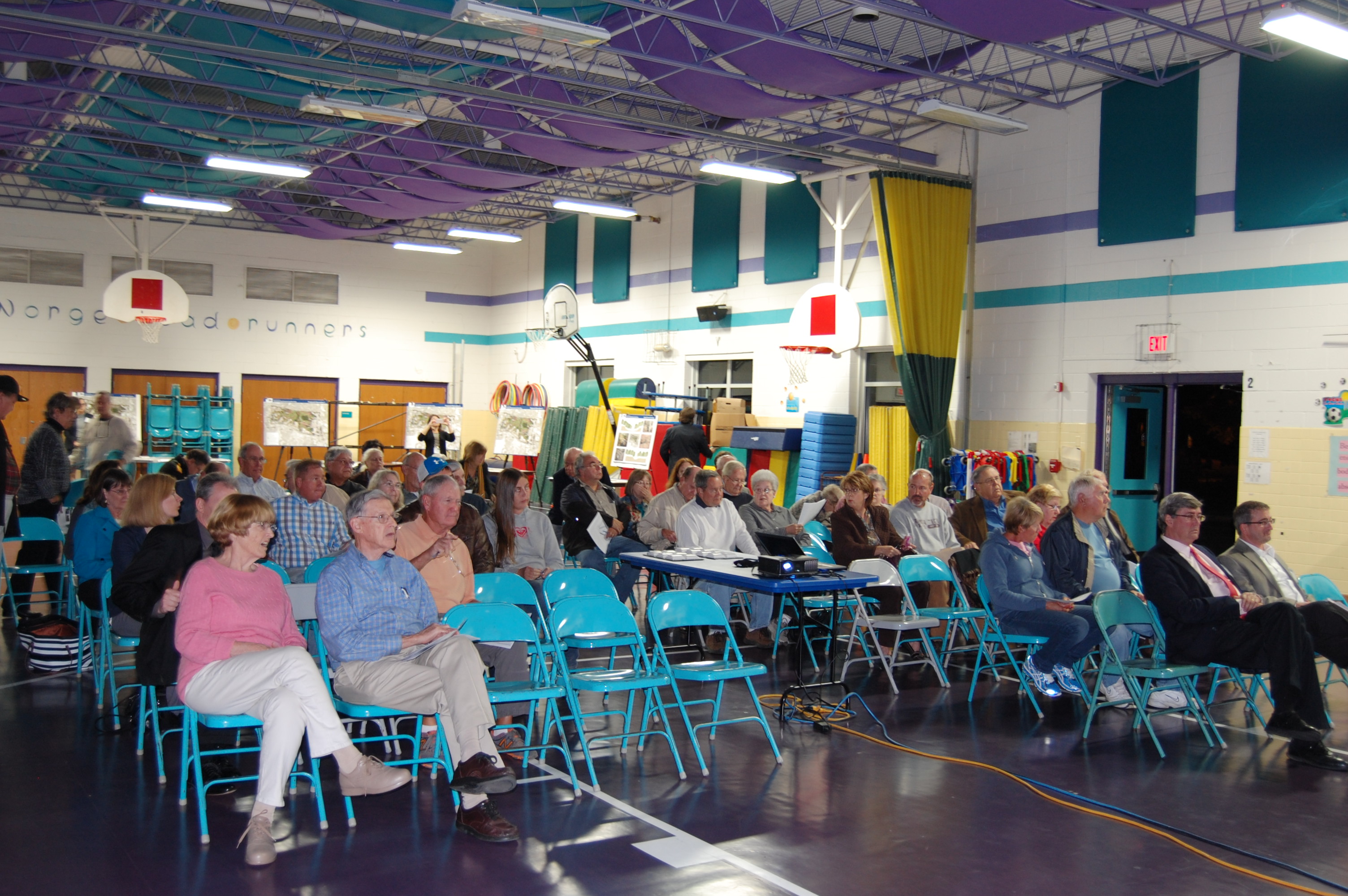
The meeting, the second of three on the topic, drew more than 45 people to Norge Elementary School, where engineering firm Vanasse Hangen Brustlin Inc. presented three options for a possible road extension in that area.
The first alignment, the most direct route from Route 199 to Croaker Road, cuts through the middle of the study area, affecting the largest area of wetlands and offering the greatest opportunities for development.
The second option dips west and runs along Route 60 and the CSX railroad. The third runs east, joining Rochambeau Drive near Skimono Creek, and has the least potential areas for development.
All three options would cross both James City and York counties.
Of the people who expressed a preference, 12 said they preferred the alignment that cuts through the most land. Seven people chose the alignment that connects with Rochambeau Drive, while three people favored the alignment that runs along the CSX railroad.
The engineering firm evaluated the environmental impacts as well as the projected traffic and development to design the three proposed roads.
The land consists of streams, wetlands and resource protection areas. The first and second road alignments include four culverts or bridge crossings over wetlands, while the third alignment would have two culverts.
The study concluded the area was “generally over-retailed” and would be best suited for a mixed use development consisting of residential and retail space.
“We have enough retail. We have empty retail,” said Kim Scholpp after the presentation. She said she would prefer to see the area used for industrial purposes. “To have another New Town is shocking and horrifying. I do not see the need for it.”
The firm also looked at traffic impacts, comparing the total amount of traffic currently running through the study area — about 27,000 trips per year — to the amount of traffic projected in 2040 without the road extension — about 47,000 trips — and with the road extension — about 65,200 trips per year.
Keith Lewis, principal engineer, said about 18,000 to 19,000 vehicles would use the extended road each day. He recommended building a four-lane highway with a grass median, shoulder, curb and gutter options and a bike or pedestrian path.
When asked to choose from the five 4-lane highway designs, most citizens favored the option hand-written on a Post-it note that read “None of [the] above.”
The first and second alignments run through Phillip and Allison Drinkwater’s farm. The couple purchased 37 acres of land along Peach Street near Route 60 last year and opened an equestrian farm in March.
“I love [the farm] because it’s right in the middle of town,” Phillip Drinkwater said, adding it took him and his wife four months to build the stables.
He was concerned the first road option would divide their property in half, while the second option would run 100 to 200 feet from the edge of their house. He understood, however, that if approved, construction would not start on the extension for a few years.

Wayne Moyer, a member of the James City County Citizens Coalition, a nonprofit preservation group, said he would prefer a two-lane country road over a four-lane highway.
In an email to WYDaily, Moyer argued the extension project would negatively impact the deep ravines, broad resource protection areas, numerous wetlands and free-flowing streams in the area.
He said the road would “create pollution, increase storm water runoff and encourage more sprawl to the north and west.”
Charlie Ross preferred the first alignment that runs directly through the area.
“It seems to make the most sense to me, particularly for development,” he said at the meeting, adding he could see the area being developed as light industrial or mixed use.
The area owned by the Williamsburg Pottery is also undergoing evaluation. The study, which costs between $17,500 and $20,000, was recently approved by the Economic Development Authorities of both James City and York counties.
Williamsburg Pottery shared its vision with James City County to develop an “international, family-focused entertainment and education complex” that would feature shopping, lodging, dining, an indoor electronic museum and a cinematic production studio.
No funds have yet been established for the Mooretown Road extension. A final design for the road will not be created until the Board of Supervisors approve a route and funding. Lewis said funding would be covered by a federal grant.
The proposal to extend the road first came about in 2005 in York County and 2009 in James City County. Each locality included the extension as a study topic in their respective Comprehensive Plans.
At the culmination of the third public meeting on the possible road extension, Lewis will gather all of the feedback and present it to the James City County Board of Supervisors, who will then decide whether to move forward with the project.
The public is encouraged to offer input on an ongoing basis. County Zoning Administrator Jason Purse is the point of contact for the study and can be reached at 757-253-6685 or via email at [email protected]. The last public meeting is scheduled for December.
Related Coverage:
