


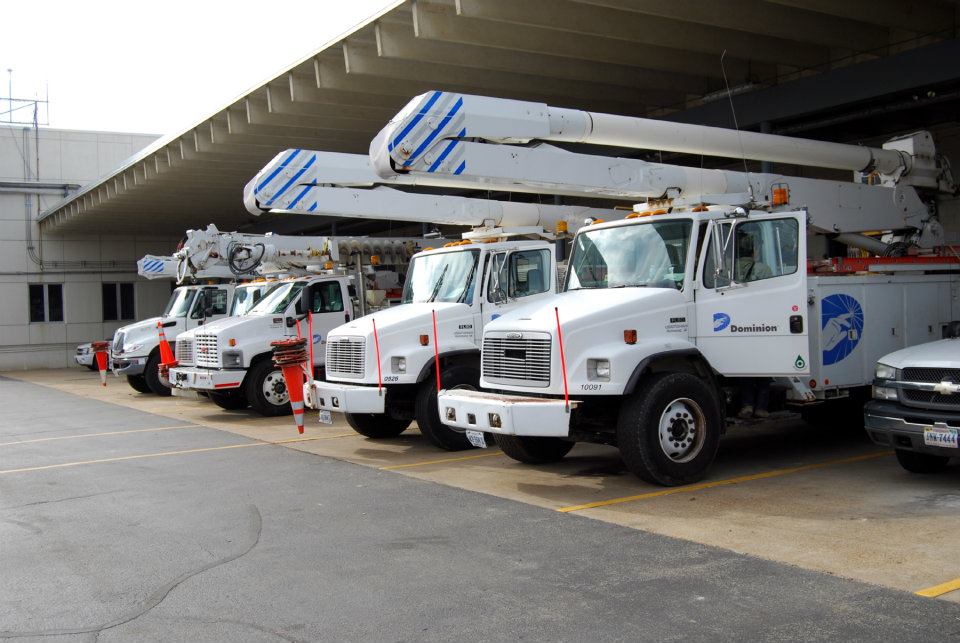
 When a storm knocks out power across the area, crews working to restore electricity are often bogged down repairing the same lines each time.
A new $2 billion initiative from Dominion Virginia Power seeks to change that: About 4,000 miles of power lines with a long history of frequent outages will be placed underground in the coming years, including 50 to 75 miles of lines in the Historic Triangle, according to Alan Bradshaw, the director for electric distribution underground at the utility.
Work will not begin until late next summer. When it does, customers can expect a rate increase to fund the initiative.
Initially, an extra charge of less than a dollar per month will be tacked on to utility bills. As the program continues, rates could reach a peak cost of about $5 per month for each customer in the state in 10 to 12 years , he said. After that, the cost will begin to be reduced until the project is finished.
Bradshaw said the goal of the initiative is to cut down on how much time it takes to restore power to the grid after a major storm event. Because crews spend so much time working in the aftermath of a storm on the 4,000 miles identified by Dominion, it means more time before power can be restored to other customers suffering from outages. By placing those lines underground, they would no longer be subject to high winds and falling debris.
Dominion officials are currently finishing work on an implementation plan to submit to the State Corporation Commission for approval. Moving the wires underground will directly affect about 160,000 customers who receive power from those lines, but Bradshaw said the benefit of the program extends far beyond them.
“It really doesn’t matter how many customers we underground — what we’re after is driving off potential work repair locations,” he said. “If we can eliminate work repair locations, the ones we go to the most, the resources that would have had to go there can now go to other lines and restore power for other customers sooner.”
Dominion officials began thinking about the program after a new law was passed earlier this year that allows investor-owned utilities like Dominion to explore new methods to place power lines underground. About two-thirds of Dominion’s lines are above ground, and a study aimed at placing them all underground estimated a cost of $83 billion, Bradshaw said. That translates to a cost of $27,000 per customer.
To pinpoint which lines needed to be placed underground, Dominion officials looked at outage history for the 20,000 miles of power lines not made up of large-scale transmission lines, as those are far more costly to place underground and are better protected against the elements. After looking at a decade worth of outage history for the 20,000 miles of lines, they were able to select the 4,000 they want to place underground.
The lines they hope to place underground are mostly in heavily wooded areas and may serve as few as one or two customers. Dominion officials will have to receive permission from property owners to place lines underground. About 90 percent of property owners approached thus far have agreed to the lines being placed underground on their land, Bradshaw said.
“We think it’s a win-win for customers who get their facilities undergrounded and the customers who benefit from faster restoration,” he said.
The new initiative and the funding structure that enables it are not the only ways for lines to be placed underground. The City of Williamsburg has in the past seven years spent $5.55 million placing power lines underground, however the funding for that work is generated from local funds instead of rate increases for the utility’s customers. But the scale of that work is a fraction of the new initiative.
A website has been established to provide customers information on the project.
