


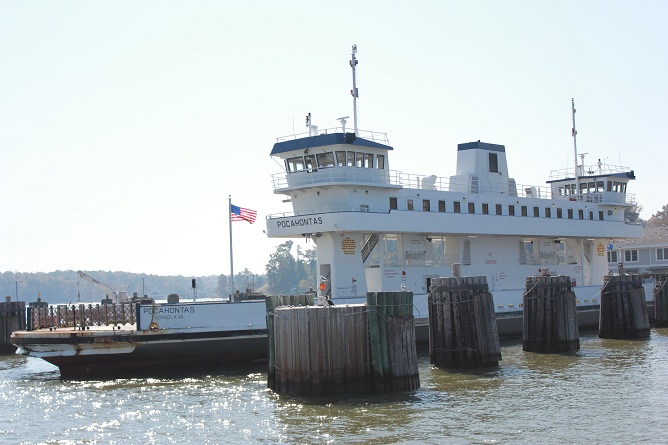
The Jamestown-Scotland Ferry will likely run at reduced capacity until at least May 20, the day work on the ferry’s largest ship is scheduled to be completed.
Officials from the Virginia Department of Transportation announced last week the “Pocahontas,” which can carry up to 70 vehicles at a time, was heading to a shipyard in Norfolk for hull inspections and repair work mandated by the U.S. Coast Guard. The move leaves the three smaller ships in the Jamestown-Scotland fleet to handle the ferry load, according to VDOT spokesperson Marshall Herman.
The loss of the “Pocahontas” has reduced the overall capacity of the ferry by about 20 cars per trip. The three ferries are able to keep the existing schedule in place.
The hull inspection is mandatory and must take place for each ferry twice every five years. The thickness of the hull will be checked to see if any sections are rusting. If anything is found, a new section will be installed to make sure the hull is safe for passengers, Herman said.
While in the shipyard, the “Pocahontas” will be cleaned and painted, undergo engine and generator repairs, piping repairs, repairs to the ship’s propulsion system and a number of other repairs.
The Jamestown-Scotland Ferry carries about one million vehicles per year between James City and Surry counties. Along with the “Pocahontas,” the ferry has the “Surry” and the “Williamsburg,” each of which can handle 50 vehicles, and the “Virginia,” which can handle 28 vehicles.
The “Virginia,” which was built in 1936, is slated to be replaced by a new 70-vehicle ferry by fall 2018. The $27.5 million project will yield a double-ended steel ferry boat.
Related Coverage:
