


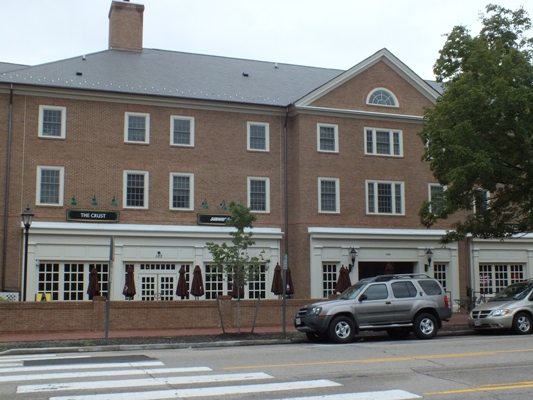
Businesses at Tribe Square are struggling. The Crust is up for sale and both Pita Pit and MOOYAH Burgers, Fries & Shakes have experienced drops in sales this year.
It has sparked a response from the business owners of all four restaurants who have requested to be included on the mandatory meal plan being rolled out at the College of William & Mary. Pita Pit Owner Brandon Twine wrote a letter earlier this month to W&M’s Vice President for Finance Sam Jones, detailing how the businesses were working with a lawyer to work toward a resolution.
Last year, Pita Pit brought in $500,000 in sales, Twine said in an interview with WYDaily. With one month left in 2013, the business has so far brought in $330,000. In February 2012, MOOYAH Burgers, Fries & Shakes brought in about $60,000 in sales and this year brought in $30,000, said owner Alpen Patel.
The Crust was hit hard as well with Chief Operations Officer Pat Gordon of the company that owns The Crust saying sales were down 20 to 25 percent this year. It was a factor in the decision to put the business up for sale last week.
“It would be difficult for us, based on the path we’re now on, to sustain our business,” Gordon said. “The potential for closing is certainly there.”
Pita Pit owners Kimberly and Brandon Twine, MOOYAH Burgers, Fries & Shakes Owner Alpen Patel and Subway Owner Nitesh Patel — all doing business in Tribe Square — said they think their struggle in the square is largely a result of one thing: the new mandatory meal plan at W&M.
Prior to 2011, only incoming freshman were required to have a meal plan and live on campus. In April 2011, Jones announced the college would be implementing a new policy for the fall 2011 semester that would require any student in campus housing to purchase a meal plan. The new requirement applied to freshmen in the fall of 2011 and all subsequent classes.
The minimum requirements are lowered as a student progresses through years at W&M, with freshmen required this year to buy 14 meals per week from the college and juniors required to buy 50 per semester. Mandatory meal plans are being used to partially fund the recent $8 million expansion to the Sadler Center’s Dining Hall.
The Tribe Square restaurant owners believe the new meal plans cause a problem for their businesses because the plans do not include their restaurants as culinary destinations. Students must use the meal plans at one of the dining halls on campus.
College Spokesperson Brian Whitson said in an email the meal plan is likely not the only reason sales at Tribe Square could be down. He said lower sales could reflect market competition, “student satisfaction with the Tribe Square options, quality or service” or it could reflect satisfaction with the current meal plan.
For one junior at W&M, Blake Martin, the latter isn’t the case. Martin, who lives in the student housing above the restaurants, said he thought mandatory meal plans don’t let students choose how they spend their money.
“We’re spending money that we don’t have to spend,” Martin said.
Tribe Square is owned by the William & Mary Real Estate Foundation, a nonprofit founded in 2006 that acquires and manages land for the College of William & Mary. The foundation rents its lower floors to the four businesses and the upper floors are leased to the college for student housing.
The result has been a frustrating experience for Tribe Square business owners who have students living above them, like Martin, who are required to purchase a percentage of their meals elsewhere. The owners are also not allowed to park in the square’s lot, which is patrolled by William & Mary’s parking services.
It’s even caused Pita Pit co-owner Kimberly Twine’s vehicle to be marked as “tow-on-site” if it is seen in the parking lot after Twine disputed and refused to pay a ticket. Twine and the other business owners must park on the street or in other public parking areas often far from the businesses’ entrances — something a recently failed parking agreement between the city and the church next door would have alleviated.
A representative of the W&M real estate foundation told Alpen Patel he could park in the lot if he first bought a William and Mary campus parking pass — a purchase of $470 per year for non-college affiliated individuals. Pita Pit’s Brandon Twine said the current situation at Tribe Square is a far cry from the situation he and his mother were promised when they rented the location.
Twine’s mother spent her life savings to purchase the Pita Pit location for her son and his wife. Upon signing a lease with the foundation through Glen Allen-based real estate company Thalhimer, they were promised a “no-fail” location – a “home run.” The spot would get plenty of attention from students during the school year and tourists during the summers.
“The only tourists we get are the ones wanting to use our bathroom,” Brandon Twine said.
WY Daily attempted to contact Nancy Buchanan, executive director of the William & Mary Real Estate Foundation, but received an email saying she would be out of the office until Dec. 2.
Gordon said he had met with a college official about the problem who said William & Mary is in negotiations with its food vendor, ARAMARK, and noted he would not know more until the end of January.
