


An early summer survey conducted to find what drives visitors to the Historic Triangle showed half of the people who do not visit the area are either uninterested or have been here and don’t believe there is anything left for them to see; about one-third of visitors who do come to the area consider themselves to be history buffs.
In March, Strategic Marketing and Research Inc. was hired to conduct research into what drives visitors to the Historic Triangle and what keeps non-visitors away. The Williamsburg Area Destination Marketing Committee, tasked with increasing overnight visits by spending the $2 per night hotel tax, contracted the Greater Williamsburg Chamber and Tourism Alliance to hire SMARI.
SMARI spent months conducting research and made a presentation to a room filled with tourism representatives from across the Historic Triangle on Wednesday. Results from the sixth annual survey used to gauge the effectiveness of WADMC’s TV commercials were also released and discussed at the meeting.
SMARI Research Findings
SMARI set out to find out what drives visitors to the Historic Triangle and what keeps non-visitors away. A total of 1,501 online surveys were completed in areas from where Williamsburg visitors typically travel. Of those surveyed, 1,202 had visited the area and 299 had not. The people surveyed live in New York City, Philadelphia, Baltimore, Washington, D.C., Raleigh/Durham, towns within a 200-mile radius of Williamsburg and other areas of Virginia.
“The findings suggest that non-visitorship is driven by low interest in the area as a product, rather than a lack of familiarity with what it offers,” the study reads.
For the purposes of the survey, Williamsburg was compared to a number of other destinations to find where people are more likely to travel: Orlando, Fla.; Savannah, Ga.: Charleston, S.C.; Asheville, N.C.; Virginia Beach; Myrtle Beach, S.C.; Washington, D.C.; Hershey, Pa.; and Annapolis, Md.
The survey results showed 86 percent of Williamsburg visitors said they were very familiar with Williamsburg, while 35 percent of non-visitors said they were very familiar with Williamsburg. On the familiarity scale overall, Washington, D.C. topped the list and Asheville, N.C. was ranked last.
More than half of Williamsburg’s visitors come from somewhere else in Virginia, 25.9 percent come from Washington, D.C., and 14.8 percent come from somewhere within a 200-mile radius.
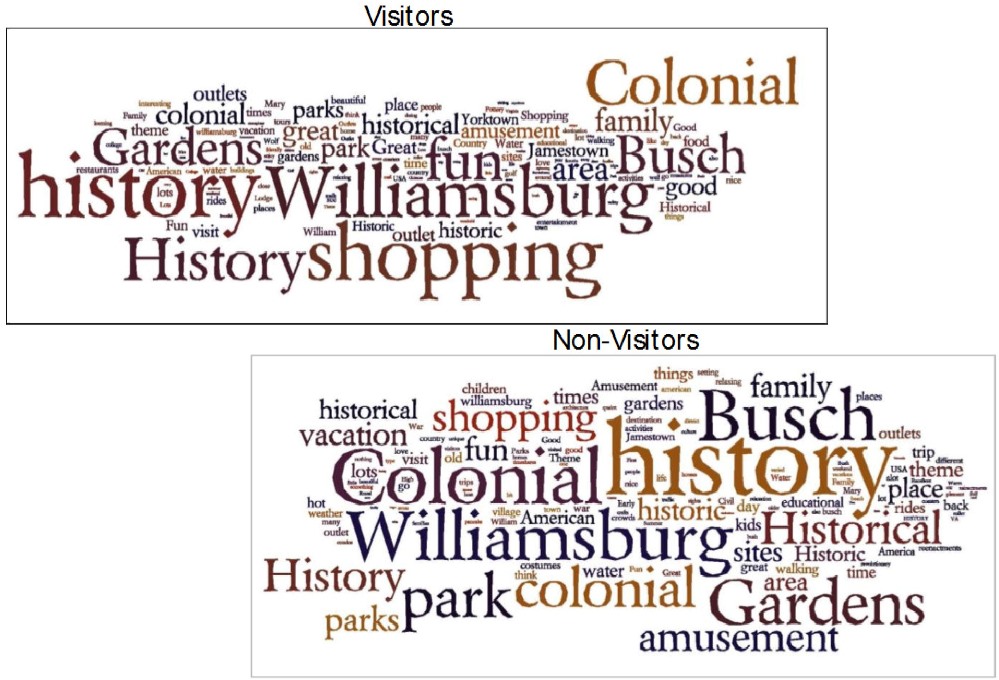
SMARI also asked the respondents to list words that came to mind when they think about Williamsburg.
“The results were clear and straightforward. Williamsburg, in the mind of those interviewed, is about history,” the study reads. There was not much difference between the words visitors and non-visitors listed.
The people who visit the area represent a variety of different travel groups: 32 percent consider themselves to be history buffs, 17 percent are outlet shoppers and 13 percent like to visit theme parks.
Survey respondents were most familiar with Colonial Williamsburg and Busch Gardens, and they were least familiar with the Yorktown Victory Center and the Historic Triangle. Visitors said they were most satisfied with “history, shopping, fun, food and family” when traveling to the area and disliked “crowds, traffic and parking, the expense and weather.”
Of those surveyed who have not visited Williamsburg, 27 percent said “the experience has already been had—‘been there, done that.’” Another 24 percent were not interested in the area at all. Only 2 percent said they want to visit the area.
The survey looked at demographic information as a possible explanation for who does and does not visit, but only different marital statuses showed contrast. Visitors who are married made up 77 percent of those surveyed while 11 percent are single or were never married; non-visitors who are married made up 68 percent of those surveyed while 18 percent were single or never married.
More than half of visitors and non-visitors have only two people living in their household. More than 90 percent of visitors and non-visitors have more than a high school education. Most visitors are older than 35, almost half are employed full-time while roughly 30 percent are retired. Also, 86 percent of visitors are white and 69 percent of visitors have an annual household income of $60,000 or more.
The survey showed non-visitors are also mostly 35 or older, employed full-time or retired, 85 percent are white and more than half make more than $60,000 annually.
Putting all the information together, SMARI came up with some suggestions to increase visitors to the area. First, SMARI said history buffs do not need a separate advertising message because they will find Williamsburg because of its historic significance and will choose to visit the area often.
Visitors who come for vacation, entertainment and history and shopping choose the area because they can experience history and other things in one trip, so Williamsburg should be promoted as an area for history and visiting a theme park as an alternative to Washington, D.C. or Orlando, Fla.
“The goal should be to broaden the image among specific segments, to show them other things to do so they recognize Williamsburg as something other than just the history place,” they research reads.
Washington, D.C. was identified as a major competitor for people looking to travel for history; the segmented messages could be used to draw visitors away from that area and to Williamsburg instead.
To read the full results, view them online.
WADMC Post-Advertising Survey
Every year, WADMC puts out television commercials to drive visitors to the area. For this year, the ad campaign was extended by eight weeks to reach more visitors while they were planning their vacations. The commercials ran from the first week in March to the first week in August.
In 2012, the commercials ran from early March through early June; in 2011 they ran from mid-April to the first week in August.
From Aug. 5 through 18, 250 people each from New York City, Philadelphia, Washington, D.C. and Raleigh/Durham were surveyed online to find the effectiveness of the commercials. All were parents with children under 18 years old.
Of those surveyed, 48 percent were male and 52 percent were female. Most respondents fell into the 35 to 54 age range. Only 4 percent had only a high school education and 58 percent make $100,000 or more annually. Most had children who were 7 years or older.
The survey asked parents if they remembered seeing an advertising campaign for Williamsburg; 47 percent did initially recall seeing an ad but 25 percent remembered the 2013 ad after it was shown in the survey. Only 2 percent of parents said they use TV ads as a source of inspiration for vacation.
Parents who remembered seeing an ad for Williamsburg were asked to describe what the ad was for; 26 percent said Busch Gardens, 25 percent said historic sites and 19 percent said Colonial Williamsburg.
The results showed 54 percent of parents were likely to visit Williamsburg in the next 12 months, which is an all-time high. Exactly half of the parents who visited Williamsburg in the last year said they were very satisfied with the experience.
Parents were asked to rank different images from the TV ad for appeal. Most responded well to the ad overall, but viewers were least interested in the image of a golfer and of rifle and cannon fire.
After watching the ad, parents were asked what Williamsburg offers: 93 percent said it’s a good place to experience history, 87 percent said it’s a good place for kids and 52 percent said it’s a place to visit repeatedly.
Read the full results of the post-advertising survey online.
