


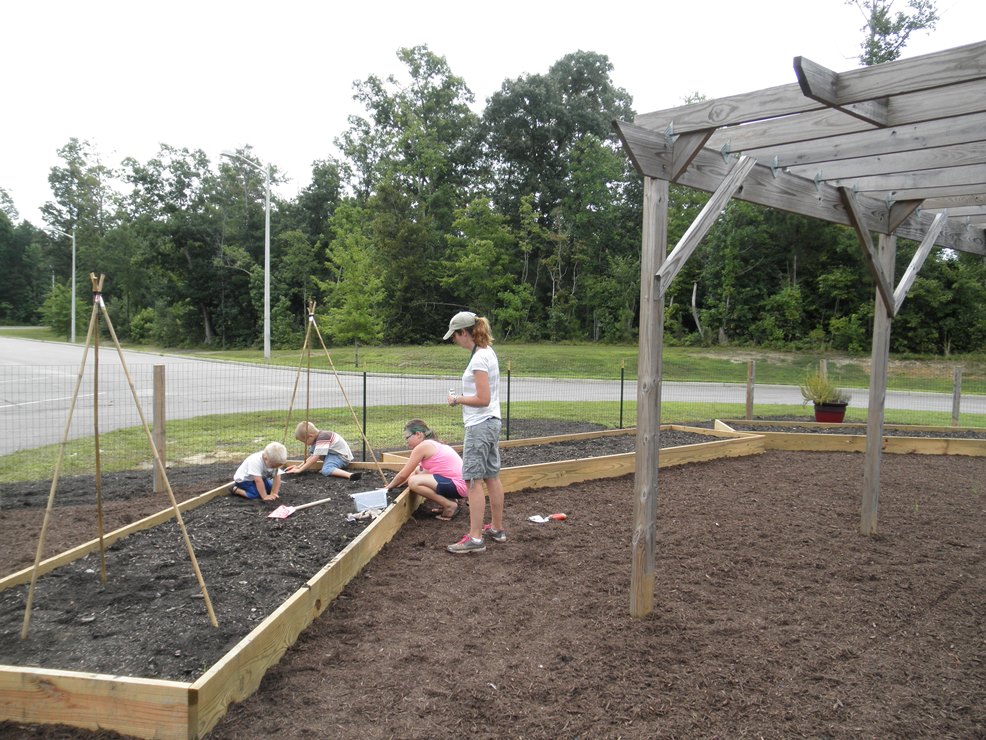
Matoaka Elementary School Principal Andy Jacobs says he affectionately refers to the school’s Master Gardener Adviser Leanne Conrad as the school’s own Mother Nature. Last week, she worked her magic on the school’s garden.
When it was initially established in 2008 — a year after the school opened– the garden had two raised beds. Last week, Matoaka’s garden was expanded to include a butterfly garden and six raised beds, giving each grade level a bed to care for.
“I think the parallel of this garden is we will grow along with it,” Jacobs said. “I’m excited to see what happens.”
The six raised garden beds and butterfly garden at Matoaka are positioned around a pergola and picnic tables, providing an educational oasis to students learning about plant growth, soil and butterflies.
Several aspects of gardening lend themselves to science and social studies education at the elementary school level, and the garden allows students to put their hands-on education.
The ability for the school to start small with the capacity to grow the garden is something Jacobs places value in. The garden lends itself to a wide range of school curriculum and before- and after-school programs. The thinking behind having six beds it to give each grade level a bed to care for when school is in session.
It also gives parents and students a chance to be responsible for the garden’s care in the months when school is out for summer vacation. Conrad works alongside children and parents to care for the garden, visiting the school once a week during the summer.
Jacobs said the garden’s prime time is the summer, but this summer was a bit different than most. Typically, the garden is planted in April so its well-stocked come summer, but this year they did not plant until summer because of the garden’s expansion.
Most years, families sign up to take care of the garden throughout the year and some are placed on a waiting list due to high demand. Parents bring their children out to pull weeds, water the garden and harvest any vegetables, herbs or flowers they may want to take home.
“I think that’s a sign that people realize the value of it for kids,” Jacobs said.
Caring for the garden while school is in session isn’t specifically part of a class, but students take about 10 to 15 minutes to come out the garden periodically as a class. Conrad said the students have the opportunity to plant seeds or transplant plants, watch the plants grow and harvest the crops.
“Plants are part of the curriculum all the way through,” said Maureen McFarland, the school’s computer resource teacher. McFarland was out working in the garden last week, preparing it for the upcoming school year.
Last week, Conrad was working with volunteers to plant bush beans, pole beans and carrots so students would have something to care for and harvest when school starts in September. In August, turnips, beets, broccoli, kale, spinach and mustard greens will be planted. During the first or second week of school, kindergartners will plant lettuce and radishes.
The students get the chance to “be excited about what they grew themselves,” Conrad said.
Kindergartners are also asked questions, such as “What season is it?” and “What do plants need to live?” so the garden creates even more of a learning experience.
A compost bin in the garden works as an educational tool — helping students understand soil — as does a worm bin maintained by the school’s third-graders. The butterfly garden lends itself to kindergarten through the second-grade curriculum, helping students understand the life cycle of a butterfly by giving them the ability to observe the life stages themselves.
In addition to lending itself to school curriculum, the garden provides opportunities to learn from the garden to the before and after school Rec Connect program and an after-school nature club.
Last year, the second-graders planted birdhouse gourds in the spring. In November the nature club, which Jacobs expects may one day transform into the garden club, harvested them. The gourds were cured through the winter and then students were able to make birdhouses out of them to take home. Conrad said the gourds brought in a social studies aspect in addition to science, because a comparison was drawn to Native Americans, who used birdhouse gourds around their camps to keep the bug population down.
Going further than contributing to the school’s curriculum, the garden also has the opportunity to contribute to the school’s cafeteria.
Jacobs said at one point herbs from the garden were used to supplement the school’s cafeteria. If there is an abundance of vegetables or herbs, the cafeteria can use them for school meals. J. Blaine Blayton Elementary School also has a garden that produced a large sweet potato crop one year that was used in the cafeteria. If anything is going to grow in abundance at Matoaka this year, Conrad thinks it could be lettuce, which could then be used in the cafeteria.
“It fits our efforts to promote fitness and wellness initiatives,” Jacobs said. He said students who enjoy eating vegetables at school will be more likely to go home and ask their parents to cook vegetables for them for dinner.
The School Health Initiative Project initially funded the garden, though it is now funded through the Parent Teacher Association, and fitness and wellness are a primary focus of the SHIP program. Pam Dannon, Williamsburg-James City County Schools’ SHIP/Child Nutrition Services registered dietitian, said SHIP is working on curriculum including healthy eating for the upcoming school year. The curriculum will include lessons in gardening and eating vegetables.
In addition to funding from the PTA, the school relies on donations for the project. Eagle Scouts donated some painted benches that are placed around the garden; they will be sealing a pergola that will eventually provide some cover for four picnic tables. Southern Blue, LLC donated bricks and mulch for the garden.
Currently, the school is seeking any donations of time or garden items, especially flowering or fruit trees. Dannon said people interested in making donations should contact the school’s principal for information about donating. Jacobs’ email is [email protected].
