


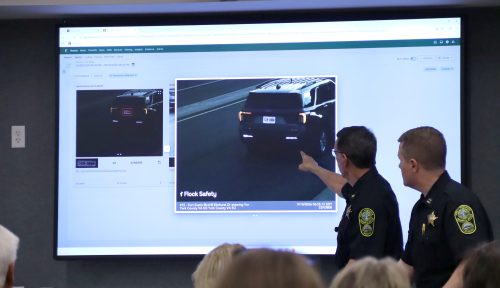
YORK COUNTY – The York-Poquoson Sheriff’s Office held a community forum Thursday to explain how the county’s automatic license plate readers operate, how the office uses the technology and the safeguards in place for the information it collects.
“I want you to understand that it’s not my intent tonight to try to change your mind about this technology,” Sheriff Ron Montgomery said at the meeting’s start. “When you walk out of here, you may not agree with this technology … but you will have the facts as to how it’s used here in York County.”
The sheriff’s presentation outlined what information ALPR cameras collect, when deputies can search that information and how long the data is retained. He also discussed the department’s policies for auditing searches, restricting access, responding to potential misuse and a live demonstration of what information shows up when a Flock camera search is conducted in the department.
According to the presentation, the system captures an image of a vehicle’s rear license plate along with its make, model and color. Montgomery said the system does not use facial recognition or connect to Department of Motor Vehicle or Virginia Criminal Information Network records.
Under Virginia law, searches of ALPR data must be connected to an active criminal investigation supported by reasonable suspicion or another legally permitted purpose, such as locating a missing or endangered person. Officers must log three things to run a search: a case number, an offense type — such as larceny or kidnapping — and a written reason.
Montgomery emphasized that his officers are not allowed to run license plates or do Flock camera searches without reasonable suspicion; by Virginia law, doing so is a Class 1 misdemeanor.
“I have fired two deputies in the past for doing exactly what I just said, who ran license plate numbers for friends, trying to find out information they were not entitled to,” Montgomery said.
He later clarified that these incidents happened years prior to the Flock cameras and said that there have been no similar incidents with the Flock system in his department.
In a live demonstration, the sheriff searched his police vehicle’s plates. The image showed only the vehicle’s rear and plates, along with the time, date and location of the photo taken.
Much of the question-and-answer session focused on privacy concerns and the possibility of tracking vehicles over time. Residents asked about the system’s ability to trace a vehicle across multiple cameras and jurisdictions and whether that could be used to establish a person’s habits.
Montgomery said investigators can trace a vehicle when it is relevant to a criminal investigation, but using the system to track someone without an investigative purpose would be illegal. He also said a Flock alert alone does not justify a traffic stop; deputies must independently verify the vehicle and other information before taking action.
Residents also questioned how the county came to use the technology and whether residents had been given an opportunity to weigh in.
One woman in the audience, who later declined to be identified, asked Montgomery, “When were we given the opportunity to vote on these in the first place?”
“Three years ago, when you voted for me,” Montgomery said.
Later in the discussion, the woman raised concerns about who has access to information collected by the cameras.
“You guys do a great job. However, I am concerned about the people that have designed these that still have access to the information. I don’t trust them,” she said.
Residents also asked about data security, access and accountability. The sheriff said his office controls the data and limits system access to law enforcement personnel with a legitimate reason to use it. The department conducts regular audits of searches – Virginia law requires monthly audits, but YPSO does them weekly – and reports information to the Virginia State Police. He added that VSP will publish the audits on April 1, 2027.
Residents also raised concerns about the technology’s cost and effectiveness.
Montgomery said each camera costs approximately $2,500, including equipment, installation, maintenance and software updates.
One resident questioned how often ALPRs directly contributed to solving crimes. Montgomery said he did not have exact numbers but said the cameras aided in “at least four homicides,” “five or six armed robberies” and “lots” of stolen-vehicle recoveries.
He noted that there are no ALPRs in residential areas and that cameras are located at major intersections and roadways.
When asked why the department refuses to release the locations of its ALPRs, the sheriff said he “won’t make a criminal’s job easier.”

