


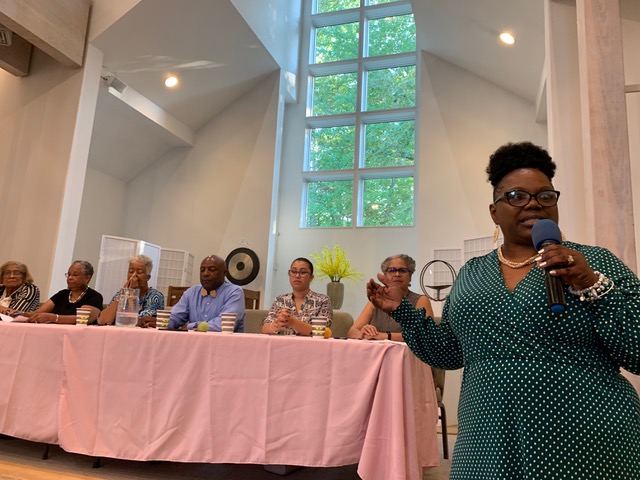
Williamsburg, VA, September 23, 2019 – The Village Initiative welcomed community members to a public forum on school integration this past Saturday, September 21 at the Unitarian Universalist Church. The forum, titled Integration Then and Now: Voices from the Community, marked the 50th anniversary of school integration in the WJCC School District. The forum featured a multi-generational panel that was invited to reflect on both the experience of school integration and the implications for our school system today. “The event went better than we could have imagined,” said The Village Initiative founder, Jacqueline Bridgeforth-Williams, “We want to extend a huge thanks to all involved and specifically to the panelists who came ready and willing to share their thoughts and experiences. What happened in that room was people sharing their painful truths with the community.”
The panelists included: Edith ‘Cookie’ Heard who graduated from Bruton Heights and whose six children attended WJCC schools, Sylvia Willis who graduated from James Blair HS and is the mother of two Lafayette graduates, Janice Canaday who attended WJCC schools as did her six children and presently works as a CW museum educator/interpreter, Philip Canady who graduated from Lafayette HS and is now an elementary school teacher and Doctoral student studying why African American male teachers remain in K-12 education, and Xavia Carter who graduated from Lafayette HS in 2018 and will soon begin a bachelor’s degree in business administration. In the audience to hear their stories were a broad array of community members, state-level politicians, and WJCC school board members, administrators, and staff.
Often we focus on what was gained by school integration, but at this event panelists were asked to reflect on what was lost. “Integration was the best thing that happened to Black people and it was the worst thing that ever happened to Black people,” said panelist Edith Heard, “Black people lost their entire culture because, all of a sudden, what we had, white people told us, didn’t fit.” Other panelists reported feeling isolated and unwelcome in majority-white schools and blocking out these painful memories. Xavia Carter, as the most recent graduate on the panel, insisted that the schools were still segregated today just in different ways.
The panelists also discussed their role models and mentors during their school years. While all the panelists could name teachers that made a difference in their lives, a common theme was the lack of teachers of color who looked like them, who were rooted in their community and neighborhoods, and who understood their culture. For Edith Heard, this is what was lost with integration: Bruton Heights, the Black school under segregation, was a community of teachers, parents, and students that supported every child’s success. “All of our teachers told us that we must go to college…that it was important,” said Edith Heard. In stark contrast, Philip Canady spoke of being stereotyped as a disciplinary problem in integrated schools because he was a Black boy and recalled his high school guidance counselor telling him he would never attend college.
All of the panelists spoke strongly about how little they learned about Black history and culture at school. Panelist Sylvia Willis, and others, noted that a small group of well-known figures—George Washington Carver, Booker T. Washington, Martin Luther King Jr., Rosa Parks—were taught in the schools, but that this neglected the many important Black change-makers that have been integral to the country’s history. The panelists also insisted that local Black history should be taught in the schools. “This forum showed just how significant history is—all history,” Williams said, “It shows how history still shapes our educational system today.”
Despite the sobering testimonies, the panelists saw the event as a necessary step toward a broader community effort, in conjunction with the WJCC School District, to address these problems. “This event established the needed groundwork to understanding the cultural make-up and history of our community and its impact on the community’s relationships with WJCC,” said panelist Philip Canady, “The event provided a window into the importance of working within the community for a more inclusive approach to educating all stakeholders vested in our students beyond SOLS.”
Jacqueline Bridgeforth Williams agreed that this event demanded change: “I heard one of the panelists speak from a place of great pain and isolation. That was tough. We have to come together on this—the children are depending on us. In attendance were folks from the community, politicians, school officials—the right mix of people to take what we heard beyond this forum and out into the community. The right mix of people to make changes. The future is depending on us to make the change. Be the change.”
The Village Initiative is moving forward with a range of efforts to address these pressing issues and invites community members to volunteer with the organization. “The Village will continue our work with an even greater focus on sharing our great history and working for equity,” Williams says. The Village Initiative is working in partnership with W&M and the WJCC School District to integrate more local Black history into the classrooms. As part of this effort, the organization invites community members to share their oral histories of school integration. The Village Initiative also operates a tutoring program in local pre-school, elementary, and middle schools and is currently initiating an African-American Culture Club at one of the high schools. The Village Initiative also advocates regularly at the school board meetings for greater equity in the schools, including addressing the opportunity gap through
needs-based funding, ending the school-to-prison pipeline, and dedicating more resources to hire and retain teachers of color and to provide all staff with cultural competency training.
A video of the forum will be available to the public soon. To share your oral history, join the tutoring team, or get more information about other Village Initiative projects, contact The Village Initiative at [email protected] or visit villagewjcc.org.
This content was provided by a community member via Local Shout, a new initiative at WYDaily. WYDaily cannot guarantee the accuracy of information presented in this story. If you have additional information or would like to submit a story, please contact [email protected]

