


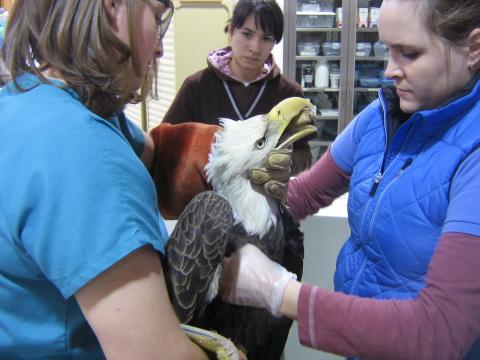
Last week a Smithfield man entered into a plea bargain with federal authorities for shooting a bald eagle before running it over with his ATV.
While the violent act made headlines around the nation, experts say humans shooting eagles is not the real threat to the national bird — but bullets are.
“Our eagle population here on the James River is near saturation,” said Dr. Bryan Watts Director of the Center for Conservation Biology at College of William and Mary and Virginia Commonwealth University.
Watts said the actions of 62-year-old Allen Thacker, who shot a bald eagle with a Remington .22 caliber rifle and then crushed the bird by running it over with his all-terrain-vehicle, are uncommon.
“One incident like that,” Watts said. “If you look at it from a population perspective, is insignificant.”
However, wildlife experts across the Commonwealth all agree: the biggest threat to bald eagles in Virginia are the fragments of lead left behind by hunters when they gut big-game.
“Lead has become an epidemic of a problem,” Watts said. “It’s become one of the larger threats to the bald eagle population.”
When the birds scavenge after the hunting season, they often eat the parts of an animal that a hunter wouldn’t want. A fragment of lead the size of a piece of rice is enough to kill four eagles.
‘Hard to describe without profanity’
The Wildlife Center of Virginia is where most of the state’s injured bald eagles are taken for rehabilitation. The center took in 38 bald eagles in 2016, 35 in 2015, and 38 in 2014, according to its former director of veterinary services Dave McRuer.
Eighty percent of the bald eagles admitted to the center in 2016 had measurable levels of lead. These levels of lead can contribute to bald eagles injuring themselves in other ways, including inhibiting an eagle’s ability to fly properly, McRuer said.
“The Wildlife Center is one of the better wildlife rehab places and medical groups in the East,” Watts said. “They are one of the best. They handle most of the difficult cases.”
Ed Clark Jr., president of the Wildlife Center, got into the business nearly 40 years ago, and it’s those cases in which people actively try to maim eagles that get stuck in his craw.
“This guy, it’s hard to imagine how anyone can rationalize killing the national bird and failing to finish it off with a gun and then finishing it off with a vehicle,” Clark said. “It’s so outrageous it’s hard to describe without profanity.”
While Clark says cases in which people will deliberately kill eagles are disturbing, they are also rare. The larger threat of lead poisoning leads a litany of ailments and disorders before death. Bald eagles with measurable levels of lead in their bodies can “fly drunk,” according to several experts at the Wildlife Center of Virginia.
Measurable levels of lead in a bald eagle can shut down the bird’s gastrointestinal tract, disrupt the nervous system, cause oxygen deprivation, and disrupt the bird’s ability to see and fly. According to McRuer, lead poisoning is a contributing factor with incidents of acute trauma, such as an eagle colliding with a motor vehicle or falling from its roost in a tree.
The toxicity of lead is increased when consumed by wildlife, compared to lead shot from a gun that lodges in muscle tissue. The consumed lead has exposure to digestive fluids and stomach acids, which break the lead down. It is then easily absorbed into the bloodstream and disseminated throughout the animal’s entire body, according to a document from the Wildlife Center of Virginia.
As little as 1 part per million of lead in an eagle’s blood is usually lethal, according to the Wildlife Center of Virginia.
Making gains against odds
This year, Virginia’s bald eagle population reached a new high of 1,070 nesting pairs. That’s up from the 1970s low of 33 nesting pairs, according to the Department of Game and Inland Fisheries.
“That’s the first time that Virginia has broken 1000, since we started keeping records in the late 1950s,” Watts said. “It’s beyond what any of us thought the population could reach. The population is maybe on par with what it would have been in colonial times.”
The Wildlife Center of Virginia’s Director of Veterinary Services Dave McRuer said he thinks the lead poisoning deaths of bald eagles are entirely preventable — if hunters are made aware.
“The scientific community has put up enough overwhelming evidence, that the lead is coming from spent ammunition,” McRuer said. “The vast majority, especially from scavenging raptors, is from spent ammunition.”
Clark suggested hunters need to mindful of where and how they dispose of game and field dressings.
“Even after that bullet stops, it can continue to kill,” Clark said. “People don’t go into the woods to deer hunt with the idea they’re going to kill an eagle, too.”
WYDaily archives were used in this article.

