


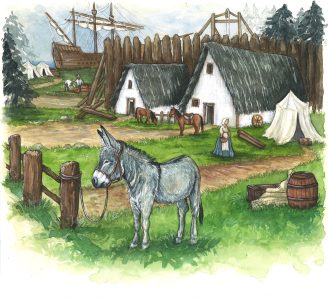
JAMESTOWN — A new paper studying equine remains excavated at James Fort reveals what may be the first donkey brought to the eastern seaboard of North America, as well as new insights into the role of horses, Jamestown Rediscovery announced.
According to Jamestown Rediscovery, a collaborative group of researchers conducted a full zooarchaeological analysis, plus isotope and ancient DNA investigations, on sixty-two equine skeletal remains from two features excavated inside James Fort, the circa 1608 barrel-lined well commonly known as Jamestown’s “First Well” and a contemporaneous cellar commonly known as Jamestown’s “Kitchen Cellar.”
Both of these features were filled in with trash immediately after the Starving Time winter of 1609-10. In addition to the equine remains, the Kitchen Cellar previously yielded butchered human remains, the only proof of survival cannibalism at Jamestown, Jamestown Rediscovery notes.
The just-released paper on the investigation revealed a previously unknown donkey at Jamestown, likely the first brought to English North America, according to Jamestown Rediscovery. Isotope analysis made clear the donkey, never mentioned in ship manifests, was not born in Britain and was likely picked up along the journey across the Atlantic.
In 1609, the Third Supply, a fleet of ships bringing settlers, food, and other materials to Jamestown, set sail with “sixe Mares and two horses” aboard, Jamestown Rediscovery explained. One horse died on the journey, but somewhere between Plymouth, England, and Jamestown, they, or another one of the other supply ships sent to Jamestown before 1610, picked up a donkey. Stopovers may have included the Canary Islands off the coast of Africa and various locations in the Caribbean, including Martinique, Dominica, Nevis, St. Croix, Puerto Rico, and the Mona and Monito Islands, it noted.
Biomolecular analysis of the donkey tooth excavated the kitchen cellar suggest West African or Iberian ancestry, which, the paper’s authors write, mirrors patterns emerging from other taxa, such as cattle, that show inputs to American livestock population from other regions of the world.
“Applying new scientific techniques to the archaeological record of early North America,” said lead author William Taylor of the University of Colorado, “is showing us just how complex the early trans-Atlantic exchange of domestic animals truly was. The spread of livestock westward is turning out to look less like a single ‘event’ and more like a stream of animals and people with inputs and outputs from all over Europe, Africa, the Caribbean, and the Americas.”
The horses and donkey were likely brought to Virginia to be used as work animals, but, the new study shows that more than 80% of the skeletal remains of equids exhibit modification related to butchering and consumption. Teeth in the assemblage were broken to access the pulp cavity and larger bones split to access marrow. Some tooth fragments even have iron embedded cut marks from unsuccessful ax swings. This intensive processing of horses and donkeys is consistent with other Starving Time-era artifacts, according to Jamestown Rediscovery, which show settlers turning to atypical and, eventually, taboo sources of nutrition in their desperate effort to survive.
“The identification of a donkey at Jamestown highlights the significance of archaeology to understanding our shared past, as it represents one of many instances of a gap in the 17th-century documentary record,” said Jamestown Rediscovery Senior Curator Leah Stricker.

