



For more than 300 years, a stretch of roadway at the northeast corner of Williamsburg has ferried travelers into the city. Capitol Landing Road was once just that: an access road to the landing dock for the colonial capital.
Today, the city is taking steps to revitalize the corridor — but rather than looking to the past, the city is using the roadway as a path toward the future.
The thoroughfare that now connects the city to Interstate 64 was first created as an access road to the colonial capital. During the early 17th century, there were two port entrances to Williamsburg, which was surrounded by the York and James rivers: Capitol Landing off the York River and College Creek off the James River.
Capitol Landing once served as the main entrance to the city, according to an archeological report published by the Colonial Williamsburg Foundation. Colonists bustled by the gallows which stood near the intersection of Capitol Landing Road and Merrimac Trail.
“Around its wharf grew a small settlement of shops, houses, and light industries,” read a report by the Virginia Landmarks Register. “All of the buildings vanished during the 19th century.”
After the founding of Colonial Williamsburg and the automobile age, the entrance corridor to the City of Williamsburg burgeoned once again, but in recent years the area hasn’t seen the same economic growth of other areas of the city, such as Merchants Square.
City officials are hoping to change that with millions of dollars in investments and tax incentives to bring new businesses to the Capitol Landing Road corridor.
“That corridor is the backbone of the tourism zone,” said Williamsburg’s Economic Development Director Michele Dewitt.
Creating a vision
In October 2016, the Williamsburg City Council created a tourism zone along the road, which freed up tax dollars from the Commonwealth and the city to encourage businesses in the area.
“Tourism zones are a state tool that empower localities to provide tax incentives,” Councilor Benming Zhang said in a news release after the zone was created. “It plays an equitable, major role with City efforts to revitalize the ‘Northeast Triangle’ planning area.”
Since the decision, Williamsburg has tried to facilitate economic growth in the corridor through land deals to consolidate properties for redevelopment. The city continues to offer tax incentives to new and existing hospitality businesses to further their presence in the area.
On Oct. 12, a year after the tourism zone was established, the council voted to expand the zone to include property owned by Colonial Williamsburg, , according to city documents.
The plan for the expanded zone is to “create a critical mass of activity and energy” in Williamsburg, Mayor Paul Freiling said in a radio interview hosted on the WYDaily parent company’s radio station, 92.3 The Tide FM.
“The city has purchased a number of parcels on that Capitol Landing Road corridor that we now have the ability to combine into one larger parcel and then make that available to the private sector for purchase and then redevelopment,” Freiling said in the interview.
Although the city created the district last year, the city’s redevelopment plan has been in place for more than three years, according to city documents.
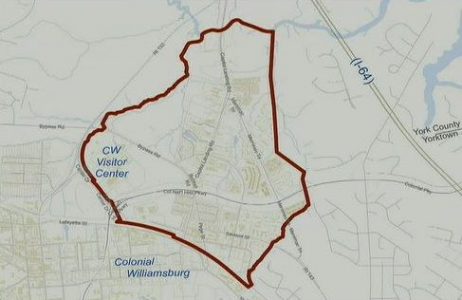
Shaping the Northeast Triangle
Starting in 2013, the city set its goals, initiatives and outcomes for the Northeast Triangle, which included generating urban redevelopment in the area. The city’s biennial goals, initiatives and outcomes touts the Copper Fox distillery as an example of new life on Capitol Landing Road.
Then in 2015, the city began buying up properties near the intersection of Capitol Landing Road and Merrimac Trail. Since that time, the city or its economic development authority have purchased about 10.3 acres of land for a cost of about $2.2 million, according to land records.
One of those properties is on the market right now, according to City Economic Development Authority Director Michele Mixner DeWitt.
The property at 912 Capitol Landing Road could house a hospitality business as large as 21,000 square feet, DeWitt said. A brewery, gastro-pub, or even a hotel are among the list of businesses the city would like to see move onto the property.
Beyond buildings and properties, in November the city authorized $5,774,300 in road and streetscape projects for Capitol Landing Road.
“I think it’s a positive thing in terms of the city’s long-term dynamics,” Councilor Doug Pons said before voting to approve a proposed resolution for the project.
Wider sidewalks, bike lanes, and the opportunity for on-street dining for restaurants are among the upgrades the city is eyeing for the road.
“That’s the type of activity that creates a new energy in a neighborhood and helps people feel as though there’s a certain vitality,” Freiling said. “When all the activity takes place indoors. People don’t see it.”
Construction of the Capitol Landing Road projects was recently pushed back to July 2019 as the city looks to accommodate potential redevelopment near the Williamsburg Shopping Center.
But the temporary hold won’t stop the city from making a “real investment in streetscape and Capitol Landing Road to complement what we’ve done there,” Freiling said.
Bringing in business
When City Council voted in to rezone the Northeast Triangle in 2016, the designation created state and local tax incentives to bring business back to the entrance corridor for vehicles coming from the interstate.
The tourism zone opens up businesses to pay less taxes on Business, Professional, and Occupational License tax, as well as room, meal, and sales taxes, according to city documents.
New businesses that invest at least $250,000 and existing businesses that invest $50,000 and up in commercial infrastructure or redevelopment can be eligible for tax relief from the city and the state.
Tax-breaks aren’t the only incentive to businesses, the city also offers development grants to businesses in the zone, according to city documents.
The city’s Economic Development Authority is giving out matching-grants up to $10,000 for businesses such as the Hampton Inn, Work Nimbly, and Sal’s Ristorante Italiano among others in the tourism zone.
The grant pays for improvement projects such as installing new floors, putting up new awnings, and refurbishing hotel rooms, according to city documents.
In order to apply for a grant, businesses had to receive bids and commit to the projects, according to city documents.
The authority was allocated $50,000 for the grant program, and only $200 remains, DeWitt said.
Although the city has paused most projects on Capitol Landing Road, the delay isn’t stopping the city’s Economic Development Authority from pursuing new businesses to move into the area, according to DeWitt.
“We just need to find the investors who want to make these projects happen,” DeWitt said.

