


Former York-Poquoson Sheriff Press Williams, 90, still remembers the day he and several other Peninsula leaders “tossed the first shovel of dirt,” and broke ground for the Virginia Peninsula Regional Jail.
It was September 14, 1995, and plans for the 322-bed jail had started to come to fruition. Almost two years later, the jail’s doors opened, replacing two outdated and overcrowded jails in York County and Williamsburg.
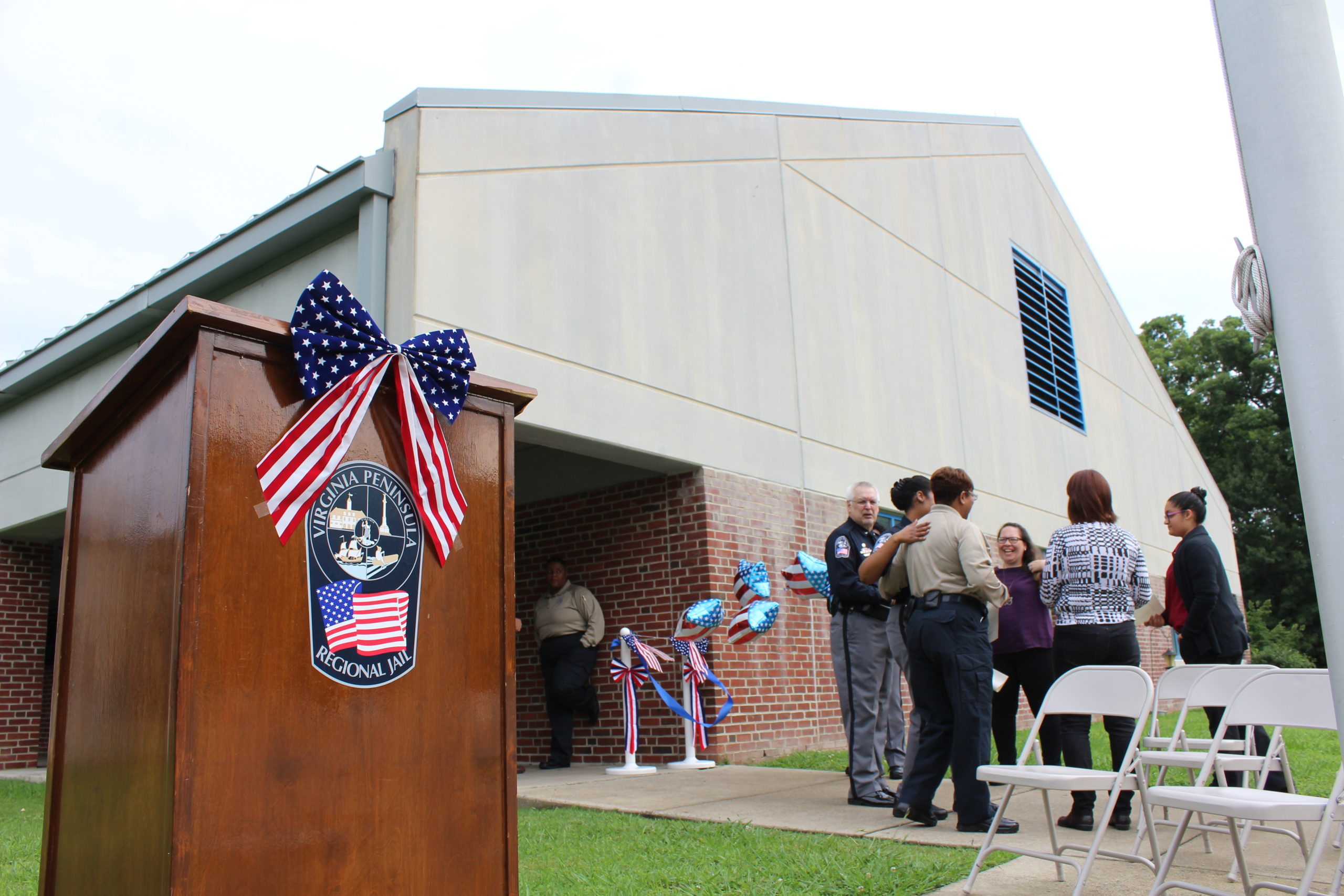
Twenty years later, on Wednesday, Williams returned to the jail, this time to celebrate the facility’s 20-year anniversary. Williams was among about 25 people, including several government officials, law enforcement officers and jail staff, who attended the 9 a.m. ribbon cutting ceremony.
Despite funding challenges and changes in technology and jail programs, Superintendent John Kuplinski said the jail has experienced 20 years of success keeping the community safe.
“Most of what a jail does is not seen by the public,” said Kuplinski, who has witnessed changes in the jail since he was hired in January 1996.

Overcoming obstacles
Securing funding and addressing funding cuts from the state has been a recurring challenge since the jail opened, Kuplinski said.
The VPRJ has been able to makes ends meet each year, however, and has worked hard to keep the burden off localities that contribute funding annually, the superintendent said.
James City County, York County, Poquoson and Williamsburg contribute funding each year to the jail. This fiscal year, James City County budgeted $2,679,252 for the jail. York budgeted $2,613,821, Poquoson budgeted $296,199 and Williamsburg budgeted $1,191,527.
One major source of funding came in 2014, when the jail agreed to house immigrants for U.S. Immigration and Customs Enforcement (ICE). At the time, jail officials estimated the ICE facility would increase revenue by about $800,000 annually.
“They’re doing a great job,” Williams said, referring to the facility’s operations.
Education and improvement
While many programs have come and gone over the years, the VPRJ now offers 25 different educational and life skill programs. The jail has been able to maintain its list of programs with the help of volunteers, Kuplinski said.
Kuplinski added keeping inmates busy and teaching new skills is a route to success.
“The goal is to keep them productive and active to occupy their time while they’re here,” Kuplinski said Wednesday, adding that over 400 inmates have graduated from the jail’s GED program since the jail opened.
Charles Williams, 41, is one of 18 to 20 inmates who work in the jail’s kitchen, with eight or nine working per shift. Inmates may work for the jail after they have been incarcerated there for 30 days.
They are put through a screening process and appointed to jobs that fit their given skill set or interests, Food Service Manager Tina Cowles-Perkins told WYDaily in February.
Inmates can work in the kitchen, laundry room, in maintenance or perform other tasks throughout the jail.
“If they were a mechanic, they’d probably send him to maintenance,” she said. “But if they’re a mechanic and want to become a cook, or if they’re a cook and want to do maintenance, sometimes they can.”
“I wanted to keep myself occupied and not get in trouble,” said Williams. “If I didn’t have this job, I’d just stare at the clock all day.”

For local law enforcement, the jail has not only played a role in keeping their communities safe for 20 years, but has also provided an opportunity for people to improve themselves.
“It’s a place where those who are incarcerated here have an opportunity to try to improve their lives by completing the GED program, getting involved with a drug [recovery] program or some of the other programs the jail offers,” York-Poquoson Sheriff J.D. “Danny” Diggs said.
New trainings for local police and correctional officers have also helped decrease the number of inmates admitted during psychiatric crises, Kuplinski said. Riverside Doctors’ Hospital in Williamsburg also opened at crisis center in 2014, which helped decrease the number of inmates coming to jail in the midst of a psychiatric crisis.
Setup for success
Kuplinski said one particular architectural aspect of the VPRJ has generated success over the years: The direct supervision setup.
When the VPRJ was first planned, officials decided to make it a direct supervision facility, meaning there are no bars or windows between correctional officers and inmates, and the units are horseshoe-shaped to keep all cells visible at all times.
Direct supervision allows inmates and guards to have more personal interactions, and ensures safety practices, Kuplinksi said.

In 1997, the design differed from other area jails, such as the Williamsburg and York County jails, which had a linear setup, he added. Some nearby jails, including the Newport News City Jail, still have the linear setup.
According to Lt. Robert Sodorsky, an Army veteran and 16-year correctional officer with the VPRJ, the direct supervision setup has allowed him to work one-on-one with inmates.
“We’re not here to punish them for the mistakes they made in life,” Sodorsky said.

