


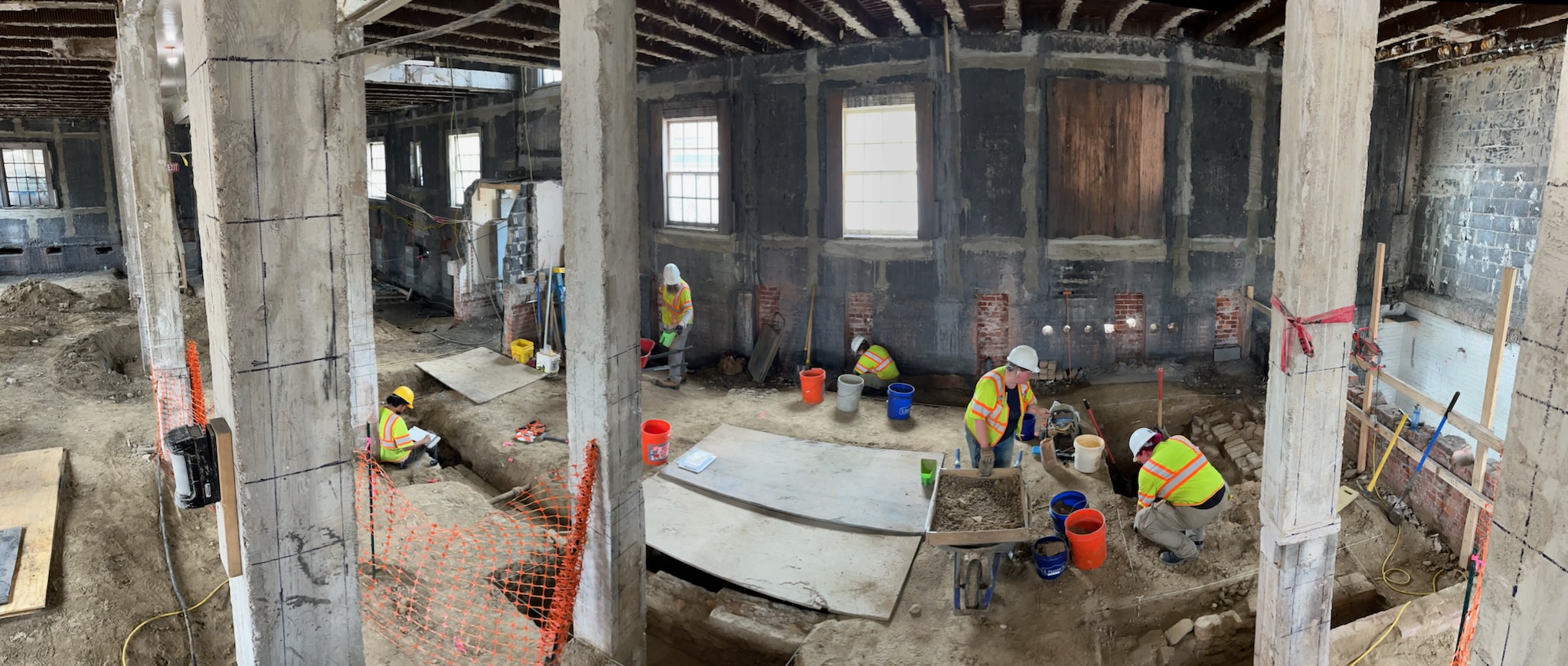
WILLIAMSBURG — Beneath William & Mary’s Robert M. Gates Hall, archaeologists this summer uncovered the near-complete 18th-century foundation of the Williamsburg Bray School, the university announced.
The Bray School, one of the oldest known institutions in North America dedicated to the education of enslaved and free Black children, operated on the site from 1760 to 1765. Its foundations were thought to be only partially intact.
Researchers also discovered a previously undocumented cellar, layered with centuries of artifacts, the university said, adding the discoveries provide a new portal into the site’s past, providing a more complete story of the Williamsburg Bray School, its scholars and their impact.
“As the United States prepares to mark its 250th anniversary, William & Mary is embracing its role as a steward of the nation’s origin stories — and as a catalyst for their expansion,” said W&M President Katherine A. Rowe.
“The discovery of this cellar is thrilling,” Rowe added. “The roots of our city and university entwine here. Every layer of history that it reveals gives us new insights into our early republic, from the Williamsburg Bray School through the generations that followed, up through the early 20th century.”
Layered with history
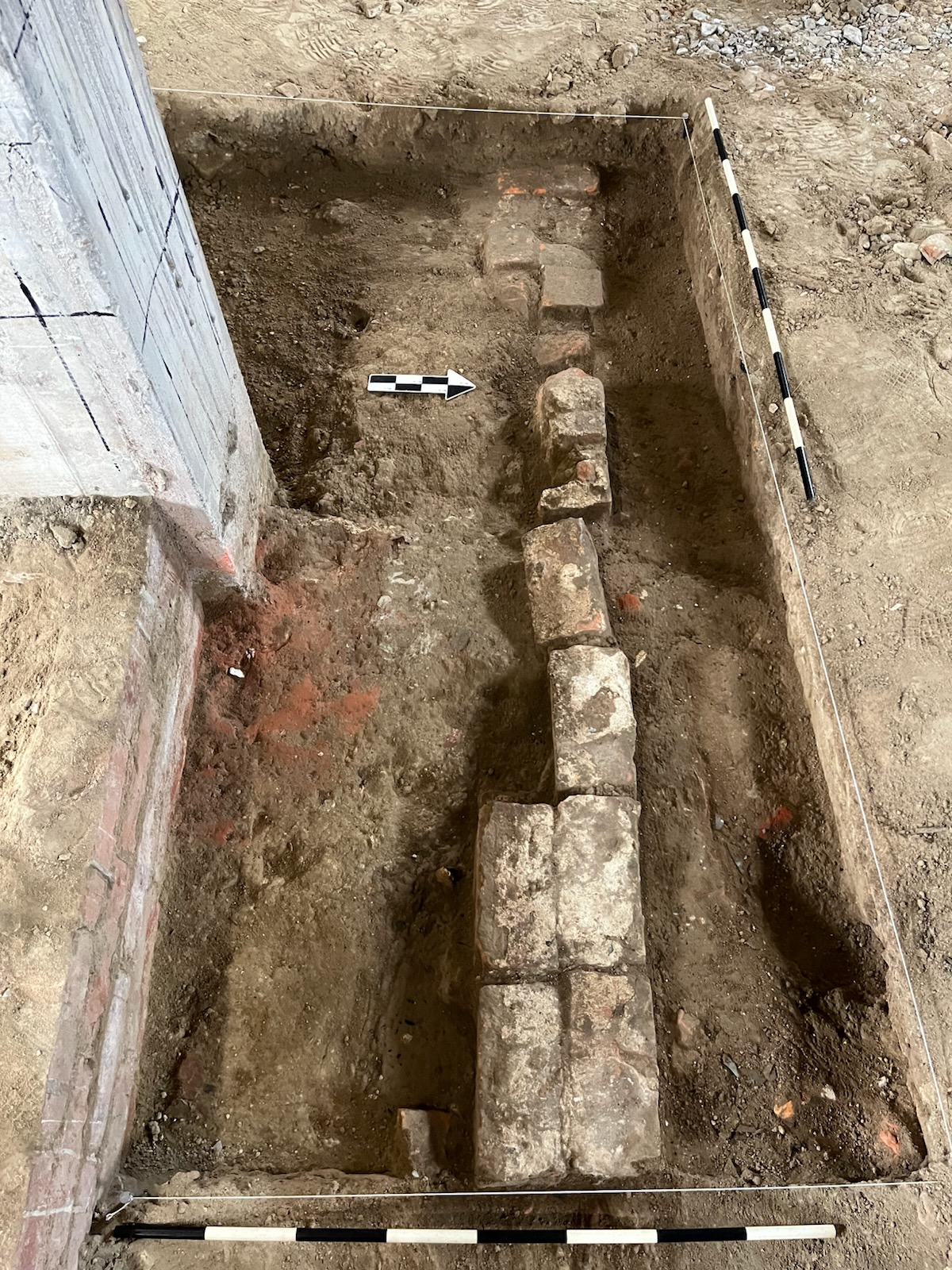
The foundation and cellar discoveries were first made early this spring by Colonial Williamsburg Foundation archaeologists conducting preliminary investigations for the Gates Hall renovation project, according to the university.
The W&M Real Estate Foundation is managing the renovation and expansion on behalf of the W&M Foundation. Since the spring, the W&M Center for Archaeological Research, under the leadership of Elizabeth J. Monroe and David Lewes, has expanded the excavation and led artifact recovery.
The cellar is approximately 36 by 18 feet. Two distinct levels are emerging, according to the announcement. The Center team has exposed the bottom of the cellar almost eighteen inches higher than the previous depth found by the CWF team.
“It looks like the cellar was a partial cellar, and had different floor levels potentially,” said Center Project Archaeologist Tom Higgins. “It’s not a brick-lined cellar — it was probably dug soon after the foundations were laid.”
In addition to the foundation and cellar, their work is revealing 18th-century to mid-20th-century jewelry, slate pencil fragments, sherds of pottery and vases and buttons.
Among the recovered items are fragments of colonoware pottery — handmade ceramics often associated with sites of enslavement and Indigenous communities — as well as sherds of Greek Revival ceramics, glass and decorative items linked to the women who lived in Brown Hall during the early 1900s. Before it was moved down Prince George Street in 1930, the original Williamsburg Bray School building housed Methodist women attending William & Mary from 1924-1930.
The team is careful not to draw too many conclusions from what they are finding — yet. “It’s early days,” Monroe added. Once bagged and labeled, artifacts will travel to the lab at the Center for further study, according to the announcement.
Plans are underway to incorporate the archaeological discoveries, as well as photographs and other documents, into a permanent exhibit inside Gates Hall. The exhibit will be co-curated with members of the Williamsburg Bray School Descendant Community and other stakeholders, the university said.
Other artifacts will be lent to The Colonial Williamsburg Foundation, where they will join additional items connected to the site for display at the Colin G. and Nancy N. Campbell Archaeology Center, scheduled to open in 2026.
At Gates Hall, the intention is to outline the foundation of the original Bray School on the floor and, if possible, excavate a portion for display in the exhibit, according to William & Mary.
“This is exciting,” Maureen Elgersman Lee, director of the W&M Bray School Lab, part of Strategic Cultural Partnerships, said. “What else are we about to learn? We are not done understanding the history of the Williamsburg Bray School, the history of Black education. We are not done learning the history of this area, and we are certainly not done learning the history of this country.”
The renovated Gates Hall will house the Global Research Institute, the Institute for Integrative Conservation and the Whole of Government Center of Excellence.

