


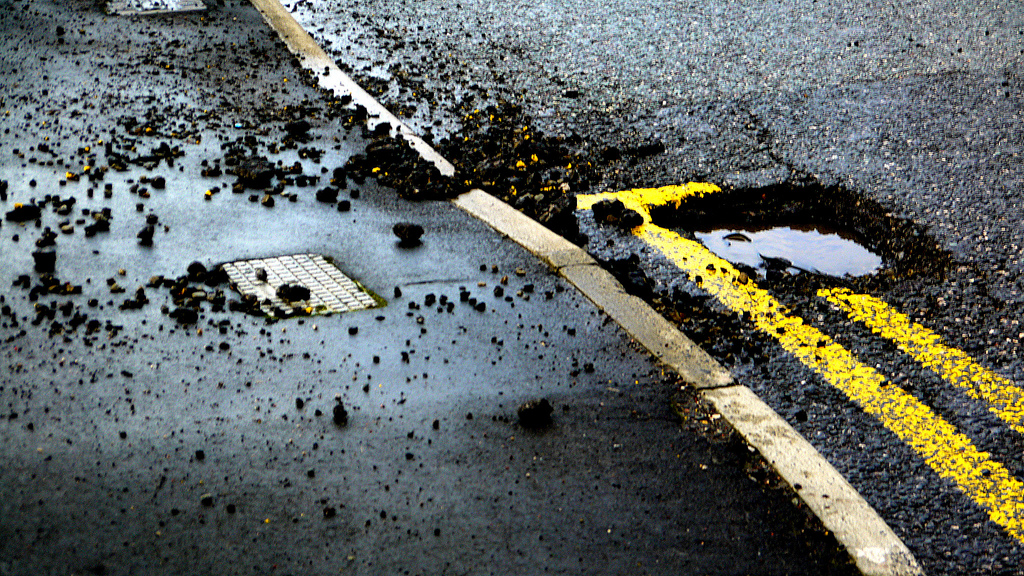
Driving around the Historic Triangle, drivers might experience the bumpy turbulence of potholes and in the spring, it will most likely get worse.
According to the Virginia Department of Transportation website, potholes occur far more frequently in the spring because the temperatures are warming the pavement and evaporating ice. During this process, air pockets are formed that can eventually cause the pavement to break up.
If there is a winter of heavy snow, drivers can expect an open range of potholes in the following spring.
In Williamsburg, there have been efforts to address that issue. In February 2018, the city launched the chat message service Citibot. Part of the use of the service is that it allows residents to easily report potholes.
Related story: Pothole in the road? Text the City of Williamsburg and it’ll get fixed
Not all potholes are created equal, though.
Jenny O’Quinn, media contact for the department, said VDOT has a prioritization scale based on a number of factors for pothole assessment. O’Quinn said any pothole that poses an immediate danger to motorists is prioritized and repaired first.
“VDOT crews are always on Virginia’s roads addressing various maintenance needs,” O’Quinn said. “Potholes are considered a safety issue, so when a pothole is discovered or reported, crews will repair it as soon as possible if weather permits.”
The next factor is considering the size and depth of the hole. Any pothole that is six or more inches wider and deeper than one inch will be patched as a part of the department’s planned work.
Repairing a pothole takes a couple of steps and depends on the weather conditions as well as availability of materials, O’Quinn said.
Hot asphalt mix is preferred but often is not available when temperatures are colder. If that’s the case, repairs will be made with other materials and then revisited in the warmer months.
When that happens, first the hole is carved out with a jackhammer or masonry saw to create a rectangle. Any excess asphalt is then removed and an adhesive is applied. Following this, asphalt is added in layers and the area is leveled off and compacted with a pavement roller.
However, VDOT is not responsible for all potholes on every public road. The department only repairs potholes on state maintained roads, which includes interstate highways and routes numbered between 1 and 599.
Local governments are responsible for secondary roads, which are routes 600 and up.
The City of Williamsburg Public Works Department did not immediately respond for comment and VDOT did not provide information on how many potholes have been reported in the area.
But to know exactly where to find the potholes, VDOT receives a lot of information through citizen input, O’Quinn said. This can be done through reports online to VDOT or through the city’s website.
When vehicles run over potholes, sometimes they can cause more than just a little jostling.
“If drivers experience damage to their vehicle and they believe the damage was caused by road conditions, they have a legal right to submit a property damage claim,” O’Quinn said.
To file a claim, the VDOT provides resources online. The department’s customer service center will verify the information and an investigation will begin.
While spring will bring out sun and flowers, it will also make the commute to work more than a little bumpy. When that happens, VDOT and Williamsburg encourages drivers to reach out to help solve the issue by providing in formation.
To report a pothole visit VDOT or the City of Williamsburg online.

