



The day Wallace Green went on kidney dialysis was also the first time he ever met with a dietitian.
“I said ‘Why am I seeing a dietitian now? Why wasn’t this a long time ago?’” Green recalled.
Green, who lives in Virginia Beach, was 54-years-old then. His kidneys, however, had been showing the first signs of distress three decades earlier, when he was “a screaming sailor” in the U.S. Navy.
“Because I was working 12 hours a day, I tried to party twelve hours a day,” he said.
He picked up smoking and drinking and weighed nearly 300 pounds.
“They put me in the fat boy farm,” he recalled. “You had to lose weight, or they would discharge you. When I noticed that I was getting a little heavy, I would go on another diet.”
But no one made the connection between his diet, overall lifestyle and his GFR—which stands for glomerular filtration rate. It’s an indicator of how well your kidneys are removing waste from your blood. A normal GFR is 60 or above, but Green’s number was plummeting.
It wasn’t until Green retired from the Navy in his 40s that his primary care doctor referred him to a nephrologist.
“He was monitoring it [the GFR]. But it was still given to me as it was okay,” Green said. “I never recall hearing a sense of urgency that it’s important you do something about this or your kidneys will fail.”
Eventually, Green’s kidneys did fail, and he went on dialysis for eight years, followed by two kidney transplants—the most recent, in 2015.
Nonprofit focused on prevention
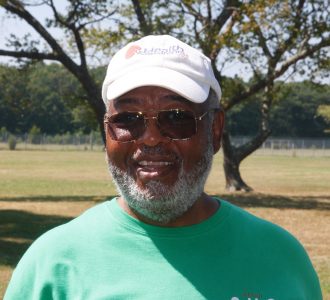
Green, now 64, wants to help other people avoid a journey like the journey he had. In 2011, he created a nonprofit called Health and Awareness to educate people about preventing kidney disease.
Last week, Virginia Gov. Terry McAuliffe recognized Green for his work. He was one of nine organizations or individuals who received the 2017 Governor’s Volunteerism and Community Service Award.
Green was recognized as the “Outstanding Senior Volunteer.”

An attendee from one of Green’s sessions nominated him for the award. In 2016, Green spoke at 60 health fairs. Since launching his nonprofit, he’s spoken at more than 200 health fairs. Most have been in the Hampton Roads area, but he’s gone as far as Washington D.C. and Maryland.
Green also gives free presentations at churches, schools, retirement homes, and even family reunions—as well as places like the Eye Bank and Life Net.
Although kidney disease normally strikes people over age 60, Green has talked to elementary school students about their kidneys.
“We do the Hokey-Pokey to identify where the kidneys are located,” he said.
Understanding risk factors early
Risk factors for kidney disease include obesity, diabetes, hypertension and a family history of those conditions, or kidney disease itself. Green’s mother had diabetes, and his father had hypertension, so he was a prime candidate.
As an African-American, Green was also at higher risk. According to the National Kidney Foundation (NKF), 35 percent of dialysis patients in the U.S. are African-American. As a group, African-Americans are almost four times as likely as whites to have kidney disease.
The risk is associated with a higher risk of diabetes and heart disease as well. Green in part blames a salty diet, which is bad for the kidneys—and specifically the history of “soul food.”
“We didn’t have refrigeration for food, so it was cured—salted it down and stored in the barn,” Green said. “If it wasn’t salted, we added salt. And everything considered soul food had a lot of salt in it.”
Green wants to use his organization to help people understand the risk factors. He’s met a lot of people who like him, didn’t understand they were at risk.
“They were doing the screening, but they weren’t told the meaning of scores and test scores,” he said.
Dr. Max Mirovski, a Virginia Beach nephrologist, applauds Green’s educational efforts.
“I think the grass-roots efforts are helpful. Understanding risk factors is very important,” Mirovski said. She added, high-risk patients should be screened early, especially since, “[Kidney disease] is frequently silent until late stages.”
The focus of kidney disease treatment has been dialysis and transplant, instead of prevention, Green added.
“For far too long our health system has been focused on treating people once they are sick,” Green said. “My organization is educating individuals on how to stop the progression [of kidney disease.]”

