



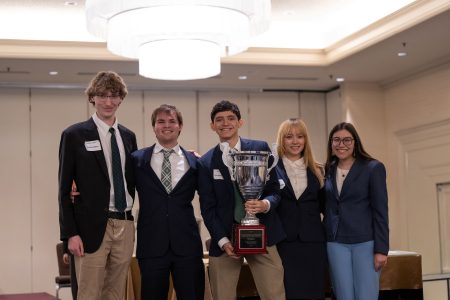
WILLIAMSBURG— Students from the William & Mary undergraduate team won the national championship at the APPE Intercollegiate Ethics Bowl, held March 7–8 in St. Louis. The team defeated Seattle University in the final match.
Over two days, 36 undergraduate teams from colleges and universities across the country examined complex ethical questions using cases based on real-world challenges in education, business, daily life and politics.
Teams competing in the Ethics Bowl were judged not on providing specific “right” answers but on their ability to clearly and thoughtfully identify and analyze the ethical dimensions of each case while demonstrating an appreciation for differing perspectives.
“Like in life, the cases are complex, difficult to resolve and sometimes polarizing,” said Michael Jordan, chair of the Ethics Bowl council. “Unlike debate, in Ethics Bowl teams are not assigned ‘pro’ and ‘con’ sides of an ethical issue. Each team’s goal is to identify the various ethical considerations, analyze their importance and engage in civil discourse with another team that expands the conversation based on its position. Our goal is to help students see the value of continuing to engage with others despite differences, to understand more about views that differ from their own and to help students think of collaborative solutions to solve societal problems.”
Semi-finalists in the competition were teams from Stanford University and the University of Florida. Quarterfinalists included teams from Harvard University, Macalester College, St. Mary’s College of Maryland and Utah Valley University.
“In some ways, the conversations during Ethics Bowl rounds are the antithesis of what most of us have come to expect when picturing conversations about really difficult topics,” said Kristen Fuhs Wells, executive director of the Association for Practical and Professional Ethics. “Although the students are dealing with controversial questions and often opposing viewpoints, they listen and empathize. They discuss and reason with each other. They present positions based on just and ethical considerations. I can’t help but imagine the types of solutions we could come up with if we all practiced the same approach to talking with people about our disagreements.”
The 36 qualifying teams were:
Bowling Green State University; Cameron University; Colorado School of Mines; DePauw University; Georgia Southern University; Georgia Institute of Technology; Harvard University; Louisiana State University; Macalester College; Northwestern University; Occidental College; Ohio Northern University; Seattle University; Snow College; Spelman College; St. Mary’s College of Maryland; Stanford University; United States Military Academy; University of California, Santa Barbara; University of California, Santa Cruz; University of Central Arkansas; University of Central Florida; University of Florida; University of Houston; University of Iowa; University of Maryland, Baltimore County; University of Missouri; University of Pennsylvania; University of Richmond; Utah State University; Utah Valley University; Washington and Lee University; Whitworth University; William & Mary; Yale University; and Youngstown State University.
The national competition is held in conjunction with the annual international conference of the Association for Practical and Professional Ethics, a nonprofit membership organization founded in 1991 dedicated to advancing scholarship, education and practice in practical and professional ethics.
Next year’s competition is scheduled for March 6–7 in Pittsburgh.