


Children grow up learning about Pocahontas, either in history class or the Disney movie about an imagined union between Pocahontas and John Smith, but the facts of Pocahontas’ life and marriage to John Rolfe are blurry.
The 400th anniversary of Pocahontas’ wedding to John Rolfe will be commemorated Saturday with a re-enactment at Historic Jamestowne, but four centuries of study has not settled a debate among historians about whether the wedding took place at James Fort.
For Dr. William Kelso, Historic Jamestowne’s director of research and interpretation, and his staff, evidence points to Pocahontas’ wedding being held in a 64-by-24-foot church inside the original 1607 fort at Jamestown.
Nancy Egloff, a Jamestown-Yorktown Foundation historian specializing in the 17th century, believes it happened at a settlement outside present-day Richmond.
Any details known about the wedding have been discerned from few documents written in the 1600s. The most information about the wedding was written by Secretary of the Colony Ralph Hamor, which he sent back to England after the 1614 wedding. Along with his writings, Hamor sent letters written by Sir Thomas Dale, deputy governor of the colony, and John Rolfe.
With certain details missing, including where the wedding took place, historians have to fill in the gaps using clues in the writing.
In 2010, archaeologists uncovered evidence of a church inside the original James Fort. The wood-walled church, anchored with wooden posts driven deep into the dirt, stood from about 1608 to 1616 inside the walls of the original fort. The dimensions of the church matched Hamor’s description of Pocahontas and Rolfe’s wedding site, so Historic Jamestowne historians surmised the wedding took place there.
No evidence the church was used for Pocahontas’ wedding was uncovered, but Kelso said archaeologists did not expect to find any artifacts.
Anglican tradition dictated religious items be preserved, so the church was cleared out before being torn down in 1616, Kelso said. All artifacts uncovered at the church site are Native American and predated the fort.
“It’s like a time capsule of that period that was preserved by what was done in 1608, ironically,” Kelso said.
With no archaeological proof the wedding took place at James Fort, Historic Jamestowne’s Manager of Public Education and Programs Mark Summers relies on bits of information found in the few documents written by English settlers in the 1600s.
Several written accounts describe the wedding ceremony and Pocahontas’ life in the months before the wedding. Because none are in her voice, historians question whether the documents accurately portray her feelings. The documents leave much up to interpretation.
At the time, the wedding was viewed as a political one that would bond the colonists to the tribes surrounding their settlements, so letters and writing from the time focused on the prospect of peace, not the details of the wedding, Summers said.
No person living today is likely to ever know how Pocahontas wore her hair or if she wore a dress sewn for the occasion, nor will anyone know whether she married Rolfe willingly or for love.
Reading documents to determine historical events requires the same educated guesses scientists make when preparing to execute an experiment, said Egloff, who theorizes Pocahontas and Rolfe married just outside of present-day Richmond at the English settlement Henricus.
“Historians make their best hypothesis based on the documents they read,” Egloff said, explaining she has read the same letters and writing from the 1600s as Summers but cannot definitively say where the wedding took place.
The events leading up to the wedding, beginning with Pocahontas’ capture by Samuel Argall in 1613, make Egloff believe they wed at Henricus.
Pocahontas was taken captive while on land near the Potomac River, with her release hinging on her father returning prisoners and tools he was accused of taking from the English. Powhatan did not return all of the items, so Pocahontas was not released.
Egloff drew conclusions from the writing about what happened during Pocahontas’ time in captivity, when she was educated in Christianity and baptized, likely by the Rev. Alexander Whitaker of Henricus. John Rolfe petitioned Dale for the right to marry her, which was granted.
“It was a big step; it was the first recorded marriage between an English person and an Indian person,” Egloff said.
Summers interpreted the wedding story and events leading up to the ceremony differently.
Deputy Gov. Dale wrote a letter to England from Jamestown on June 18, 1614, in which he explained Pocahontas’ uncle gave her to Rolfe in the church, but does not specify which church.
Dale’s presence in James Fort a few months after the wedding leads Summers to believe the wedding took place there.
“Without that letter it would be very tough to make the call we’re making,” Summers said.
Summers also argues it would make sense the wedding occurred at the then-capital, Jamestown, because the wedding was political.
Summers recognized historians have different opinions about what happened – and where – during Pocahontas’ captivity. Powhatan’s tribe was moving villages away from the English, so Summers said Pocahontas could have bounced between Henricus and James Fort.
“It’s very difficult to actually pinpoint where Pocahontas is on every single given day while she is a captive,” Summers said.
To Summers, Jamestown is a logical place because it was more secure against a Powhatan raid. Egloff believes Henricus to be the more defensible site.
Though Summers stands by his Jamestown theory, he believes the Henricus reverend Whitaker had been a key figure in Pocahontas’ conversion to Christianity. Rolfe’s friendship with Whitaker likely led to him meeting Pocahontas.
Rolfe wrote letters telling stories about getting to know Pocahontas, likely while she was being converted to Christianity. He wrote about being in love with her, but said he could not marry her because she was a heathen.
“Likewise, adding hereunto her great apparance of love to me, her desire to be taught and instructed in the knowledge of God, her capablenesse of understanding, her aptnesse and willingnesse to receive anie good impression, and also the spirituall, besides her owne incitements stirring me up hereunto,” Rolfe wrote in a letter to Dale in 1614.
Once Pocahontas was baptized, Rolfe was comfortable with the idea of a wedding. Whether Pocahontas loved Rolfe, or wanted to marry him, is unclear.
“We don’t really hear her own words about this. We do have a quote attributed to her, where she is upset with her father for valuing her little more than broken tools and guns … the English are quoting her, so that’s the tricky thing here,” said Summers, who is cautious when interpreting quotations attributed to Pocahontas because the English could distort her comments to suit their purposes.
Pocahontas’ anger toward her father for not returning the stolen English tools to earn her release could have led her to marry Rolfe out of spite, Summers said.
The ceremony’s officiant is also the subject of some dispute. If Whitaker performed Pocahontas’ conversion, he was likely present at the wedding. If it occurred in Henricus, he would have officiated the ceremony. If the wedding happened at Jamestown, the Rev. Richard Buck could have performed the ceremony, as it took place in his own church.
“History is actually a very muddy business. It’s tricky, especially the further back you go,” Summers said.
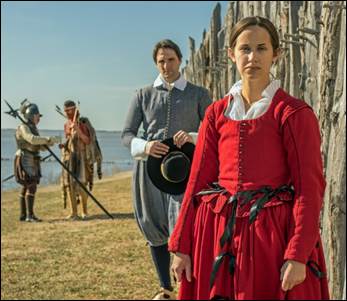
Despite the debate, Historic Jamestowne is re-enacting the 1614 wedding Saturday on what would have been the altar site under the Jamestown theory.
“It’s kind of cool. We can almost do a time machine situation on it,” Kelso said.
All the 1614 characters will have a time to shine; Buck and Whitaker will be represented, and Buck will likely perform the wedding.
“As with all re-enactments, it’s an interpretation,” Summers said. “In the end what we’re really trying to show you is the value of John Rolfe and Pocahontas’ wedding.”
The wedding will be re-enacted at 10:30 a.m., 1 p.m. and 3:30 p.m. at Historic Jamestowne. A regular paid admission ticket is required for the re-enactment. For more information, visit Historic Jamestowne’s website.
