


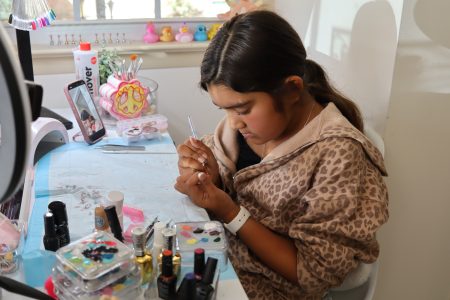
YORKTOWN — Sofia De La Lastra is a 12-year-old who loves the Jonas Brothers, sloths and Highland cows, painting, building dollhouses and swimming. She’s the youngest of three and wants to own a nail salon when she grows up. She’s also in the final stage of kidney failure and is seeking a living donor.
Her mother, Melissa De La Lastra, said Sofia’s illnesses blindsided them last summer after the family went to Florida and they all got colds. She didn’t think anything of it until Sofia started getting worse — vomiting, lack of appetite and struggling to keep food down.
After a round of antibiotics for a suspected urinary tract infection, a finger-prick test revealed that Sofia was significantly anemic, prompting a chest X-ray and full blood work.
“Then her doctor called me,” De La Lastra said. “[She] said, ‘Stop at my office, and then you guys need to go straight to CHKD’s emergency room. Something’s going on with [Sofia’s] kidneys.’”
Sofia was admitted to Children’s Hospital of The King’s Daughters in Norfolk on Oct. 8, 2025, after tests revealed her kidneys were in “severe distress.” She started dialysis almost immediately and had a kidney biopsy.
“The biopsy showed that, outside of a miracle, there was no returning kidney function that was going to happen,” De La Lastra said.
Doctors diagnosed Sofia with two rare autoimmune diseases, anti-neutrophil cytoplasmic antibody vasculitis and Goodpasture syndrome, in which the immune system attacks the body’s own tissue and can damage organs.
“To have both of them at the same time is literally a one-in-a-million chance that that would happen,” De La Lastra said.
De La Lastra said she and her husband agonized over what signs they missed and what they did wrong, wondering how they could’ve prevented this.
“Her doctor explained to us … something so simple, like a common cold or exposure to a chemical, can ignite that autoimmune condition in the body and cause rapid deterioration in organs,” she said.
Hemodialysis at CHKD, three times a week, brought mixed results, so a nurse suggested peritoneal dialysis, which can be done at home. Unlike hemodialysis, which filters blood through a machine, peritoneal dialysis uses the lining of the abdomen.
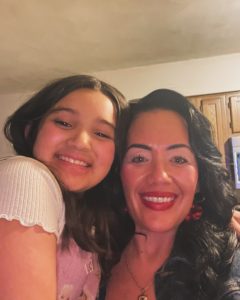
De La Lastra said they’re glad they opted for it due to the positive impact it’s had on Sofia’s health.
“[With hemodialysis], she was on upwards of six blood pressure medications to control it,” she said. “Now she’s on two and they’re lower doses.”
While Sofia is currently stable, De La Lastra said she’s effectively “lost what it means to be a normal kid,” since her conditions are lifelong and a transplant would mean a lifetime regimen of anti-rejection medications.
Although Sofia does her daily 10-hour dialysis while sleeping, she’s restricted in her activities and daily schedule — she can only swim in the ocean or her backyard pool due to the dialysis tube in her abdomen, has to be homeschooled and can’t travel overnight due to the volume of equipment they would need to transport.
De La Lastra said Sofia’s doctor is being highly selective given Sofia’s conditions and her age.
According to Karl Neumann, program manager for Sentara’s Kidney Pancreas Transplant Clinic, living donations are generally better than deceased organ donations as the latter can often come with their own host of problems, including pre-existing diseases and trauma.
“If you think of it in a very practical way, that organ is coming from a living person, so technically it’s healthier,” he said. “Those donors are actually screened very well for any health deficits of their own, so you’re really getting kind of that cream of the crop as far as patient population.”
Neumann – who was a living kidney donor in 2019 – also mentioned the “emotional piece” of living donations, whether it’s a family member donating or a stranger.
“Recipients tend to look at it as, ‘Someone really did do that for me, I need to take care of that [organ] very well,’” he said.
He mentioned the extensive screening process that living donor candidates go through, including psychological and social assessments. Neumann said the goal is to make sure the donor is not only healthy enough to donate, but also stable enough for the recovery process.
Given the donor’s sacrifice and risks – albeit small – of living with one kidney, if their remaining kidney were to ever fail, they would be moved closer to the top of the deceased organ transplant waiting list. Living donors also don’t pay for any of the medical expenses, including tests, the surgery or post-operation care; the recipient’s insurance fronts the costs.
He clarified that the transplant wouldn’t involve open surgery, but rather small incisions from a laparoscopic nephrectomy that’s either hand-assisted or performed by a robot.
Neumann said the main complaint he hears from donors post-operation is discomfort from the air pumped into their abdomen during the surgery, though they report feeling much better after the gas has passed.
“Generally, it’s a one to two day hospital stay,” he said. “Most of the time it’s one.”
Neumann said patients are usually good to get back to work and their regular routines at around two to three weeks on average.
De La Lastra said a living donation would be life-changing for them.
“The impact it would have on her [ability] to do good for others would be tremendous,” De La Lastra said. “She’s just so full of love, and right now, her ability to be her true self is restricted by this disease.”
While she said they’ve all learned a lot in the past year, they would “give it back any day for this to have not happened.”
De La Lastra got emotional when she spoke about the road ahead.
“We’re trying to be patient and we’re faithful that the right person will come along at the right time, but at the same time, it’s hard to live this life and look at her every day and see the things she misses out on,” De La Lastra said. “It’s not fair, you know? Why didn’t it happen to me? We believe that everything happens for a reason, but it’s like, what’s the reason, and how do you explain that to her when she’s a kid?”
Despite her conditions, Sofia’s still a bubbly child who enjoys rollercoaster rides and recently got a puppy named Tallulah through the Make-A-Wish Foundation.
The family is looking for an organization in the area that will help train the Portuguese water dog to be a service animal.

Her mother described Sofia as an empath, saying she would cry at any sad or slow songs even as a baby.
“She’s very much in tune with how others feel,” she said. “She just has such a good heart.”
Her ultimate passion is nail art, of which she said she usually prefers a quiet atmosphere to focus on. Her favorite style is French tips, followed by polka dots.
“My hands are very shaky when I do this, which is why I like to be in silence so I can just focus,” she said. “The one that took me the longest … was almost 2 hours.”
Anyone interested in becoming a living kidney donor can visit Sentara’s webpage, which includes the screening form. Screening is confidential and can be done online. For more information on Sofia and how to help her, visit the family’s webpage.

