


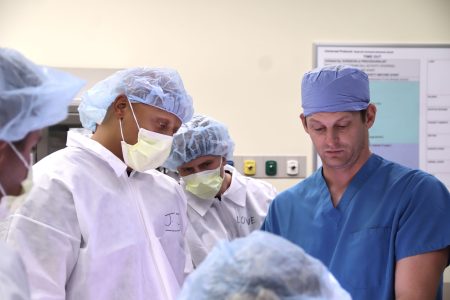
WILLIAMSBURG — As trick-or-treaters lined up in the Sentara Williamsburg Regional Medical Center lobby on Friday morning, on the second floor, local emergency medical services personnel donned coverings of their own. They weren’t there for Halloween, though; they were preparing to work on cadavers.
Sentara Williamsburg held its fourth annual cadaver training for local EMS personnel on Oct. 30, with over 100 people attending, according to hospital trauma educator Elizabeth Marquardt. The classes, held across two days, are open to any interested EMS providers from surrounding communities, as well as hospital and clinical staff. Marquardt said they had attendees all the way from Virginia Beach up to Abingdon in the Northern Neck.
“[The lab offers] the opportunity to practice skills that you’re going to need to do in the field to save the life of a patient who’s been involved in a trauma,” Marquardt said, though she noted attendees may not often encounter situations where they have to use these skills.
She described an experience from the program’s first year, when Walsh explained the spleen’s fragility.
“You barely touch it and it pops,” Marquardt said. “If there’s any shearing force from trauma, you can see why these patients will bleed out.”
Sentara is the only hospital in the area that offers this type of training for EMS personnel; Virginia Commonwealth University and Eastern Virginia Medical School have cadaver labs but priority is given to students, making it difficult for EMS workers to access the training.
Dr. Taylor Walsh, a general surgeon and the hospital’s trauma medical director, said the training has two goals: medical education and awareness of Sentara’s recent Provisional Level III Adult Trauma Center status from the Virginia Department of Health. The hospital is authorized to operate in this condition for a year, after which the VDH will determine whether the hospital has earned full Level III designation.
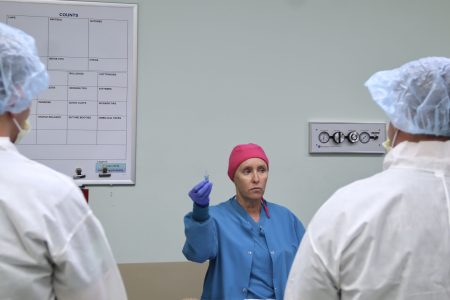
“[We want to] show the local EMS teams here … what a level three trauma program and provisional status can offer, what resources we do have … and how they can help improve patient care locally,” Walsh said.
The training offered three 30-minute stations focused on what Marquardt said are the most “frequent skills” EMS personnel will need during a trauma.
One station, led by Kelly Pulley, clinical affairs manager for medical company Teleflex, demonstrated how to use EZ IO – a specialized needle inserted into the bone marrow when intravenous access isn’t possible – on a leg and arm. Pulley, who’s previously helped with the cadaver lab, emphasized the difference between practicing EZ IO on a mannequin or “bone block” versus a real person.
“We know that it increases the success rate tremendously if [EMS] can use an actual body to get that feel ‘cause it’s totally different than the fake bone,” she said.
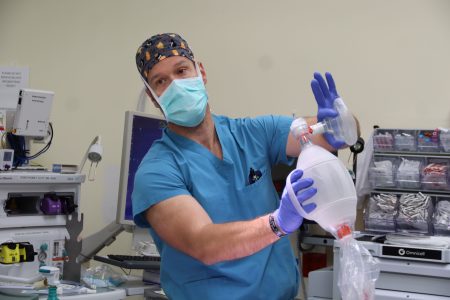
The second, led by certified registered nurse anesthetist Stephen Bertsch, focused on airway management and involved bag-valve masks and laryngoscopes for inserting tubes.
The third focused on needle decompression, also known as needle thoracostomy, led by Walsh. It’s a procedure where an incision is made in the chest and a tube is inserted into the pleural cavity to drain air or fluid.
The class culminated in Walsh demonstrating a resuscitative thoracotomy, a surgical procedure where the thoracic cavity is opened so EMS can see the patient’s organs. While Walsh said it’s a rare, last-resort measure performed on patients who have sustained severe trauma, he noted that it’s still something EMS professionals may encounter.
Walsh added that, with Sentara’s provisional status, the hospital operates as a “middle ground” that EMS haven’t had before. While the Hampton Roads region has three fully-designated trauma centers – Sentara Norfolk General Hospital, Riverside Regional Medical Center and Sentara Virginia Beach General Hospital – the travel time is usually upwards of 30 minutes, depending on the level of care needed, which can mean a reduction in the number of available EMS providers in a locality.
“Our goal is to minimize the transfer time and out-of-network time of these EMS providers … so if they do have an unstable patient that they don’t think can make it [to another hospital], they have an opportunity to stop here, triage, treat, transfer, stabilize the patient and either provide definitive care or provide temporary care with the next step to get to the definitive care at a higher [trauma center] level,” he said.

