


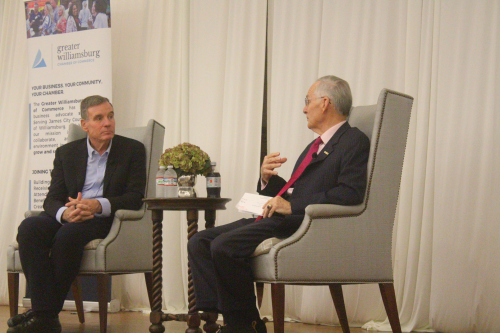
WILLIAMSBURG — During a Thursday luncheon event at the Colonial Heritage Club, U.S. Sen. Mark Warner called for moving toward universal health coverage, establishing safeguards for artificial intelligence and rebuilding bipartisan cooperation.
Former Republican state Sen. Tommy Norment moderated the discussion, billed by the Greater Williamsburg Chamber of Commerce as a fireside chat. The two longtime Virginia politicians discussed Warner’s upbringing, business career and entry into public service before turning to policy.
About 100 people attended, including local business owners, community leaders, financial advisers and health care professionals. Before turning to policy questions, Warner and Norment traded stories and jokes about their careers.
Warner, now a multimillionaire, recalled earning $18,000 a year working for the Democratic National Committee. Norment quipped that he was still earning that amount when he retired from the state Senate.
“You were a public servant,” Warner said.
After the exchange, Warner responded to an audience question about federal health care changes, saying expanding coverage and controlling costs must go together.
“I think the country’s got to move to universal healthcare, and that doesn’t have to be Medicare for all,” Warner said, pointing to Australia and Germany as alternative models.
The question concerned H.R. 1, which President Donald Trump signed into law in July 2025. Among its Medicaid changes, the law requires states to implement work requirements for certain adults beginning in January 2027.
Warner warns that losing insurance does not eliminate people’s need for treatment, saying that many patients instead seek care in emergency rooms. Virginia Mercury reported in July that emergency room visits by uninsured patients at Virginia hospitals rose 8% in 2025, compared with the previous year.
Warner introduced the Health CARE Act in September. According to his office, the proposal would establish a public health insurance option, make enhanced Affordable Care Act premium tax credits permanent, reverse health care provisions of H.R. 1 and expand prescription drug pricing reforms.
Warner’s Republican challenger in the Nov. 3 election, retired Army major general Bert Mizusawa, dismissed the Health CARE Act as “political theater,” according to a WRIC report.
Attendee Kathy Howell, who recently retired after owning James City County-based Howell Creative Group for 40 years, said that rising healthcare costs affect businesses as well as households.
Howell said she paid 80% of her employees’ health insurance premiums to attract and retain staff. Beyond the expense, choosing coverage required considerable time negotiating and evaluating plans.
“That’s something I’ve always wondered: how did business inherit that duty?” Howell said.
The discussion turned to bipartisan governing. Norment recalled working with Warner during his time as Virginia’s governor, when Republicans controlled the legislature.
“Gov. Warner was practical enough to realize, in spite of the Republican majorities, that he needed to work on a bipartisan basis,” Norment said.
Warner credited those relationships with helping his administration address the state’s financial challenges at the time.
“I made my Democrats kind of mad because I spent so much more time with Republican legislators because I had to build that trust,” Warner said, adding that legislation often needs refinement. “I’ve never worked on a law that’s been perfect.”
Norment later offered a joking rebuttal: “That tells me you never read one of my bills.”
Artificial intelligence and the proliferation of data centers were another focus. Warner described AI as a potentially transformative technology and said he is generally “pro-AI,” while raising concerns about employment, safety and the demands data centers place on communities.
Under the senator’s proposed Data Center Tax Accountability and Disclosure Act, data centers would lose a tax break that lets them deduct equipment costs more quickly unless they meet standards for energy efficiency and environmental performance.
A March Pew Research Center found that data centers raise concerns about electricity costs, pressure on local power and water supplies and effects on nearby communities.
There are about 3,000 data centers operating in the US — with Virginia hosting the largest concentration of data center infrastructure in the world — with that number potentially doubling in the next few years, according to ???
Regarding how residents and small businesses would be protected from infrastructure and electricity costs, Sen. Warner told WYDaily that his goal is to require data centers to provide their own energy needs.
“[They’d] have to bring [their] own energy,” he said. “[They’d] have to make sure [they] don’t overuse water.”
Warner, 71, is seeking a fourth Senate term, which he has previously said would be his last.
Asked why he is seeking another six-year term, Warner pointed to his desire to advance health care policy and continue working across party lines.
“Trying to leave a legacy and dramatically improve and move us towards universal health care,” Warner said. “And you’re going to still need, in these times, people that do know how to make deals on a bipartisan basis.”

